
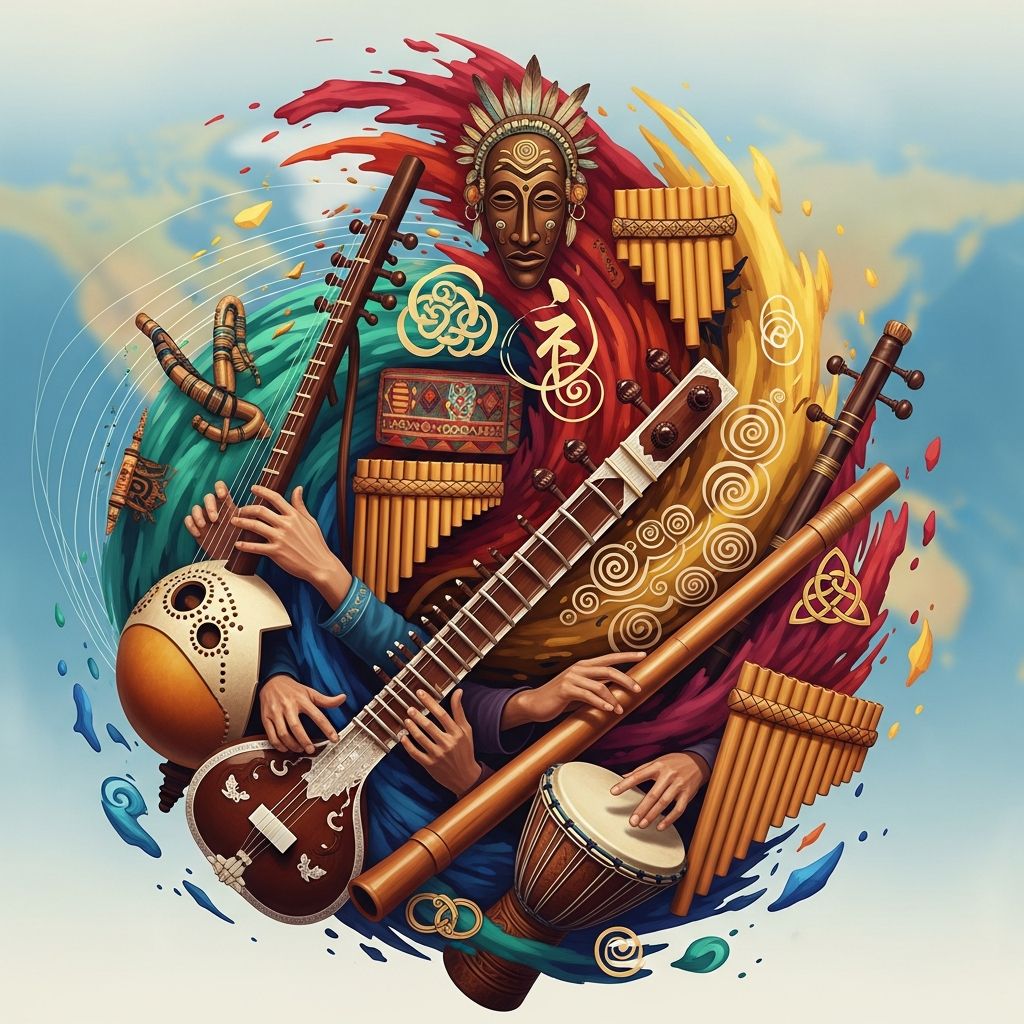
Ethnomusicology stands at the intersection of music and culture, examining how sounds shaped by human hands reflect the deepest aspects of societal life. This field transcends traditional music analysis by embedding melodies, rhythms, and performances within their social, historical, and environmental contexts. Far from merely cataloging tunes, ethnomusicologists probe why communities create specific musical expressions and how these sounds influence identity, power structures, and daily interactions.
Defining the Heart of Ethnomusicology
At its core, ethnomusicology is the multidisciplinary exploration of music as a cultural artifact. It investigates social, cognitive, and biological facets of music-making, viewing it not in isolation but as intertwined with human behavior and traditions. Pioneering voices like Jeff Todd Titon described it as the study of \”people making music,\” emphasizing the creators, their activities, and the cultural domains music inhabits. This approach recognizes music as both an aesthetic pursuit and a vessel of social power, revealing how it mirrors and molds human conditions.
Unlike conventional musicology, which often focuses on Western classical compositions through scores and archives, ethnomusicology embraces a global scope. It applies ethnographic methods to dissect music’s role in rituals, protests, celebrations, and everyday routines, fostering a holistic understanding that bridges art and anthropology.
Historical Evolution: From Comparative Roots to Global Embrace
The origins of ethnomusicology trace back to the late 19th century, evolving from comparative musicology—a Eurocentric endeavor primarily documenting non-Western folk traditions. Early scholars transcribed melodies from distant lands, often with biases that positioned Western art music as superior. This phase aimed to preserve \”exotic\” sounds threatened by modernization, yet it frequently overlooked the living contexts of these musics.
By the mid-20th century, the field transformed. In 1950, the term \”ethnomusicology\” gained traction, coined as a portmanteau of \”ethno\” (people) and \”musicology\” (study of music). Willard Rhodes in 1956 framed it as a fusion of musicology and anthropology, advocating for the \”total music of humankind\” unbound by time or geography. Post-World War II shifts toward cultural relativism expanded its gaze to include all musics, dismantling hierarchies and integrating performance, linguistics, and folklore.
Alan P. Merriam’s 1964 work outlined four key objectives: preserving non-Western repertoires, safeguarding folk traditions, using music as a bridge for intercultural dialogue, and broadening insights into human societies. This era marked ethnomusicology’s maturation into a rigorous academic pursuit, influencing programs worldwide, such as UCLA’s pioneering Department of Ethnomusicology, established as the first in the U.S.
Core Methodologies: Immersion and Analysis
Ethnomusicologists employ immersive fieldwork as their cornerstone, living among communities to observe, participate, and document music in situ. This ethnographic immersion demands learning local languages, mastering instruments, and grasping cultural nuances, transforming researchers into participant-observers. Transcription—converting oral performances into notation—remains vital, especially for non-Western systems defying standard staffs.
- Participant Observation: Joining ensembles or rituals to experience music’s embodied knowledge.
- Interviews and Oral Histories: Capturing performers’ perspectives on meaning and technique.
- Audio-Visual Recording: Archiving sounds and visuals for analysis and posterity.
- Comparative Analysis: Juxtaposing traditions to uncover universal patterns and unique traits.
Beyond fieldwork, scholars blend historical research with theoretical frameworks from anthropology, sociology, and sound studies. Digital tools now enhance this, enabling spectral analysis of timbres or mapping global music flows via online databases.
Interdisciplinary Connections: Bridging Disciplines
Ethnomusicology thrives on cross-pollination. It draws from cultural anthropology to decode rituals, psychology to explore cognitive processing of rhythms, and linguistics to analyze song texts as poetic expressions of worldview. Collaborations with gender studies reveal how music reinforces or challenges norms, while area studies contextualize regional variations.
| Discipline | Contribution to Ethnomusicology |
|---|---|
| Cultural Anthropology | Contextualizes music in social structures and power dynamics. |
| Folklore | Preserves oral traditions and narrative songs. |
| Performance Studies | Examines embodiment and live interaction. |
| Sound Studies | Analyzes acoustic environments and listening practices. |
| History | Traces evolutions and colonial influences on repertoires. |
This table illustrates how ethnomusicology’s strength lies in its integrative nature, producing insights unattainable in siloed fields.
Pioneering Figures and Lasting Legacies
Key thinkers have shaped the discipline. Alan P. Merriam’s \”music as culture\” paradigm emphasized analytical depth. Bruno Nettl advocated inclusive pedagogy, training students in diverse traditions. Timothy Rice highlighted music’s role in identity formation amid globalization. Institutions like the University of Toronto underscore ethnomusicology’s role in educating on global musics and sociocultural themes.
These luminaries shifted focus from preservation to interpretation, encouraging reflexive practices where researchers confront their own cultural lenses.
Modern Applications: Music in Contemporary Contexts
Today, ethnomusicology addresses pressing issues. It scrutinizes music’s commodification in streaming eras, nationalism in anthems, and healing in indigenous ceremonies. Amid migration, it tracks hybrid genres born from diaspora, like Afrobeat or K-pop fusions.
In education, courses span world regions, popular sounds, and film scores, preparing students for careers in curation, policy, and therapy. Public engagement includes festivals and podcasts demystifying global beats, fostering empathy in divided times.
Challenges and Future Trajectories
Ethical dilemmas persist: balancing preservation with consent, navigating power imbalances in fieldwork, and decolonizing archives tainted by colonial extractions. Digital divides challenge access to remote traditions, while climate change threatens endangered musics tied to ecosystems.
Yet, optimism abounds. Emerging scholars leverage AI for pattern recognition in vast recordings and virtual reality for simulated immersions. The field increasingly centers marginalized voices, ensuring ethnomusicology evolves inclusively.
Frequently Asked Questions (FAQs)
What distinguishes ethnomusicology from musicology?
Ethnomusicology prioritizes cultural and social contexts through fieldwork, while musicology often emphasizes notation, composition, and Western canons.
Do ethnomusicologists only study non-Western music?
No, the field encompasses all musics globally, including Western popular and classical forms in their sociocultural settings.
How long does typical fieldwork last?
Periods vary from months to years, depending on community depth and research goals, prioritizing meaningful immersion.
Can anyone become an ethnomusicologist?
Yes, with training in music, anthropology, and languages; many programs welcome diverse backgrounds for global perspectives.
What careers await ethnomusicology graduates?
Opportunities include academia, museums, cultural policy, music therapy, media production, and nonprofit preservation work.
Key Takeaways
- Ethnomusicology views music as a dynamic social process, not static art.
- Fieldwork and interdisciplinarity drive its methodologies.
- From colonial origins, it has grown into a tool for cultural equity.
- Contemporary relevance spans globalization, identity, and technology.
This exploration reveals ethnomusicology’s vitality in decoding humanity through sound, inviting deeper appreciation of our sonic world.
References
- Ethnomusicology – Wikipedia — Wikipedia Contributors. 2023-10-15. https://en.wikipedia.org/wiki/Ethnomusicology
- What is Ethnomusicology? — University of Toronto Faculty of Music. 2023-01-01. https://ethnomusicology.music.utoronto.ca/whatisethno/
- Ethnomusicology | Music | Research Starters — EBSCO. 2022-05-12. https://www.ebsco.com/research-starters/music/ethnomusicology
- What is Ethnomusicology? – Classics for Kids — Classics for Kids. 2021-11-20. https://www.classicsforkids.com/what-is-ethnomusicology/
- Ethnomusicology – The UCLA Herb Alpert School of Music — UCLA. 2024-03-10. https://schoolofmusic.ucla.edu/academics/ethnomusicology/
- About Ethnomusicology — Society for Ethnomusicology. 2023-09-05. https://www.ethnomusicology.org/?page=AboutEthnomusicol

Medha Deb is an editor with a master's degree in Applied Linguistics from the University of Hyderabad. She believes that her qualification has helped her develop a deep understanding of language and its application in various contexts. Medha specializes in the areas of beauty, health, sports, and wellness and is committed to ensuring that the content on the website is…