
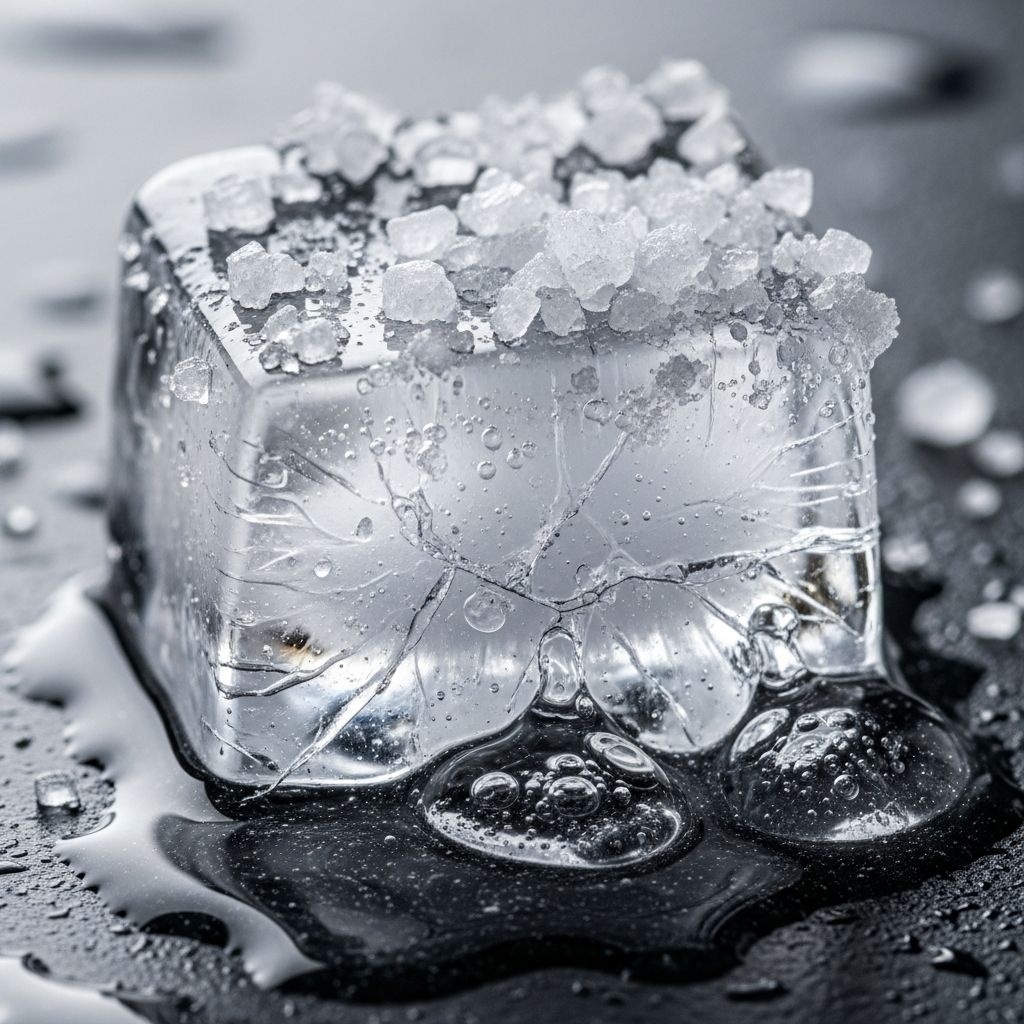
Salt melts ice through a process called freezing point depression, where dissolved salt ions disrupt water molecules’ ability to form solid ice crystals, causing existing ice to liquefy at temperatures above its normal freezing point.
Molecular Interactions at Play
Water freezes at 0°C (32°F) because its molecules arrange into a rigid crystal lattice via hydrogen bonds. Even below this temperature, ice surfaces maintain a thin quasi-liquid layer where molecules are more mobile. When sodium chloride (NaCl) contacts this layer, it dissociates into Na⁺ and Cl⁻ ions. These charged particles interfere with hydrogen bonding, preventing water molecules from locking into the lattice structure.
The resulting brine solution—a mix of water, salt, and ions—has a depressed freezing point. For every mole of NaCl per kilogram of water, the freezing point drops by about 1.86°C. This colligative property depends on ion count rather than type, explaining why salts producing more ions work faster.
Step-by-Step Process of Ice Dissolution
- Initial Contact: Salt crystals land on ice, dissolving slightly in the surface’s quasi-liquid film.
- Ion Dissociation: NaCl splits into ions, which hydrate by attracting polar water molecules.
- Bond Disruption: Ions wedge between water molecules, weakening hydrogen bonds and expanding the liquid layer.
- Melting Cascade: Heat from the environment melts adjacent ice to replenish the layer, propagating the effect inward.
- Brine Formation: The solution undercuts ice, seeping into cracks for faster breakup.
This chain reaction accelerates as more salt dissolves, but efficiency hinges on surface area exposure—fine grains outperform rocks.
Temperature Thresholds and Effectiveness Limits
Salt excels between -9°C to -4°C (15°F to 25°F), where enough surface moisture exists for dissolution. Below -18°C (0°F), the quasi-liquid layer vanishes, halting the process; salt merely sits inert. At these extremes, ice requires mechanical removal or advanced deicers.
| Temperature Range | Salt Performance | Best Alternative |
|---|---|---|
| Above -4°C (25°F) | Optimal | NaCl |
| -9°C to -18°C (15°F to 0°F) | Moderate | CaCl₂ |
| Below -18°C (0°F) | Ineffective | Magnesium acetate or sand |
Data derived from field studies on deicing agents.
Comparing Deicing Agents: A Performance Breakdown
Not all salts equate; effectiveness ties to ions produced and solubility. Table salt (NaCl) yields two ions but is economical. Calcium chloride (CaCl₂) yields three, melting faster and at -29°C (-20°F), though costlier.
| Agent | Ions Produced | Effective Low Temp | Cost per Unit | Environmental Impact |
|---|---|---|---|---|
| NaCl (Rock Salt) | 2 | -9°C | Low | High corrosion, soil damage |
| CaCl₂ | 3 | -29°C | Medium | Moderate, less volume needed |
| MgCl₂ | 3 | -15°C | Medium | Lower toxicity |
| CMA (Calcium Magnesium Acetate) | Organic | -16°C | High | Biodegradable, eco-friendly |
CaCl₂ outperforms in harsh cold by exothermic dissolution, releasing heat.
Practical Strategies for Maximum Efficiency
To optimize salt use: pre-wet crystals with 20-30% brine for instant activation; apply 20-50g/m² thinly for even coverage; plow first to expose ice. Avoid excess—beyond saturation, salt wastes without further depression.
- Rock salt: Best for mild winters, bulk roads.
- Pre-mixed brines: Preventative, reduce total salt by 50%.
- Tools: Spreaders ensure uniformity, minimizing overuse.
Environmental and Infrastructure Consequences
Overuse contaminates waterways—1.5M tons used yearly in the US elevates road chloride to 1000+ mg/L, harming aquatic life and vegetation. Vehicles corrode faster; concrete spalls from freeze-thaw cycles amplified by brine. Mitigation includes sand for traction sans melt, or beet juice-blended brines sticking better with less spread.
Debunking Winter Myths
Myth: Sugar melts ice better. False—sugar minimally depresses (one particle/molecule) versus salt’s two ions.
Myth: Salt boils water. No; it raises boiling point slightly via boiling point elevation.
Myth: Colored salt melts hotter. Dye is cosmetic; performance matches plain.
Frequently Asked Questions
What temperature does salt stop working on ice?
Salt becomes ineffective below -9°C to -18°C (15°F to 0°F), as insufficient liquid prevents dissolution.
Does salt melt snow the same way as ice?
Yes, but snow’s air pockets slow wetting; pre-brining aids penetration.
Is road salt safe for pets and plants?
No—high concentrations burn paws, kill roadside plants, and pollute groundwater. Rinse pets post-exposure.
Why use magnesium chloride over sodium?
MgCl₂ is less corrosive to infrastructure and slightly more eco-friendly, effective to -15°C.
Can salt melt black ice?
Yes, but black ice bonds tightly to pavement; scarify first for brine access.
Future Innovations in Winter Management
Emerging tech includes graphene-enhanced deicers for ultra-low temps and enzyme-based organics mimicking natural antifreeze proteins. Smart sensors could dose precisely via apps, slashing usage 30-40%. Policy shifts favor low-chloride blends amid climate variability extending ice seasons.
Infrared road heating and permeable pavements draining brine underground offer non-chemical paths, though energy-intensive.
References
- Why Does Salt Melt Ice? The Science Explained — Old Station Landscape Supply. 2023. https://oldstationlandscapesupply.com/why-does-salt-melt-ice/
- Why Salt Melts Ice, According to Science — Popular Mechanics. 2022-01-11. https://www.popularmechanics.com/science/a41936364/why-does-salt-melt-ice/
- Why Does Salt Melt Ice? — Britannica. 2023. https://www.britannica.com/story/why-does-salt-melt-ice
- De-icing with Salt Safely — California Governor’s Office of Emergency Services (Cal OES). 2024-01-15. https://www.news.caloes.ca.gov/de-icing-with-salt-safely/
- How Does Salt Melt Ice? — American Chemical Society (YouTube). 2019-12-10. https://www.youtube.com/watch?v=JkhWV2uaHaA

- Integrated M.A. in Applied Linguistics, University of Hyderabad
- 5+ years in editorial, instructional, SEO, and research-based writing
Sneha is a relationships and lifestyle writer with a strong foundation in applied linguistics and certified training in relationship coaching. She brings over five years of writing experience to theskillvault, crafting thoughtful, research-driven content that empowers readers to build healthier relationships, boost emotional well-being, and embrace holistic living. Her writing and insights reflect the belief that beauty, happiness, and wellness…