
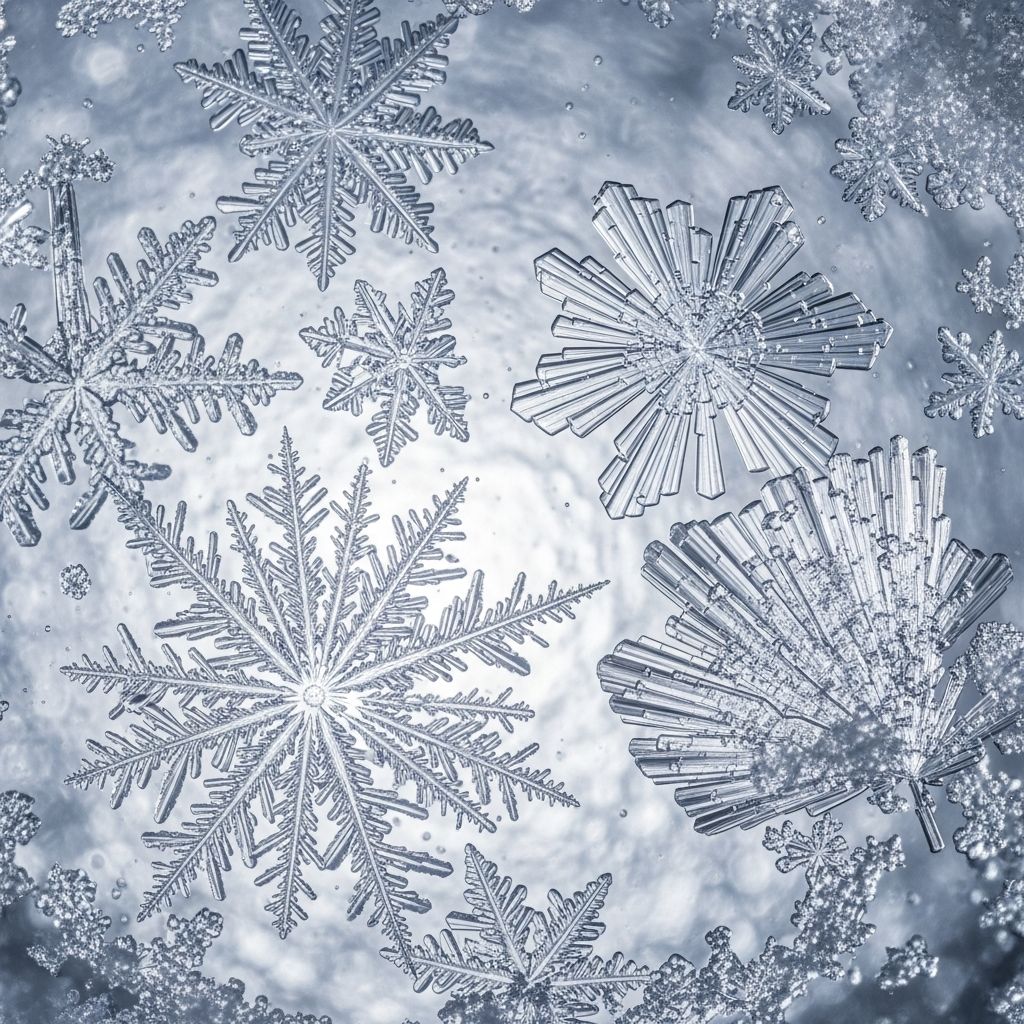
Understanding the Optical Mystery of Snow
When winter arrives and snow blankets the landscape, one of nature’s most visually striking phenomena unfolds before our eyes: the brilliant white appearance of freshly fallen snow. This common observation masks a deeper scientific puzzle that has intrigued researchers and curious minds alike. The fundamental question seems straightforward yet deceptively complex—how does a substance composed entirely of clear, transparent ice crystals and frozen water appear so vividly white? To answer this question, we must venture into the realm of optics, light physics, and the microscopic architecture of frozen water.
The paradox begins with a simple observation about the nature of water and ice. When we examine pure water in a glass or look at a single piece of clear ice, light passes through it almost unobstructed, allowing us to see objects on the other side with clarity. This transparency occurs because light photons travel in relatively straight paths through the uniform structure of these materials. Yet when billions of these transparent ice crystals accumulate together to form snow, the collective appearance transforms dramatically into a brilliant white substance. Understanding this transformation requires knowledge of how light interacts with matter at different scales.
The Fundamental Properties of Light and Matter Interaction
Light behaves in three primary ways when it encounters any material: it can be transmitted (passing straight through), absorbed (soaking into the material), or reflected (bouncing off the surface). The behavior depends on the surface structure and the material’s optical properties. When light strikes a perfectly smooth, flat surface like a windowpane or a single piece of ice, the light rays maintain their original direction and pass through largely unimpeded. Our eyes perceive objects by processing the light waves that either reflect from or pass through materials, which is why smooth ice and glass appear transparent and colorless to our vision.
However, the situation changes dramatically when the same material is fragmented into countless tiny pieces. Consider the analogy of taking a clear glass windowpane and smashing it with a hammer into numerous small shards. The individual pieces remain chemically identical to the original pane—they are still clear glass—yet when gathered together, these fragments appear white. This transformation occurs because the countless new surfaces created by the fragmentation interrupt the direct path of light rays, causing them to scatter in multiple directions rather than passing straight through. The same principle applies directly to snow.
Ice Crystals: The Building Blocks of Snow
Snow is not simply frozen water in a solid block; rather, it consists of intricate, beautifully structured individual ice crystals arranged in complex patterns. These snowflakes form through a specific process that begins high in the atmosphere. When temperatures drop sufficiently, water vapor in the air condenses around microscopic particles such as dust, soot, or pollen. As this ice particle falls through the clouds, additional water vapor freezes onto its surface layer by layer. The molecular structure of water, when frozen, naturally arranges itself into a hexagonal pattern, creating the characteristic six-sided symmetry that defines snowflakes.
Each snowflake, despite its intricate beauty and complexity, remains fundamentally transparent when examined individually. A single snowflake backlit against the sky reveals itself to be clear, just like a piece of ice or a glass bead. The individual crystal does not appear white; rather, it transmits light with minimal interference. However, the detailed structure of each snowflake, with its branching arms and geometric facets, creates numerous internal surfaces and interfaces between ice and air pockets. These surfaces offer opportunities for light rays to change direction.
How Multiple Ice Crystals Create the White Appearance
The critical factor that produces snow’s white appearance is quantity and collective interaction. When light enters a snowdrift—a pile containing millions or even billions of individual snowflakes—the behavior of light becomes entirely different from what occurs with a single crystal. As a light photon strikes the topmost layer of snow, it enters the first ice crystal. Rather than passing straight through, the irregular surface and internal structure of the crystal cause the light photon to change direction and scatter. The redirected photon then travels into another ice crystal nearby, where the same scattering process occurs. This photon might then enter a third, fourth, fifth, or countless additional ice crystals, with each interaction changing the light’s trajectory.
The key insight is that each individual snowflake reflects only a tiny fraction of the light that hits it, passing most of the light through to neighboring crystals. However, because there are so many crystals in a snowdrift, and because each one has numerous surfaces where scattering can occur, the cumulative effect is profound. Instead of light penetrating deep into the snow and emerging from the bottom layers, the repeated scattering causes the vast majority of incoming light rays to bounce back toward the surface from which they came. This is why newly fallen snow appears so bright and reflective—most of the sunlight striking it is being scattered back to our eyes rather than being absorbed or transmitted.
The Role of Light Wavelengths in Color Perception
Visible light consists of different wavelengths corresponding to different colors: red, orange, yellow, green, blue, indigo, and violet. When sunlight strikes snow, these various wavelengths interact with the ice crystals. The crucial aspect of snow’s white appearance is that all these wavelengths are scattered and reflected back equally. No single color dominates; instead, red, orange, yellow, green, blue, indigo, and violet all exit the snow in approximately equal proportions. When human eyes receive light containing all visible wavelengths in roughly equal measures, our visual system interprets this combination as white.
This principle explains why freshly fallen snow appears white under sunlight, which already contains all visible wavelengths in balanced proportions. The snow acts like a neutral reflector, bouncing back the full spectrum of incoming light. If one wavelength were preferentially absorbed while others were reflected, the snow would appear to have the color of the reflected wavelengths. For instance, if blue light were preferentially reflected while red light were absorbed, the snow would appear blue. However, the structure of ice crystals and the physics of light scattering at these scales result in nearly equal treatment of all visible wavelengths.
The Impact of Snow Depth and Purity
The appearance and reflective properties of snow change notably with depth and contamination. Very fresh, clean snow can have an albedo—a measure of reflectivity—of 0.85 or even higher, meaning it reflects approximately 85% or more of the incoming solar radiation. This high reflectivity is why newly fallen snow appears so brilliantly white. However, as snow ages or accumulates dust, soot, and other particulates, its reflective properties diminish.
Water and ice possess a subtle property that becomes noticeable in thicker snow layers: they preferentially absorb more red light than blue light. When light penetrates several feet of snow, the red wavelengths are absorbed more completely, while blue wavelengths continue to scatter through the material. If snow is sufficiently deep—typically several feet or more—observers may notice a slight bluish tint rather than pure white. This blue appearance can be seen in deep glaciers, thick polar ice, and very deep snowdrifts. The deeper the snow, the more pronounced this blue coloration becomes because the red light has been largely removed from the spectrum being reflected back.
Contamination and Color Variations in Snow
While white is the typical color of pure snow, various natural and human-caused factors can produce snow of different hues. Airborne particles such as soot from industrial activity, smoke from wildfires, or dust blown from desert regions can settle on snow surfaces and darken them. Dark snow absorbs more solar radiation than white snow, causing it to melt faster—a phenomenon with significant implications for global water resources and climate dynamics. The reduction in albedo from added particulates creates a feedback loop where darker, dirtier snow absorbs more heat, melts more quickly, and contributes to accelerated snow loss in regions experiencing increased pollution or proximity to fire-affected areas.
One particularly striking natural variation is “watermelon snow,” also known as pink snow, blood snow, or red snow. These unusual patches result from the growth of a cold-loving green algae species called Chlamydomonas nivalis within the snowpack. This algae thrives in freezing water and produces a bright red carotenoid pigment that functions as a sunscreen, protecting the organism’s green chlorophyll from harmful ultraviolet radiation. The red pigmentation from these algal cells can tint entire snow patches pink to reddish. Researchers have documented watermelon snow in alpine and polar regions, where it adds unexpected color to the winter landscape. Beyond algae, other microorganisms and organic particles can create variations in snow coloration, ranging from yellowish to brownish tints depending on the type and concentration of contaminants.
The Translucency Property of Individual Ice
An important distinction exists between transparency and translucency when describing ice. While ice might initially appear transparent, it is more accurately described as translucent. Translucency means that while light passes through the material, the light’s path is disrupted and altered by the material’s structure. This occurs because the distances between certain atoms in ice’s molecular structure are comparable to the wavelengths of visible light. When light wavelengths interact with atomic structures of similar dimensions, the light photons interact with these structures, causing their paths to be altered.
In a single piece of clear ice or a single snowflake, this translucency is subtle because there are relatively few such interactive sites within the material’s volume relative to its size. However, when examining a large mass of ice with many internal surfaces and air pockets—as exists in a snowdrift—the cumulative effect of countless translucent interactions becomes the dominant optical behavior. Each interface between ice and air, and each irregularity in the crystal structure, represents a potential site for light scattering and direction change.
Macroscopic Properties and Light Behavior
Understanding why snow appears white requires shifting perspective from microscopic properties to macroscopic phenomena. At the scale of individual atoms and molecules, the properties of materials are determined by quantum mechanical interactions. However, at the scale that humans directly observe—the macroscopic scale—the combined effect of countless microscopic interactions produces emergent properties described by electromagnetic coefficients of transmission, absorption, and reflection.
These optical coefficients depend on multiple factors including the angle at which light strikes the surface, the wavelength of the light, and the spatial arrangement of the scattering surfaces. For snow, the random orientation of individual ice crystals and the irregular packing of these crystals create a highly scattering medium that treats light from all angles and all visible wavelengths approximately equally. This uniformity of scattering across directions and wavelengths is the fundamental reason for snow’s white appearance and high reflectivity.
Frequently Asked Questions
Q: Why does a single snowflake appear clear while a pile of snow appears white?
A: A single snowflake has relatively few surfaces where light can scatter and change direction, so most light passes straight through, making it appear clear. In contrast, a pile containing millions of snowflakes presents countless surfaces for light scattering. The cumulative effect of all these tiny reflections bounces most incoming light back out, making the pile appear white.
Q: Why does deep snow sometimes appear blue instead of white?
A: Ice preferentially absorbs more red light than blue light. In very deep snow layers, red wavelengths are absorbed as light penetrates the snow, while blue wavelengths continue to scatter through. This selective absorption removes red from the reflected light spectrum, making the snow appear bluish rather than pure white.
Q: What causes pink or red-colored snow?
A: Pink or red snow, called watermelon snow, results from the presence of cold-loving green algae (Chlamydomonas nivalis) living within the snowpack. These organisms produce bright red carotenoid pigments that act as sunscreen, and their presence tints the snow pinkish to reddish.
Q: Does dirty snow behave differently than clean snow?
A: Yes, significantly. Dirty snow containing soot, dust, or other particulates has lower reflectivity (albedo) than clean snow. Dark particles absorb more solar radiation, causing the snow to warm and melt faster than white, pristine snow would.
Q: Could snow theoretically be a different color?
A: Yes, if different particulates or organisms were present that scattered different wavelengths of light preferentially. Snow could theoretically appear any color of the rainbow, depending on what particles or organisms colored it.
Conclusion: The Beauty of Physics in Action
The whiteness of snow exemplifies how scientific principles operating at microscopic scales produce observable phenomena at the human scale. What appears to be a simple visual fact—that snow is white—actually results from elegant physics involving light wavelengths, crystal structures, surface reflections, and the law of large numbers. Billions of individually transparent ice crystals arranged in complex patterns scatter light uniformly across all visible wavelengths, combining to produce the white appearance we see. This understanding of snow’s color demonstrates how nature’s intricate workings can be decoded through careful observation and application of fundamental physical principles.
References
- Why Is Snow White? — HowStuffWorks Science. Accessed 2026. https://science.howstuffworks.com/nature/climate-weather/atmospheric/question524.htm
- Snow Isn’t Actually White — Popular Science. Accessed 2026. https://www.popsci.com/science/why-snow-is-white/
- Why Is Snow White? — ScienceBlogs. 2015-02-03. https://scienceblogs.com/principles/2015/02/03/why-is-snow-white
- Why Is Snow White? — Live Science. Accessed 2026. https://www.livescience.com/why-is-snow-white.html
- Why Is Snow White? — UW-La Crosse Campus Connection. Accessed 2026. https://www.uwlax.edu/news/posts/why-is-snow-white/
- Light and Matter — California Institute of Technology. Accessed 2026. https://www.caltech.edu/
- The National Snow and Ice Data Center (NSIDC) — University of Colorado Boulder. Accessed 2026. https://nsidc.org/

Medha Deb is an editor with a master's degree in Applied Linguistics from the University of Hyderabad. She believes that her qualification has helped her develop a deep understanding of language and its application in various contexts. Medha specializes in the areas of beauty, health, sports, and wellness and is committed to ensuring that the content on the website is…