
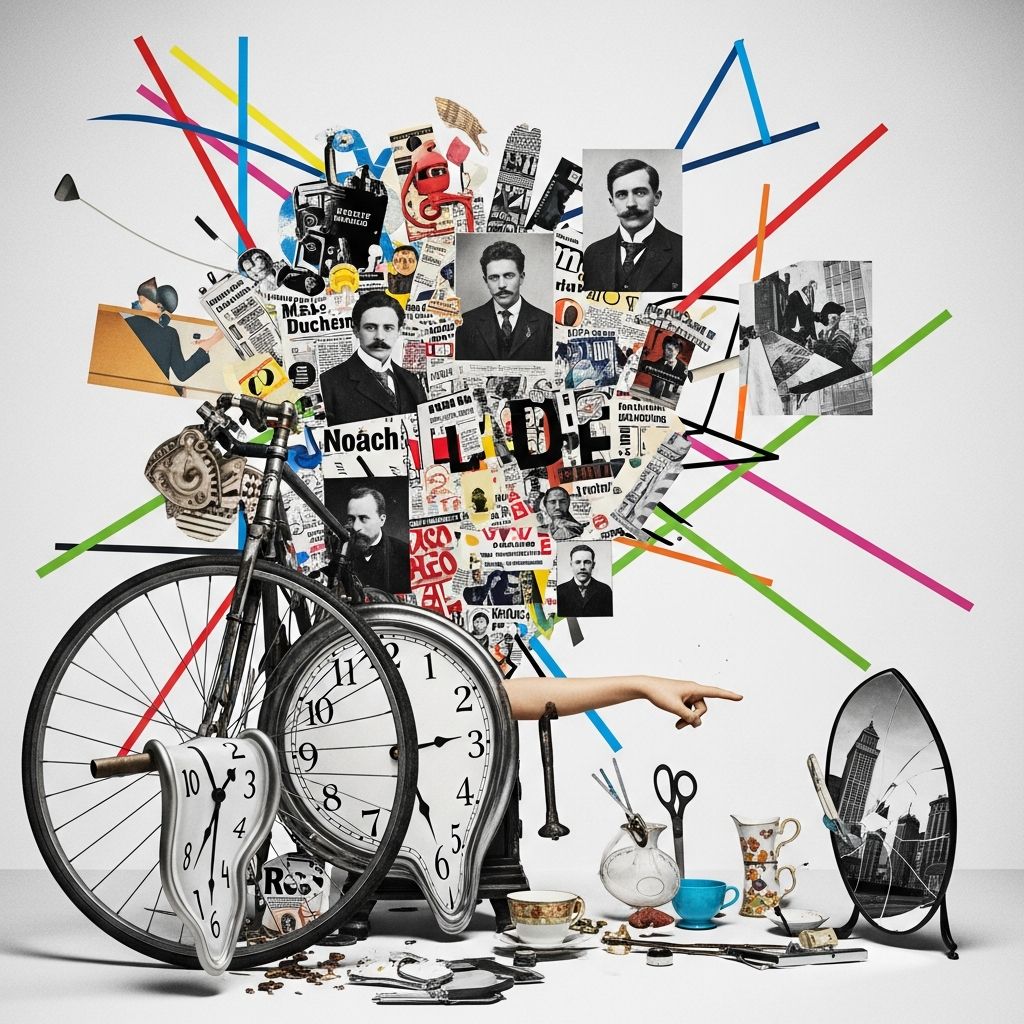
The Genesis of Artistic Rebellion: Dada’s Emergence from Global Crisis
Between 1914 and 1918, the world experienced unprecedented catastrophe. The First World War claimed approximately 10 million lives and wounded roughly 20 million more, fundamentally shattering European intellectual confidence. In the midst of this devastation, a group of disillusioned artists, poets, and intellectuals gathered in neutral Zurich, Switzerland, and sparked a revolutionary movement that would forever alter the trajectory of artistic expression.
Dada emerged not as a calculated artistic strategy but as an instinctive rejection of the rationalist thinking that had dominated European culture since the Enlightenment. These artists believed that the very intellectual frameworks underlying Western civilization had failed catastrophically, making way for mechanized slaughter on an industrial scale. How could traditional aesthetic values, refined taste, and refined artistic production hold any legitimacy in a world consumed by senseless brutality? This fundamental question drove the birth of Dada—a movement that fundamentally challenged whether art itself had any meaningful purpose in such a broken world.
The movement’s name itself embodied this spirit of chaos and rejection. Whether derived from a French children’s word, Romanian baby talk, or simply random dictionary selection, the very uncertainty surrounding Dada’s nomenclature reflected its embrace of meaninglessness and accident as artistic principles. This anti-rational foundation distinguished Dada from earlier avant-garde movements that, despite their experimental nature, still operated within comprehensible artistic frameworks.
Contextual Influences: Building Upon Earlier Experimental Movements
Although Dada represented a radical break from tradition, it did not emerge in artistic isolation. The movement drew inspiration and inherited characteristics from several preceding avant-garde traditions that had already begun challenging academic conventions.
Cubism, pioneered by artists like Picasso and Braque, had introduced fragmented perspectives and multiple viewpoints within single compositions, challenging the single-point perspective that had dominated Western art for centuries. Futurism, originating in Italy, celebrated technological dynamism, violence, and rejection of the past, though Dadaists would ultimately reject Futurism’s nationalistic fervor as complicit in warmongering ideology. Expressionism allowed artists to prioritize emotional authenticity and psychological states over objective representation. Constructivism, emerging from Soviet Russia, merged art with political purpose and industrial design principles.
Yet Dada fundamentally diverged from these movements. Where Cubism reorganized reality into comprehensible geometric structures and Futurism celebrated technological progress, Dada embraced incomprehensibility, accident, and negation. Rather than offering an alternative vision of artistic production, Dada questioned whether artistic vision itself retained any validity.
Philosophical Foundations: Anti-Art and Conceptual Provocation
At its philosophical core, Dada represented a rejection of the assumption that art objects possessed intrinsic aesthetic value. Dadaists specifically opposed Expressionism’s appeal to emotional authenticity, viewing such appeals as manipulation of “so-called echoes of the soul.” Instead, they sought to create works that challenged bourgeois sensibilities and forced viewers to confront difficult questions about society, artistic authority, and the very purpose of creative expression.
This conceptual reorientation proved revolutionary. Rather than asking “Is this aesthetically beautiful?” Dadaists demanded that audiences ask “What is art? Who determines artistic legitimacy? Can everyday objects possess artistic significance?” By introducing these questions into public consciousness, Dada fundamentally altered how subsequent generations would approach artistic creation and interpretation.
The incorporation of chance and accident into artistic production exemplified this philosophical shift. Artists like Hans Arp deliberately introduced randomness into their creative processes, directly contradicting centuries of artistic tradition emphasizing careful planning, technical mastery, and intentional design. This embrace of chance served a specific purpose: by removing the artist’s conscious will from the creative process, Dadaists challenged the Romantic notion of artistic genius and the assumption that the artist’s vision possessed special authority.
Geographic Manifestations: Dada’s Diverse Urban Centers
Although Zurich served as Dada’s birthplace, the movement rapidly developed distinct regional characteristics as it spread across Europe and North America. Each city that adopted Dadaism developed unique emphases reflecting local artistic traditions and political conditions.
Zurich: The Pacifist Stronghold
Zurich, Switzerland’s position as a neutral nation during World War I made it a refuge for artists fleeing the conflict. The Cabaret Voltaire, a nightclub in the city’s old town, became the movement’s epicenter. Here, performances combined music, poetry, visual art, and theatrical presentation in deliberately incoherent programs designed to challenge audience expectations. The emphasis remained primarily on performance art and poetry, with the spoken and performed word receiving particular attention.
Berlin: Political Militancy and Photomontage
When Dada migrated to Berlin after the war’s conclusion, it assumed a sharply political character. German Dadaists, witnessing their nation’s military defeat and subsequent political chaos, channeled their alienation into aggressive critique of political authority and social structures. Artists like Raoul Hausmann developed photomontage techniques, combining photographs and printed text to create jarring, confrontational works. These Berlin Dadaists explicitly positioned their work as protest against both artistic convention and political establishment.
Paris: Transition and Surrealist Evolution
In Paris during the early 1920s, Dada reached its public apotheosis through exhibitions, performances, and manifestos, with artists like Tristan Tzara, Max Ernst, and Marcel Duchamp orchestrating deliberately provocative events. However, Paris also witnessed Dada’s transformation into Surrealism. By the mid-1920s, many Parisian Dadaists, influenced by psychoanalytic theories, began emphasizing dreams, the unconscious mind, and poetic automatism—elements that would define Surrealism. This transition marked Dada’s gradual dissolution as a cohesive movement.
New York: Object-Based Experimentation
In New York, Dada developed along different trajectories entirely. Rather than emphasizing performance or political messaging, American Dadaists focused on object-based experimentation and the creation of readymades—ordinary manufactured items presented as art without modification. Marcel Duchamp’s submission of a urinal titled “Fountain” exemplified this approach, provocatively questioning artistic legitimacy through the presentation of mundane objects.
Cologne and Hanover: Regional Variations
Cologne and Hanover developed their own distinctive Dada expressions, though historical documentation remains less extensive than for the major centers. Each regional manifestation demonstrated the movement’s flexibility and its capacity to absorb local artistic and political contexts while maintaining its fundamental commitment to artistic negation and anti-rationalism.
Artistic Techniques and Methodologies
Dada artists developed innovative techniques that would profoundly influence subsequent artistic movements. These methodologies represented deliberate rejections of traditional artistic training and conventional creative processes.
Collage and Assemblage
Combining disparate materials—photographs, newspaper clippings, fabric, found objects—collage allowed artists to fragment meaning and create jarring juxtapositions. This technique literally embodied Dada’s fragmented worldview, presenting reality as disconnected, nonsensical, and resistant to unified interpretation.
Photomontage
Particularly prominent in Berlin Dada, photomontage combined photographs and printed elements to create disturbing, politically charged images. This technique exploited photography’s claim to objective truth by manipulating and recombining photographic fragments, thereby exposing how images could be constructed and falsified.
Readymades and Found Objects
By presenting manufactured objects as art without modification, Dadaists questioned the distinction between art and everyday life. This approach fundamentally challenged the assumption that artistic value derived from technical skill or aesthetic refinement.
Performance and Sound Poetry
Live performances combining nonsensical sound poetry, physical comedy, and musical chaos created deliberately uncomfortable audience experiences. These events rejected the aesthetic distance separating performer from spectator, instead emphasizing participation and confrontation.
Chance Operations
Incorporating randomness through dice rolls, random word selection, and aleatory processes removed authorial intention from artistic creation, challenging the Romantic artist-genius paradigm.
Major Figures and Their Contributions
| Artist | Primary Location(s) | Key Contributions |
|---|---|---|
| Marcel Duchamp | New York, Paris | Readymades, conceptual provocation, institutional critique |
| Raoul Hausmann | Berlin | Photomontage, manifestos, sound poetry |
| Hans Arp | Zurich, Cologne | Chance-based composition, sculpture, collage |
| Tristan Tzara | Zurich, Paris | Sound poetry, manifestos, performances |
| Max Ernst | Cologne, Paris | Frottage, collage, transition to Surrealism |
| Man Ray | New York, Paris | Rayographs, photographic experimentation |
Dada’s Rejection of Coherence: The Anti-Movement Manifesto
Perhaps most significantly, Dadaists explicitly rejected the very concept of constituting a coherent “movement.” Rather than presenting a unified artistic program or shared aesthetic, Dadaists proclaimed themselves an “anti-movement,” declaring their opposition to the very idea of movements themselves. Through journals, manifestos, poems, and performative gestures, they insisted on diversity, contradiction, and irresolution as fundamental principles.
This anti-movement stance reflected Dada’s philosophical commitment to negation and its refusal to establish new orthodoxies. Having witnessed how nationalist ideologies and rigid belief systems had contributed to global catastrophe, Dadaists deliberately avoided institutionalizing their own vision. Instead, they embraced contradiction, allowing individual artists maximum autonomy to pursue their own anti-artistic investigations.
Legacy and Lasting Influence on Contemporary Art
Although Dada dissolved as a coherent movement by the mid-1920s, its conceptual innovations fundamentally transformed artistic practice throughout the twentieth century and into the present era.
Dada directly preceded and enabled Surrealism, which retained Dada’s embrace of irrationality while adding psychoanalytic frameworks and emphasis on unconscious creativity. Conceptual Art, which emerged decades later, inherited Dada’s commitment to prioritizing ideas over aesthetic objects and challenging artistic institutions. Pop Art borrowed Dada’s interest in popular culture and mass-produced imagery. Performance Art adopted Dada’s emphasis on ephemeral, experiential creation that challenged conventional gallery practices.
Virtually all postmodern artistic theory traces genealogy to Dada innovations. The understanding of art as performance, the blurring of boundaries between art and everyday life, the incorporation of popular culture, audience participation, appreciation for non-Western artistic traditions, embrace of absurdity, and celebration of chance all originated or received initial systematic exploration through Dada practice. Without Dada’s radical questioning of artistic authority and institutional legitimacy, contemporary art’s conceptual sophistication would remain unimaginable.
The readymade concept particularly revolutionized artistic practice. By demonstrating that artistic significance could attach to any object regardless of its origins, Dada liberated artists from dependence on traditional media or technical virtuosity. This liberation enabled subsequent generations to work with photography, video, installation, digital media, and every conceivable material without apologizing for departing from painting and sculpture.
The Temporal Boundaries: When Dada Flourished and Faded
Dada’s duration as a cohesive international movement remained remarkably brief, lasting roughly from 1914 through the mid-1920s. The movement’s compressed timeframe reflected both its radical intensity and its inherent contradictions. Having rejected all organizational principles, aesthetic standards, and unifying philosophies, Dada possessed no mechanism for institutional survival. As artists increasingly sought to establish more systematic approaches—whether through Surrealism’s psychoanalytic orientation or other movements’ specific programs—the anti-institutional logic sustaining Dada inevitably dissolved.
The movement’s brevity paradoxically enhanced its impact. Because Dada refused institutionalization and resisted becoming a comfortable aesthetic tradition, its ideas retained transgressive power. Subsequent artists could invoke Dada’s radical questioning without Dada itself becoming absorbed into establishment legitimacy.
Frequently Asked Questions
Q: Why did Dada artists reject traditional artistic values?
A: Dada artists believed that the rational, civilized values underlying European culture—including artistic refinement—had catastrophically failed, enabling World War I’s mass destruction. They viewed traditional art as complicit in this failed system and rejected it entirely.
Q: Was Dada primarily a political movement?
A: While politically motivated by wartime devastation, Dada emphasized artistic negation and conceptual provocation rather than explicit political programs. However, individual regional manifestations—particularly Berlin Dada—assumed sharply political characters.
Q: How did readymades revolutionize art?
A: By presenting manufactured objects as art, readymades challenged the assumption that artistic value derived from technical skill or aesthetic refinement. This concept fundamentally liberated artists to work with any material and enabled contemporary art’s conceptual sophistication.
Q: Why did Dada dissolve into Surrealism?
A: As Dada’s anti-institutional logic proved unsustainable, many artists sought more systematic approaches. Surrealism’s emphasis on the unconscious mind and psychoanalytic theory provided frameworks that Dada’s pure negation could not maintain long-term.
Q: Which Dada contributions remain most influential today?
A: Conceptual approaches to art-making, the readymade, chance operations, performance art, photomontage, and the fundamental questioning of artistic authority and institutional legitimacy remain central to contemporary artistic practice.
References
- Dada Movement Overview and Key Ideas — The Art Story. Accessed 2026. https://www.theartstory.org/movement/dada/
- Dada — Wikipedia. Accessed 2026. https://en.wikipedia.org/wiki/Dada
- Dada, an introduction — Smarthistory. Accessed 2026. https://smarthistory.org/introduction-to-dada/
- A Brief History of Dada — Smithsonian Magazine. Accessed 2026. https://www.smithsonianmag.com/arts-culture/dada-115169154/
- A brief history of Dada — Christie’s. Accessed 2026. https://www.christies.com/en/stories/a-brief-history-of-dada-2750621118d343b2b011cef2027d3de3

- Integrated M.A. in Applied Linguistics, University of Hyderabad
- 5+ years in editorial, instructional, SEO, and research-based writing
Sneha is a relationships and lifestyle writer with a strong foundation in applied linguistics and certified training in relationship coaching. She brings over five years of writing experience to theskillvault, crafting thoughtful, research-driven content that empowers readers to build healthier relationships, boost emotional well-being, and embrace holistic living. Her writing and insights reflect the belief that beauty, happiness, and wellness…