
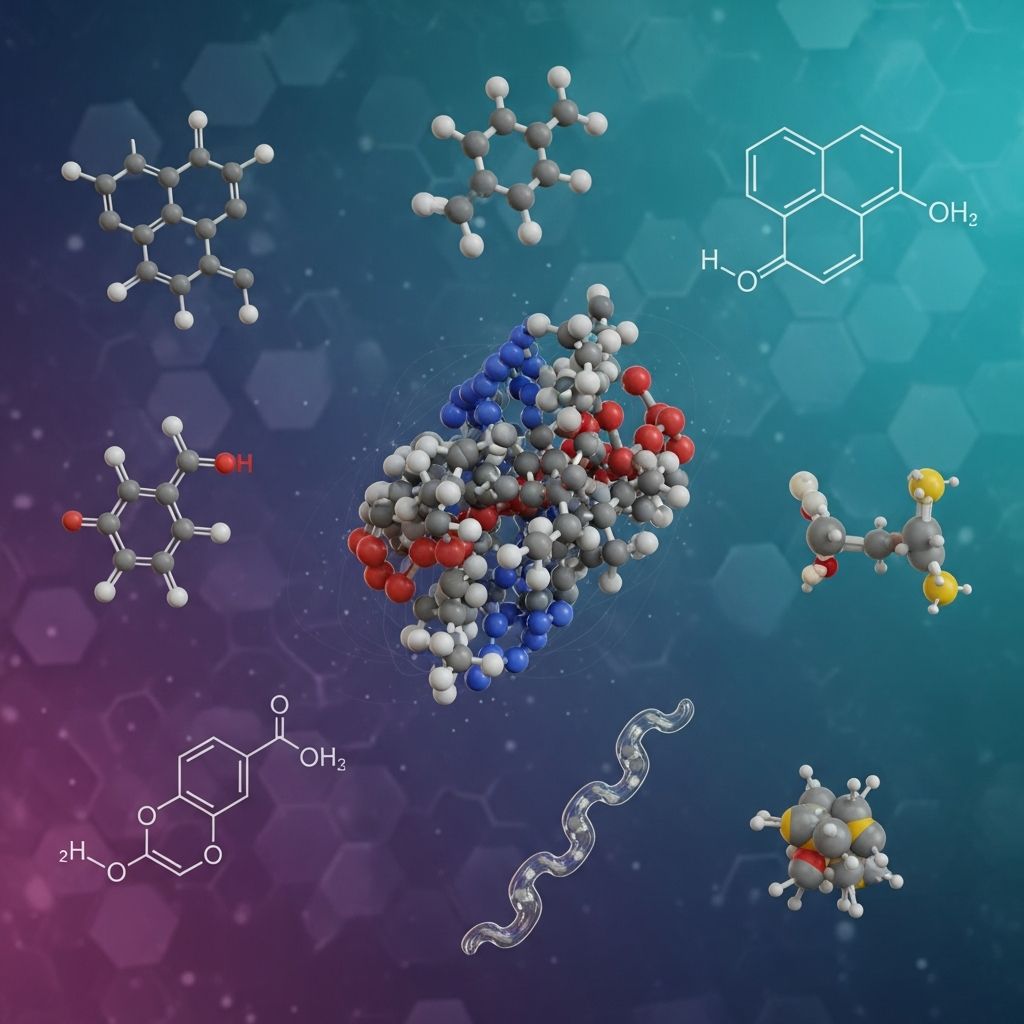
Organic compounds form the backbone of life and much of modern chemistry, characterized primarily by the presence of carbon atoms bonded to hydrogen, oxygen, nitrogen, or other elements. These molecules exhibit remarkable versatility due to carbon’s ability to form stable chains, rings, and complex structures.
The Essence of Carbon in Organic Chemistry
Carbon’s unique tetravalent nature allows it to create an immense variety of compounds, from simple methane to intricate DNA. Unlike inorganic compounds, which often lack carbon-hydrogen bonds, organic molecules typically feature C-C and C-H linkages, enabling diverse functionalities. This distinction excludes substances like carbon dioxide or carbonates from the organic category, despite containing carbon.
Organic compounds exist in all states—solids like sugars, liquids like ethanol, and gases like methane—playing pivotal roles in energy storage, structural materials, and metabolic processes.
Structural Classifications of Organic Molecules
Organic compounds are broadly categorized by their carbon skeleton architecture, providing a systematic way to understand their properties and reactivity.
Open-Chain Aliphatic Compounds
These feature straight or branched carbon chains without rings, known as acyclic or aliphatic compounds. They serve as building blocks for more complex structures and include hydrocarbons like alkanes (saturated), alkenes (with double bonds), and alkynes (with triple bonds).
- Alkanes: Fully saturated with single bonds, e.g., ethane (C2H6).
- Alkenes: Contain at least one C=C double bond, enabling addition reactions, e.g., ethene (C2H4).
- Alkynes: Feature C≡C triple bonds, highly reactive, e.g., ethyne (C2H2).
Cyclic and Alicyclic Structures
Cyclic compounds have carbon atoms arranged in rings. Alicyclic rings mimic aliphatic properties but are closed loops, such as cyclohexane (C6H12). These are stable and common in natural products like steroids.
Aromatic and Heterocyclic Systems
Aromatic compounds, exemplified by benzene (C6H6), possess delocalized electrons conferring exceptional stability. They include benzenoid (fused rings like naphthalene) and non-benzenoid types. Heterocyclic aromatics incorporate non-carbon atoms like nitrogen in pyridine or oxygen in furan, vital in pharmaceuticals and vitamins.
Functional Groups: Defining Reactivity
Beyond skeletal structure, functional groups—specific atom arrangements—dictate chemical behavior and classify compounds into families.
| Functional Group | Formula | Examples | Key Properties |
|---|---|---|---|
| Hydroxyl (-OH) | R-OH | Ethanol, glucose | Polar, forms H-bonds; alcohols |
| Carbonyl (C=O) | R-CHO (aldehyde), R-CO-R’ (ketone) | Formaldehyde, acetone | Reactive in nucleophilic additions |
| Carboxyl (-COOH) | R-COOH | Acetic acid, amino acids | Acidic, forms salts |
| Amino (-NH2) | R-NH2 | Methylamine, proteins | Basic, nucleophilic |
| Phosphate (-PO43-) | R-OPO32- | ATP, DNA | Energy transfer, polymerization |
These groups enable homologous series where compounds differ by -CH2– units, showing predictable trends in boiling points and reactivity.
Biomolecules: Organic Compounds in Life
Four major classes dominate biological systems: carbohydrates, lipids, proteins, and nucleic acids, each with distinct monomers and polymers.
Carbohydrates: Energy and Structure
Composed of C, H, O in (CH2O)n ratios, they range from monosaccharides (glucose) to polysaccharides (starch, cellulose). They provide quick energy and structural support in plants.
Lipids: Hydrophobic Essentials
Non-polar molecules like fats, phospholipids, and steroids. Triglycerides store energy; phospholipids form cell membranes; cholesterol aids fluidity.
Proteins: Molecular Machines
Polymers of amino acids linked by peptide bonds, performing catalysis (enzymes), transport, and structure (collagen). Their 3D shapes arise from folding dictated by sequence.
Nucleic Acids: Information Carriers
DNA and RNA, built from nucleotides (sugar + base + phosphate), store and transmit genetic information. ATP powers cellular work.
Applications Across Industries
Organic compounds underpin pharmaceuticals (aspirin from salicylic acid), polymers (plastics from ethene), fuels (gasoline alkanes), and dyes. Synthetic organics mimic natural ones, enhancing drug efficacy and material durability.
In medicine, functional group modifications create targeted therapies. In materials science, aromatic polymers yield strong fibers like Kevlar.
Challenges and Future Directions
Synthesizing complex organics requires precise control over stereochemistry and yields. Green chemistry seeks sustainable methods, reducing reliance on petrochemicals.
Emerging fields like organic electronics use conjugated systems for solar cells and OLEDs, promising efficient energy solutions.
Frequently Asked Questions (FAQs)
What distinguishes organic from inorganic compounds?
Organic compounds generally contain C-H or C-C bonds, while inorganic ones do not, excluding exceptions like CO2. They are central to life processes.
Why is carbon so versatile in forming compounds?
Carbon’s four valence electrons enable catenation (self-linking) and bonding with diverse elements, creating chains up to millions of atoms long.
Are all carbon-containing compounds organic?
No; carbonates, CO2, and cyanides are inorganic due to historical and structural classifications.
What role do functional groups play?
They determine reactivity, polarity, and biological function, grouping compounds into families like alcohols or acids.
How are biomolecules classified?
By monomer type: sugars for carbs, amino acids for proteins, nucleotides for nucleic acids, fatty acids/glycerol for lipids.
References
- Organic compound – Wikipedia — Wikipedia contributors. 2023-10-15. https://en.wikipedia.org/wiki/Organic_compound
- Classification of organic compounds – BYJU’S — BYJU’S. 2023-01-01. https://byjus.com/chemistry/classification-organic-compounds/
- Understanding Organic and Inorganic Compounds — Moravek, Inc. 2022-05-10. https://www.moravek.com/understanding-organic-and-inorganic-compounds/
- Classes of Organic Compounds – Introductory Chemistry — University of Utah. 2021-08-20. https://uen.pressbooks.pub/introductorychemistry/chapter/classes-of-organic-compounds/
- Overview of Organic Compounds – YouTube — Educational Video. 2020-11-12. https://www.youtube.com/watch?v=D0Fb3PudI-4
- Organic Compounds Essential to Human Functioning – BIO 140 — Hostos Community College. 2022-09-05. https://guides.hostos.cuny.edu/bio140/1-3

Medha Deb is an editor with a master's degree in Applied Linguistics from the University of Hyderabad. She believes that her qualification has helped her develop a deep understanding of language and its application in various contexts. Medha specializes in the areas of beauty, health, sports, and wellness and is committed to ensuring that the content on the website is…