
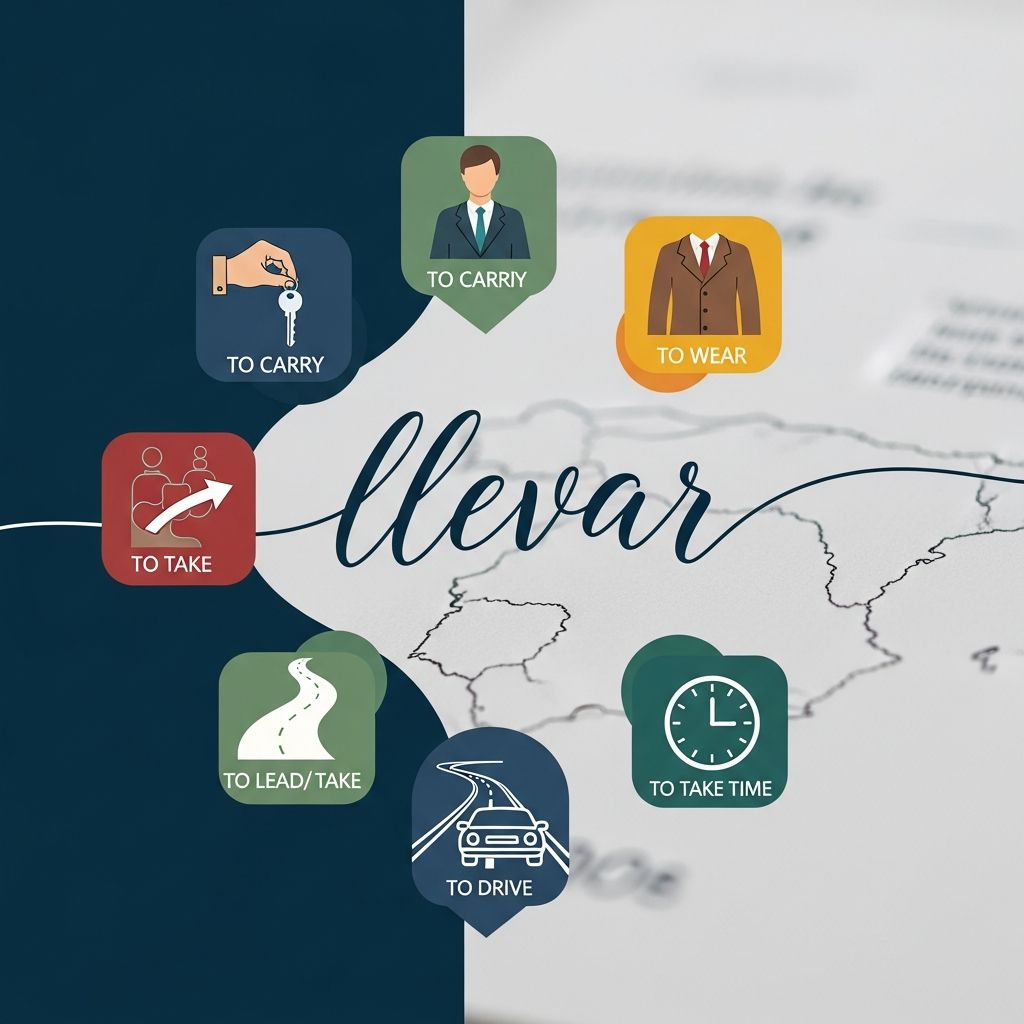
The Spanish verb llevar is one of those words that beginners encounter early on, often translated simply as “to carry.” However, its versatility extends far beyond physical transportation, making it indispensable for fluent expression. This guide breaks down its core applications, complete with conjugations, real-world examples, and nuances to help you wield it confidently in conversations.
Core Conjugation of Llevar
Before diving into uses, familiarize yourself with llevar‘s conjugation in key tenses. As a regular -ar verb, it follows standard patterns:
| Tense | Yo | Tú | Él/Ella/Ud. | Nosotros | Vosotros | Ellos/Ellas/Uds. |
|---|---|---|---|---|---|---|
| Presente | llevo | llevas | lleva | llevamos | lleváis | llevan |
| Pretérito | llevé | llevaste | llevó | llevamos | llevasteis | lleváron |
| Imperfecto | llevaba | llevabas | llevaba | llevábamos | llevabais | llevaban |
| Futuro | llevaré | llevarás | llevará | llevarémos | llevaréis | llevarán |
These forms adapt to context, whether describing current actions or past habits.
Transporting Objects and People: The Basic Sense
At its foundation, llevar means to carry or take something/someone away from the speaker’s current location. This contrasts with traer, which implies bringing toward the speaker.
- Yo llevo la caja al coche. (I carry/take the box to the car.) Here, the car is away from you.
- ¿Me llevas al aeropuerto? (Will you take me to the airport?)
- Llevamos los libros a la biblioteca. (We take the books to the library.)
Use it for vehicles too: El autobús lleva pasajeros a la ciudad. (The bus takes passengers to the city.) This sense emphasizes movement away.
Wearing Clothes, Accessories, and Styles
Spaniards frequently use llevar to describe what someone is wearing, rather than tener puesto or llevar puesto. It’s natural and idiomatic.
- Lleva falda roja hoy. (She’s wearing a red skirt today.)
- ¿Qué reloj llevas? (What watch are you wearing?)
- Llevaba barba larga. (He had/wore a long beard.) Note: Facial hair uses llevar over tener.
For hair: María lleva el pelo corto. (María wears her hair short.) This extends to glasses: Llevo gafas de sol. (I’m wearing sunglasses.)
Expressing Duration with Gerund: How Long?
A powerhouse structure: llevar + gerund (present participle) indicates how long an action has been ongoing. Pair it with time expressions for precision.
- Llevo estudiando tres horas. (I’ve been studying for three hours.)
- Llevábamos esperando dos días. (We had been waiting for two days.) Uses imperfecto for past continuity.
- Time phrases flex: Estudiando llevo tres horas or Tres horas llevo estudiando.
Perfect tenses aren’t used in Spanish here, unlike English equivalents.
Negative Duration: Llevar Sin + Infinitive
For negatives, switch to llevar + sin + infinitive to say how long since an action last occurred.
- Llevo sin comer desde ayer. (I haven’t eaten since yesterday.)
- Llevaba cinco años sin fumar. (He hadn’t smoked for five years.)
- Llevamos sin llover un mes. (It hasn’t rained for a month.)
Position time flexibly: after llevar or at the end.
Interpersonal Dynamics: Getting Along
Llevarse (pronominal form) describes relationships: llevársela bien/mal con alguien.
- ¿Cómo te llevas con tu jefe? (How do you get along with your boss?)
- Nos llevamos mal. (We don’t get along.)
- Se llevan de maravilla. (They get along wonderfully.)
This reflexive use focuses on mutual dynamics.
Advanced Expressions: Lead, Head, and More
Llevar shines idiomatically:
- ¿Qué dirección llevan? (Which direction are they heading?)
- Esto llevó a la victoria. (This led to victory.) Causative sense.
- Lleva tiempo aprender. (It takes time to learn.)
- Takeout: ¿Para llevar? (To go/take away?)
Age gaps: Lleva diez años más que yo. (He’s ten years older than me.)
Llevar vs. Llevarse: Key Distinctions
| Aspect | Llevar | Llevarse |
|---|---|---|
| Focus | Object/person transport | Who takes (often reflexive) |
| Example | Llevo el paquete. | Me llevo el paquete. (I take it with me.) |
| Relationship | N/A | Llevársela bien. (Get along.) |
Llevarse implies personal involvement or theft-like taking.
Practical Tips for Mastery
- Context is king: Away from speaker? Llevar. Toward? Traer.
- Practice gerunds: Combine with daily routines.
- Listen in media: Note llevar in songs/dialogues.
Build sentences daily to internalize nuances.
Frequently Asked Questions (FAQs)
¿Cuál es la diferencia entre llevar y traer?
Llevar moves away from you; traer toward you. Ej: Llevo al perro al parque (away); Tráeme agua (here).
¿Cómo uso llevar para decir qué llevo puesto?
Directly: Llevo camisa azul. Natural for clothes/hair/beards.
¿Llevar + gerundio funciona en todos los tiempos?
Mainly presente/imperfecto; no perfectos. Ej: Llevo trabajando años (now); Llevaba años (past).
¿Qué significa llevarse bien?
Get along well: Me llevo bien con amigos.
¿Se puede usar llevar para direcciones?
Yes: ¿Hacia dónde llevan? (Which way are they going?)
References
- Llevar + present participle expresses the duration of an action — Kwiziq Spanish. 2023. https://spanish.kwiziq.com/revision/grammar/using-llevar-gerund-to-express-duration-of-an-action
- How to use the Spanish verb Llevar — Happy Hour Spanish. 2022-10-15. https://www.happyhourspanish.com/many-uses-spanish-verb-llevar-spanish/
- How to Use Llevar Like a Native Speaker: 7 Key Uses — Tell Me In Spanish (YouTube). 2024-05-12. https://www.youtube.com/watch?v=e3MOvZ1_yPQ
- Llevar or Llevarse: Different Uses For Each Verb — BaseLang. 2023-08-20. https://baselang.com/blog/basic-grammar/llevar-or-llevarse/
- The Meanings of the Verb Llevar in Spanish — Entrelenguas. 2022. https://entrelenguas.com/verb-llevar-in-spanish/
- All About the Verb Llevar and Its Many Uses — Yabla Spanish. 2021-11-05. https://spanish.yabla.com/lesson-All-About-the-Verb-Llevar-and-Its-Many-Uses-1498

Medha Deb is an editor with a master's degree in Applied Linguistics from the University of Hyderabad. She believes that her qualification has helped her develop a deep understanding of language and its application in various contexts. Medha specializes in the areas of beauty, health, sports, and wellness and is committed to ensuring that the content on the website is…