
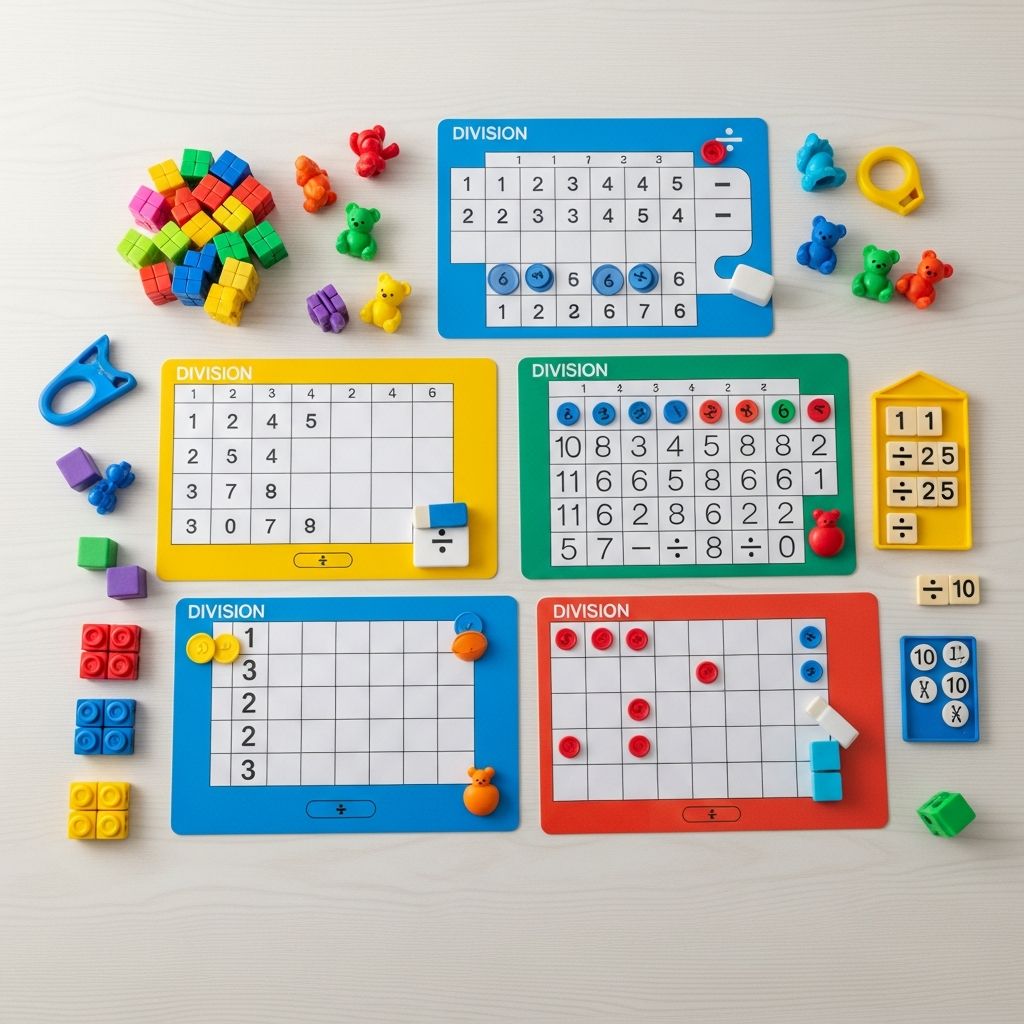
Division often poses challenges for young learners due to its abstract nature, but **division mats** offer a tangible pathway to comprehension. These versatile tools combine visual representations, manipulatives, and structured problem-solving to demystify concepts like fair sharing, grouping, and remainders. By engaging multiple senses, they foster lasting mathematical understanding in elementary classrooms.
Why Visual Aids Revolutionize Division Learning
Traditional rote memorization of division facts leaves many students confused about underlying principles. Visual and hands-on approaches, such as division mats, bridge this gap by illustrating how numbers break apart into equal parts. Research from educational resources emphasizes starting with concrete models before advancing to abstract algorithms, ensuring students internalize division as repeated subtraction or partitioning.
For instance, when children manipulate objects on a mat, they physically experience concepts like dividing 12 items among 3 groups, seeing quotients emerge naturally. This method aligns with developmental stages, building from one-to-one sharing to complex area models. Teachers report higher engagement and retention when abstract symbols pair with physical actions.
Core Principles Behind Effective Division Mats
Division mats are designed around key pedagogical strategies drawn from math education best practices. They typically feature divided sections for dividends, divisors, quotients, and remainders, encouraging multiple solution paths.
- Equal Grouping: Students partition counters or tiles into specified groups, visualizing the divisor as group size.
- Repeated Subtraction: Learners subtract divisor amounts iteratively until reaching zero, highlighting division’s inverse relationship to multiplication.
- Array Representations: Grids show rows and columns, linking division to multiplication facts for reinforcement.
- Fact Family Integration: Mats prompt writing related multiplication and division sentences, solidifying number relationships.
These elements ensure mats cater to diverse learning styles, from kinesthetic to visual learners, promoting conceptual depth over procedural fluency alone.
Designing Your Own Division Mats: A Step-by-Step Guide
Creating custom division mats is straightforward and adaptable to any classroom or home setting. Start with sturdy cardstock or laminate paper for durability.
- Layout the Template: Divide the mat into zones: a central rectangle for the total quantity, side areas for groups, and bottom spaces for equations and drawings.
- Add Prompts: Include a problem like “12 ÷ 3 = ?” at the top, with instructions for drawing, manipulating, and writing.
- Incorporate Visual Cues: Use color-coded sections—blue for sharing, green for grouping—to guide young users.
- Test and Iterate: Pilot with sample problems, adjusting based on student feedback for clarity.
Digital versions can be made using tools like Google Slides, allowing drag-and-drop manipulatives for remote learning.
Practical Activities to Bring Mats to Life
Maximize mat utility through targeted activities that progress in complexity. Begin with concrete manipulatives like beans or blocks, transitioning to drawings.
| Activity Level | Objective | Sample Problem | Materials |
|---|---|---|---|
| Beginner | Fair Sharing | Share 10 grapes between 2 friends | Counters, mat |
| Intermediate | Grouping | How many groups of 4 in 12? | Tiles, whiteboard |
| Advanced | Area Model | Divide 24 by 6 using rectangle | Paper tiles |
In a “Fair Shares” demo, distribute 18 items among 3 students using the mat; discuss equity and quotients. For “Ant Colony Challenges,” model insect groupings with dried pasta, writing division sentences as they form arrays. These games embed fun while reinforcing skills.
Progressing from Mats to Advanced Strategies
Division mats serve as a scaffold, leading seamlessly to sophisticated methods. Once comfortable, students apply mat logic to arrays—pictorial grids where they circle groups.
Next, introduce area models: rectangular diagrams where the dividend is the total area, divisor the side length, and quotient the unknown dimension. For example, dividing 32 by 4 becomes shading a rectangle 4 units wide, determining its length as 8.
Eventually, mats prepare for the standard algorithm by emphasizing place value and partial quotients. This progression ensures no gaps in understanding, as seen in curricula advocating concrete-pictorial-abstract sequences.
Adapting Mats for Diverse Learners and Settings
Flexibility defines division mats’ strength. For struggling students, enlarge mats and pair with one-on-one guidance. Gifted learners tackle multi-step problems or decimals on advanced templates.
- Homeschooling: Print mats for daily practice, integrating real-life scenarios like dividing snacks.
- Inclusive Classrooms: Add tactile elements like raised lines for visually impaired students.
- Group Work: Station rotations where teams solve mat challenges collaboratively.
Evidence from teaching resources shows such adaptations boost confidence across abilities.
Measuring Success: Assessing Mat-Based Learning
Track progress by observing mat interactions: accurate groupings indicate conceptual grasp. Use exit tickets prompting mat-free explanations of problems.
Pre- and post-assessments reveal growth, with rubrics scoring representation variety (e.g., drawing, equation, model). Long-term, students demonstrate fluency in word problems without mats, signaling transfer of skills.
Overcoming Common Division Hurdles with Mats
Remainders confuse many; mats clarify by showing leftovers in dedicated zones, teaching phrases like “4 groups with 2 left over.” Word problems gain context through scenario-based mats, like sharing cookies among friends.
Motivation wanes with repetition—gamify with timers or egg-shaped puzzles hiding facts under halves.
Frequently Asked Questions (FAQs)
What age group benefits most from division mats?
Division mats suit grades 2-5, aligning with introduction of division post-multiplication basics. Younger students (K-1) use simplified sharing versions.
Can digital division mats replace physical ones?
Digital mats enhance accessibility but lack tactile feedback; combine both for optimal results, especially in hybrid learning.
How do mats connect division to multiplication?
Through fact families on mats, students write both operations (e.g., 3×4=12, 12÷4=3), revealing inverse relationships.
Are there free resources for division mats?
Yes, teacher sites offer printable templates; customize for specific needs.
How often should mats be used in lessons?
Incorporate 2-3 times weekly for 10-15 minutes, spiraling with other strategies for retention.
Empowering Future Mathematicians
Division mats transcend worksheets, igniting curiosity and competence. By making the invisible visible, they equip students for algebraic thinking and real-world problem-solving. Integrate them today to witness transformation in math mindset.
References
- Division Mats | TPT — Teachers Pay Teachers. 2023. https://www.teacherspayteachers.com/browse?search=division+mats
- How To Teach 3 Division Methods from K-5th grade — Third Space Learning. 2023. https://thirdspacelearning.com/us/blog/guide-division-for-kids-explained/
- 41 Creative Ways To Make Teaching Division Easier (and More Fun!) — WeAreTeachers. 2023. https://www.weareteachers.com/teaching-division-games-activities/
- How to Teach Division: Tips from a Maths Tutor — DreamBox Learning. 2023. https://www.dreambox.com/math/skills/division/how-to-teach-division
- The Progression of Division — Make Math Moments. 2023. https://makemathmoments.com/progression-of-division/

- Integrated M.A. in Applied Linguistics, University of Hyderabad
- 5+ years in editorial, instructional, SEO, and research-based writing
Sneha is a relationships and lifestyle writer with a strong foundation in applied linguistics and certified training in relationship coaching. She brings over five years of writing experience to theskillvault, crafting thoughtful, research-driven content that empowers readers to build healthier relationships, boost emotional well-being, and embrace holistic living. Her writing and insights reflect the belief that beauty, happiness, and wellness…