
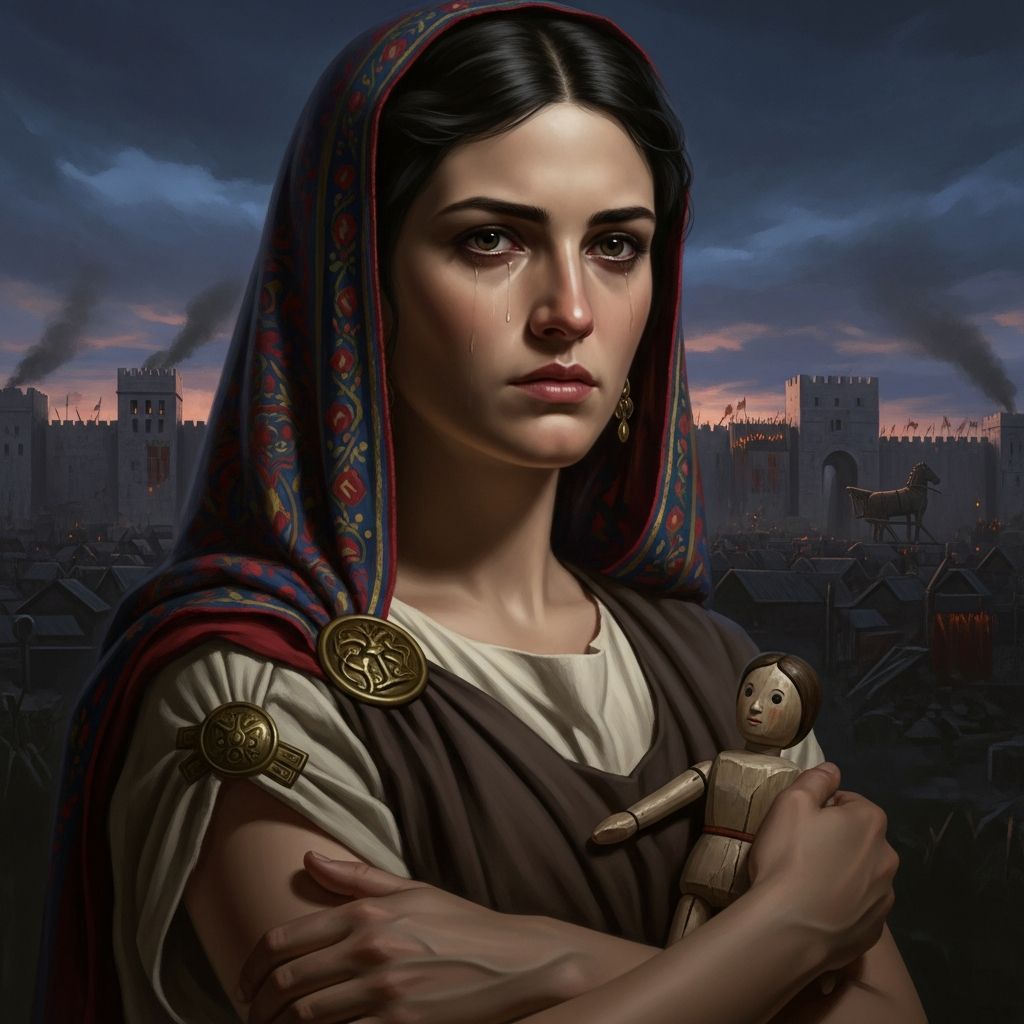
Andromache stands as one of the most poignant figures in Greek mythology, renowned for her unwavering loyalty, maternal devotion, and resilience in the face of unimaginable loss during the Trojan War and its aftermath.
Origins in Cilician Thebe
Born into royalty, Andromache was the daughter of Eetion, the ruler of Cilician Thebe in Mysia, a prosperous city under Hypoplacian Thebe’s domain. Her family included seven brothers and a sister, Podes, embedding her in a world of privilege and protection before the shadows of war encroached. Descriptions from ancient chroniclers paint her as exceptionally beautiful: tall, with a graceful figure, bright eyes, fair skin, and long blonde hair, embodying the ideal of feminine allure in ancient tales.
Her early life shattered when Achilles, the invincible Greek warrior, sacked Thebe. Eetion and all seven brothers fell in battle, leaving Andromache as the sole survivor of her royal house. This tragedy marked the beginning of her odyssey, thrusting her into the epic conflict of the Trojan War as a captive taken to Troy.
Marriage to Hector: A Beacon of Domestic Bliss
In Troy, Andromache’s beauty and noble bearing caught the eye of Hector, the eldest son of King Priam and Troy’s greatest defender. Their union symbolized the harmony between Trojan valor and gentle virtue. Unlike Helen, whose beauty sparked the war, Andromache represented the perfect wife—loving, dutiful, and fiercely protective of her home.
Together, they had a son, Astyanax (also called Scamandrius), whose name evoked the might of the Trojan prince. One of the Iliad’s most heart-wrenching scenes captures their family tenderness: Hector, returning from battle, bids farewell to Andromache and the infant on Troy’s ramparts. She pleads with him not to fight, foreseeing doom, while Hector entrusts their child’s future to the gods, highlighting the human cost of heroic duty.
- Loyal Companion: Andromache supported Hector through Troy’s siege, weaving his armor and managing their household with grace.
- Maternal Instincts: Her fears for Astyanax underscored her role as a devoted mother amid encroaching peril.
- Contrast to Helen: While Helen was faulted for vanity, Andromache’s virtues elevated her as the Greek ideal of womanhood.
The Fall of Troy and Heartbreaking Losses
The Trojan War culminated in catastrophe. Hector met his end at Achilles’ hands, avenging Patroclus. Andromache learned of his death through a messenger, collapsing in grief and lamenting her widowed fate. Yet greater horrors followed: the Greek sack of Troy, Priam’s murder, and the decision to kill Astyanax by hurling him from the walls to prevent future vengeance.
Witnessing her son’s murder devastated Andromache, symbolizing war’s brutality on innocents. As Trojan women were divided among victors, she became the prize of Neoptolemus (Pyrrhus), Achilles’ son—the very warrior who slew her child. Accompanied by Helenus, Hector’s brother taken as a slave, she sailed to Epirus, her world reduced to captivity.
Captivity and New Beginnings in Epirus
In Epirus, Andromache bore Neoptolemus three sons: Molossus, Pielus, and Pergamus (some traditions add Cestrinus). Molossus’s lineage was claimed by Epirote kings until the 3rd century BCE, linking myth to history. Neoptolemus’s death at Delphi left his realm unstable. Helenus, freed and succeeding as king, married Andromache, elevating her to queenship—a remarkable turnaround from slave to ruler.
Under Helenus, Andromache found stability, bearing Cestrinus and ruling wisely. She honored Hector with offerings at his cenotaph, her fidelity enduring beyond death. This phase showcased her adaptability and enduring spirit.
| Partner | Children | Notes |
|---|---|---|
| Hector | Astyanax | Killed post-Troy fall. |
| Neoptolemus | Molossus, Pielus, Pergamus (Cestrinus in some) | Ancestors of regional kings. |
| Helenus | Cestrinus | Born in Epirus queenship. |
Final Years in Pergamon and Lasting Legacy
After Helenus’s death, Andromache joined her youngest son, Pergamus, in Asia Minor. There, Pergamus conquered Teuthrania, slaying King Arius and founding Pergamon, named after himself. Andromache spent her twilight years in this new kingdom, dying peacefully of old age—a rare, dignified end for a war-torn life.
Her legacy endures as a symbol of Trojan women’s suffering: fidelity amid loss, virtue in adversity. Chroniclers praised her as modest, wise, and charming, her story inspiring art, literature, and Euripides’ Trojan Women.
Cultural Impact and Modern Interpretations
Andromache’s tale resonates beyond antiquity. In Homer’s Iliad, her scenes humanize the epic, contrasting war’s glory with personal tragedy. Euripides dramatized her plight, emphasizing maternal anguish. Today, she embodies resilience, influencing feminist readings of mythology where women’s voices persist despite patriarchal narratives.
Scholars note her evolution from victim to queen, reflecting post-war reinvention. Archaeological ties, like Molossian claims, blend myth with history, affirming her narrative’s depth.
Frequently Asked Questions (FAQs)
What was Andromache’s family background?
Andromache was princess of Cilician Thebe, daughter of King Eetion, with seven brothers killed by Achilles.
Who was Andromache married to, and what happened to her first son?
She married Hector, bearing Astyanax, who was thrown from Troy’s walls by Greeks post-sack.
Did Andromache remarry after the Trojan War?
Yes, first as Neoptolemus’s concubine, then marrying Helenus, becoming Epirus’s queen.
Where did Andromache spend her final days?
In Pergamon, founded by son Pergamus in Asia Minor, dying of old age.
Why is Andromache significant in Greek mythology?
She exemplifies loyalty, virtue, and women’s endurance during the Trojan War’s devastation.
References
- Andromache in Greek Mythology — Greek Legends and Myths. Accessed 2026. https://www.greeklegendsandmyths.com/andromache.html
- Andromache | Myth, Significance, & Trojan War — Encyclopaedia Britannica. 2023-10-12. https://www.britannica.com/topic/Andromache-Greek-mythology
- Andromache – Greek Mythology — GreekMythology.com. Accessed 2026. https://www.greekmythology.com/Myths/Mortals/Andromache/andromache.html
- Andromache – Wikipedia — Wikipedia Contributors. 2026-04-01. https://en.wikipedia.org/wiki/Andromache
- What was Andromache known for? Greek Mythology Story — VIS MYTH (YouTube). Accessed 2026. https://www.youtube.com/watch?v=rWuL5P6wGK0
- Hector and Andromache: The Most Moving Chapter of the Iliad — Greek Reporter. 2025-04-08. https://greekreporter.com/2025/04/08/hector-andromache-most-moving-chapter-iliad/

Medha Deb is an editor with a master's degree in Applied Linguistics from the University of Hyderabad. She believes that her qualification has helped her develop a deep understanding of language and its application in various contexts. Medha specializes in the areas of beauty, health, sports, and wellness and is committed to ensuring that the content on the website is…