
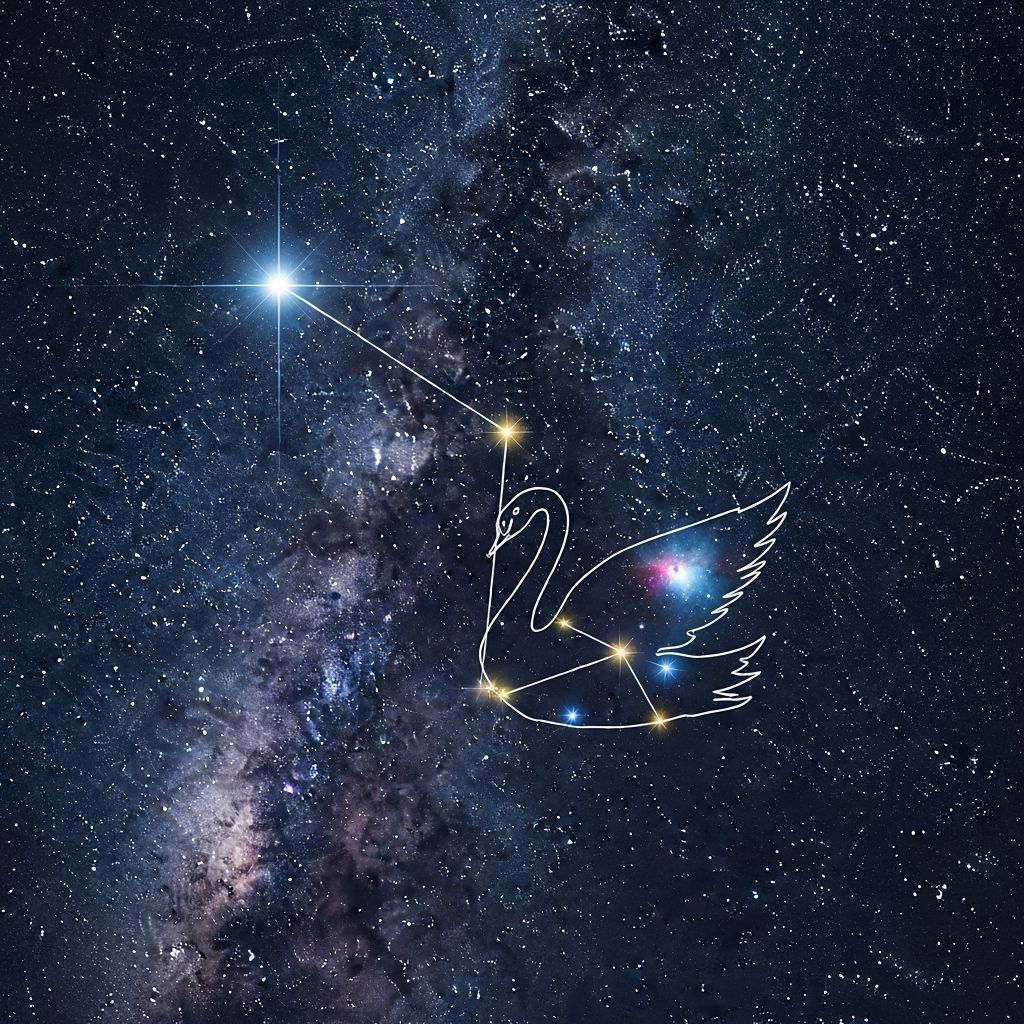
Cygnus stands out as one of the most striking patterns visible from northern latitudes, resembling a majestic bird gliding along the Milky Way’s glowing band. This constellation, cataloged among the 88 modern ones by the International Astronomical Union, spans 804 square degrees, ranking 16th in size, with boundaries defined between right ascension 19h 07.3m to 22h 02.3m and declination 27.73° to 61.36°.
Understanding the Shape and Dual Identity of Cygnus
The constellation earns its name from the Latin word for “swan,” evoking a bird in flight with wings spread wide and a long neck arched gracefully. Its stars form a distinctive cross-like asterism, earning it the nickname **Northern Cross**, distinct from its southern counterpart. This cross becomes especially prominent during summer evenings when the pattern stands upright against the starry backdrop.
Imagine a lowercase ‘t’ tilted slightly: the vertical bar represents the swan’s body, from tail to beak, while the horizontal arms depict outstretched wings. This simple visualization helps beginners quickly identify it amid the sky’s vastness.
Prime Viewing Seasons and Times for Cygnus
In the Northern Hemisphere, Cygnus graces the sky from June through December. Peak visibility occurs in June and July around 10 PM, positioned high in the northeastern sky, culminating overhead by 2 AM and lingering until dawn. By December and January, it appears earlier at 6 PM but dips below the horizon before 10 PM.
Southern Hemisphere observers catch it during winter months, though lower on the horizon. Optimal conditions include clear, dark skies away from city lights, with viewing best after sunset when the first stars emerge.
- June-July: High overhead late evening.
- August-September: Zenith position post-midnight.
- October-December: Early evening in the west.
Step-by-Step Guide to Locating Cygnus
Begin by facing east after dark in summer. Allow 15-20 minutes for your eyes to dark-adapt. The key is spotting **Deneb**, Cygnus’s brightest star at magnitude 1.25, approximately 2,600 light-years distant—one of the farthest naked-eye first-magnitude stars.
- Find the Summer Triangle: This large asterism comprises Deneb (northeast), Vega in Lyra (southeast), and Altair in Aquila (south). Deneb forms the northeastern vertex.
- Trace from Deneb: Deneb marks the swan’s tail or the Northern Cross’s top. Follow a line of stars southward to the beak at Albireo.
- Spot the wings: Stars like Gienah (west wing) and Delta Cygni (east wing) extend perpendicularly from the body.
- Center on Sadr: Gamma Cygni, at magnitude 2.23, anchors the cross’s intersection amid Milky Way star clouds.
Under suburban skies, the cross is naked-eye visible; rural sites reveal the Milky Way’s dense fields enhancing the view.
Highlighting Cygnus’s Brilliant Stars
Cygnus boasts several notable stars, each offering unique attractions for observers.
| Star Name | Magnitude | Role in Cygnus | Key Features |
|---|---|---|---|
| Deneb (Alpha Cygni) | 1.25 | Tail/Northern Cross top | Supergiant, ~2,600 ly away, 200,000x Sun’s luminosity. |
| Albireo (Beta Cygni) | 3.1 (combined) | Beak/foot of cross | Double star: gold and blue components, separable in small telescopes. |
| Sadr (Gamma Cygni) | 2.23 | Body center/cross hub | Surrounded by emission nebulae and star clusters. |
| Gienah (Epsilon Cygni) | 2.48 | West wing | Orange giant in rich Milky Way fields. |
| Delta Cygni | 2.87 | East wing | Multiple star system, adds to wing structure. |
Albireo shines as a beginner’s delight: through binoculars or a telescope, its contrasting colors—golden primary and blue secondary—create a stunning visual split.
Deep-Sky Marvels Within Cygnus
Cygnus’s position on the Milky Way plane packs it with treasures. Binoculars reveal star clusters like M29 (magnitude 7.1, near Sadr) and M39, both open clusters amid hazy glows.
Telescope users target nebulae: the **Veil Nebula** (NGC 6992/6995), a supernova remnant’s glowing filaments, spans 3 degrees—larger than the Full Moon. The **North America Nebula** (NGC 7000) mimics the continent’s shape in long-exposure images.
- M29: Compact cluster, 7,200 ly away, visible in binoculars.
- M39: Loose group of 30+ stars, easy sweep target.
- Veil Nebula: Requires filters for contrast; OIII enhances filaments.
- Black Ostrich Cluster (IC 5146): Embedded in dark nebulae, reflection glow.
Long-exposure astrophotography captures hydrogen emissions around Sadr, painting the region in reds and blues.
Myths and Cultural Tales of the Swan
Cygnus traces to Ptolemy’s 48 ancient constellations, linked to Greek lore. One myth casts it as **Orpheus**, the musician turned swan by Zeus after death, flying to the stars. Another features **Zeu**s as a swan seducing Leda, mother of Helen of Troy and Pollux—linking to nearby Gemini.
In Chinese astronomy, parts form the “Heavenly Market Enclosure.” Indigenous cultures saw birds or crosses, reflecting universal avian archetypes in northern skies.
Practical Tips for Observing Cygnus
Maximize your session with preparation:
- Location: Seek Bortle Class 4 or darker skies; apps like Stellarium or SkySafari simulate views.
- Gear progression: Naked eye → binoculars (10×50) → small telescope (4-6 inch).
- Weather check: Clear, moonless nights; avoid full moon phases.
- Family-friendly: Point out the cross first—impresses all ages.
Sweep binoculars along the Milky Way from Deneb for clusters; note plane’s dust lanes and rifts adding drama.
Frequently Asked Questions (FAQs)
What makes Cygnus easy for beginners?
Its bright, evenly lit cross shape and Summer Triangle position stand out even from light-polluted areas.
Is Cygnus visible year-round?
No, primarily summer-fall in north; winter in south, dipping low.
What’s special about Deneb?
A distant supergiant, vastly luminous, visible despite remoteness.
Best gear for Cygnus?
Binoculars for clusters; telescopes for Albireo split and nebulae.
Does Cygnus host black holes?
Yes, Cygnus X-1, first strong black hole candidate, lies near. (Note: Advanced topic for radio observers.)
Advanced Exploration: Cygnus in Modern Astronomy
Beyond visuals, Cygnus hosts Cygnus X-1, a binary with a stellar-mass black hole confirmed via X-ray emissions—pivotal in 1970s astrophysics. Radio and infrared views pierce dust, revealing star-forming regions. NASA’s Kepler mission targeted Cygnus for exoplanet hunts, discovering thousands.
Amateur spectrography on Deneb reveals supergiant traits; variable star monitors track Delta Cygni’s changes. Cygnus exemplifies accessible deep-space study.
References
- Cygnus Constellation: How to Find the Northern Cross in the Sky — Astrophotons. 2023. https://astrophotons.com/cygnus-constellation
- NEW How to Find Cygnus the Swan Constellation — Learn the Sky (YouTube). 2023-10-15. https://www.youtube.com/watch?v=1pqeDo0kwng
- Cygnus (constellation) — Wikipedia (IAU boundaries, historical data). 2026-04-01 (last edit). https://en.wikipedia.org/wiki/Cygnus_(constellation)
- The Constellation Cygnus | Facts, Location, Photos and Mythology — Astrobackyard. 2024. https://astrobackyard.com/cygnus-constellation/
- Cygnus the Swan flies along the Milky Way — EarthSky. 2025-07-20. https://earthsky.org/constellations/cygnus-the-swan-milky-way/
- Cygnus Constellation Map — IAU Office of Astronomy for Education. 2023. https://astro4edu.org/resources/diagram/HL453G70ED9/
- Night Sky Network News — NASA JPL. 2024-06-15. https://nightsky.jpl.nasa.gov/news/186/

- Integrated M.A. in Applied Linguistics, University of Hyderabad
- 5+ years in editorial, instructional, SEO, and research-based writing
Sneha is a relationships and lifestyle writer with a strong foundation in applied linguistics and certified training in relationship coaching. She brings over five years of writing experience to theskillvault, crafting thoughtful, research-driven content that empowers readers to build healthier relationships, boost emotional well-being, and embrace holistic living. Her writing and insights reflect the belief that beauty, happiness, and wellness…