
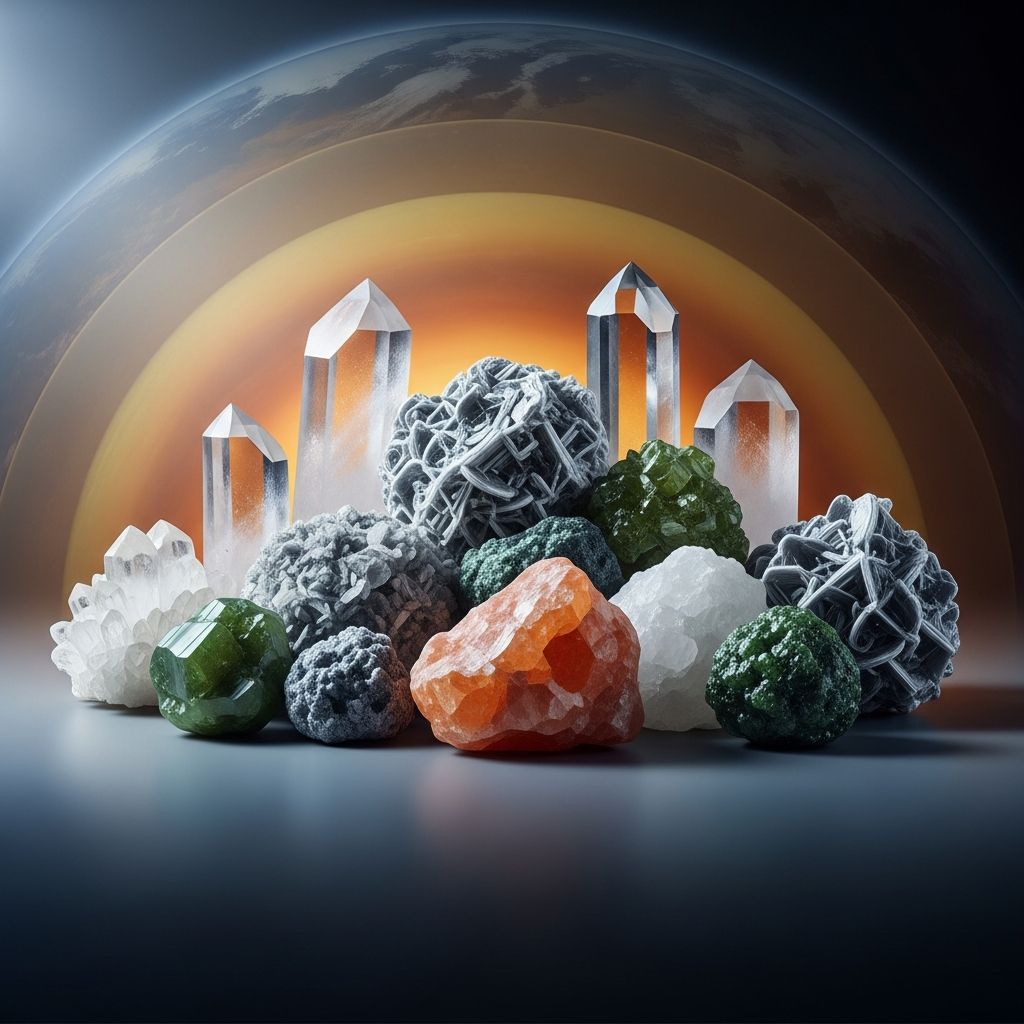
Silicate minerals constitute the predominant class of rock-forming minerals, accounting for approximately 90 to 95 percent of Earth’s crust and upper mantle by volume. These compounds, primarily built from silicon and oxygen combined with various cations, form the foundation of igneous, sedimentary, and metamorphic rocks encountered across the planet.
The Atomic Foundation: Silicon-Oxygen Tetrahedron
At the core of every silicate mineral lies the silicon-oxygen tetrahedron, a fundamental structural unit where a single silicon atom sits at the center, bonded to four oxygen atoms arranged in a pyramidal shape with triangular faces. This configuration creates a strong, stable module due to the partial ionic and covalent nature of the Si-O bonds.
The tetrahedron carries a net charge of -4 because each oxygen contributes a partial negative charge not fully balanced by the silicon. To neutralize this, cations such as magnesium (Mg²⁺), iron (Fe²⁺), calcium (Ca²⁺), sodium (Na⁺), or potassium (K⁺) bind to the oxygen atoms, stabilizing the structure. The way these tetrahedra link—sharing corners, edges, or faces—determines the mineral’s classification and properties.
This modular design allows for immense diversity: over 800 silicate species exist, though only about 25 are common in rocks. Silicon and oxygen alone make up 73.7% and 12.6% of the crust by weight, respectively, enabling silicates to dominate planetary materials from Earth to meteorites.
Classification by Polymerization: From Isolated Units to Frameworks
Silicate minerals are grouped into six main classes based on tetrahedra connectivity, ranging from isolated nesosilicates to fully linked tectosilicates. This polymerization spectrum influences hardness, cleavage, and geological behavior.
| Class | Tetrahedra Linkage | Si:O Ratio | Examples |
|---|---|---|---|
| Nesosilicates | Isolated | 1:4 | Olivine (Mg,Fe)₂SiO₄ |
| Sorosilicates | Double units/rings | 2:7 or 1:3.5 | Epidote |
| Cyclosilicates | Rings | Varies (3-8 members) | Beryl, Tourmaline |
| Inosilicates | Single/double chains | 1:3 | Pyroxene, Amphibole |
| Phyllosilicates | Sheets | 2:5 | Mica, Clays |
| Tectosilicates | 3D Framework | 1:2 | Quartz, Feldspar |
This table summarizes the structural progression, highlighting how increased sharing of oxygen atoms reduces the Si:O ratio and enhances network density.
Nesosilicates: Standalone Tetrahedra
Nesosilicates, or island silicates, feature independent tetrahedra linked only by cations. Olivine, with formula (Mg,Fe)₂SiO₄, exemplifies this group. Forming at high temperatures in mantle-derived magmas, olivine appears as green, glassy grains in basalts and peridotites. Its isolated structure yields irregular fracture and moderate hardness (6.5-7).
Other nesosilicates include zircon (ZrSiO₄), valued for gem quality and radioactive dating, and kyanite (Al₂SiO₅), which occurs in high-pressure metamorphics. These minerals’ simplicity makes them early crystallizers in cooling magmas.
Chain Silicates: Inosilicates in Action
In inosilicates (chain silicates), tetrahedra share two oxygens, forming endless chains. Pyroxenes have single chains, yielding formula (XY)SiO₃ where X and Y are cations like Ca, Mg, Fe. Common in basalts, augite (Ca(Mg,Fe,Al)(Si,Al)₂O₆) displays stubby, prismatic crystals with two cleavage planes at 90°.
Amphiboles feature double chains, with cross-links creating (XY)₅Si₈O₂₂(OH)₂ structures. Hornblende, a ferromagnesian variety, dominates andesites and amphibolites, showing splintery cleavage at 60°/120°. These chains confer toughness to mafic and intermediate rocks.
Sheet Silicates: Layered Phyllosilicates
Phyllosilicates (sheet silicates) link three basal oxygens per tetrahedron, yielding infinite sheets with Si₂O₅ ratio. Layers stack with weak van der Waals or ionic bonds, producing perfect basal cleavage and platy habits.
- Micas: Muscovite (KAl₂(AlSi₃O₁₀)(OH)₂), a light felsic mica, flakes into transparent sheets for insulation. Biotite (K(Mg,Fe)₃(AlSi₃O₁₀)(OH)₂), dark and ferromagnesian, weathers to clays in granites.
- Clay Minerals: Kaolinite (Al₂Si₂O₅(OH)₄) forms porcelain; smectite and illite enable soil fertility and swelling properties in bentonites.
Phyllosilicates dominate soils and sediments, influencing agriculture and engineering.
Framework Silicates: Tectosilicates Dominate
Tectosilicates interconnect all four tetrahedra oxygens into rigid 3D networks (SiO₂ ratio). Quartz (SiO₂), pure silica, resists weathering and forms sand, veins, and geodes with vitreous luster and conchoidal fracture.
Feldspars, the most abundant crustal minerals, incorporate Al for (Na,K)AlSi₃O₈ (plagioclase/orthoclase). They weather to clays, driving soil formation. Zeolites, porous frameworks, serve as molecular sieves.
Significance in Geology and Beyond
Silicates dictate rock cycles: olivines/pyroxenes in mafic magmas, feldspars/micas in felsic, clays in sediments. Their stability under pressure/temperature reveals tectonic histories.
Practically, quartz sands glass/concrete; micas insulate; clays pottery/drilling muds; gem beryl/emerald adorn jewelry; olivine forges forsterite refractories. Lunar/meteorite silicates confirm solar system ubiquity.
Frequently Asked Questions
What percentage of Earth’s crust do silicate minerals comprise?
Approximately 90-95%, primarily through tectosilicates like feldspar and quartz.
Why is the silica tetrahedron key to silicates?
It provides a stable, charge-balanced unit that polymerizes into diverse structures via oxygen sharing.
How do micas differ from other silicates?
Their sheet structure yields perfect cleavage into flexible flakes, unlike chain or framework types.
Are there non-silicate rock-forming minerals?
Yes, but rare: carbonates (calcite), oxides (hematite), sulfides (pyrite) play minor roles.
Why do silicates color variably?
Transition metals like Fe²⁺/Fe³⁺ in cation sites impart hues; pure Si-O frameworks are colorless.
References
- Understanding Silicate Minerals — HUATE Magnets. 2023. https://www.huatemagnets.com/news/understanding-silicate-minerals/
- 3.4: Silicate Minerals — Geosciences LibreTexts. 2023-10-15. https://geo.libretexts.org/Bookshelves/Geology/Book:_An_Introduction_to_Geology_(Johnson_Affolter_Inkenbrandt_and_Mosher)/03:_Minerals/3.04:_Silicate_Minerals
- 2.4 Silicate Minerals — OpenTextBC Physical Geology 2nd Edition. 2023. https://opentextbc.ca/physicalgeology2ed/chapter/2-4-silicate-minerals/
- Silicate mineral — Wikipedia (informational, primary sources referenced). 2026-04-01. https://en.wikipedia.org/wiki/Silicate_mineral
- 3.5 Silicate Minerals — Maricopa Open Physical Geology. 2023. https://open.maricopa.edu/physicalgeologymaricopa/chapter/2-4-silicate-minerals/
- Silicate mineral | Definition & Types — Britannica. 2025-12-15. https://www.britannica.com/science/silicate-mineral
- The Silicate Minerals — Visionlearning Earth Science. 2023. https://www.visionlearning.com/en/library/Earth-Science/6/The-Silicate-Minerals/140/

Medha Deb is an editor with a master's degree in Applied Linguistics from the University of Hyderabad. She believes that her qualification has helped her develop a deep understanding of language and its application in various contexts. Medha specializes in the areas of beauty, health, sports, and wellness and is committed to ensuring that the content on the website is…