
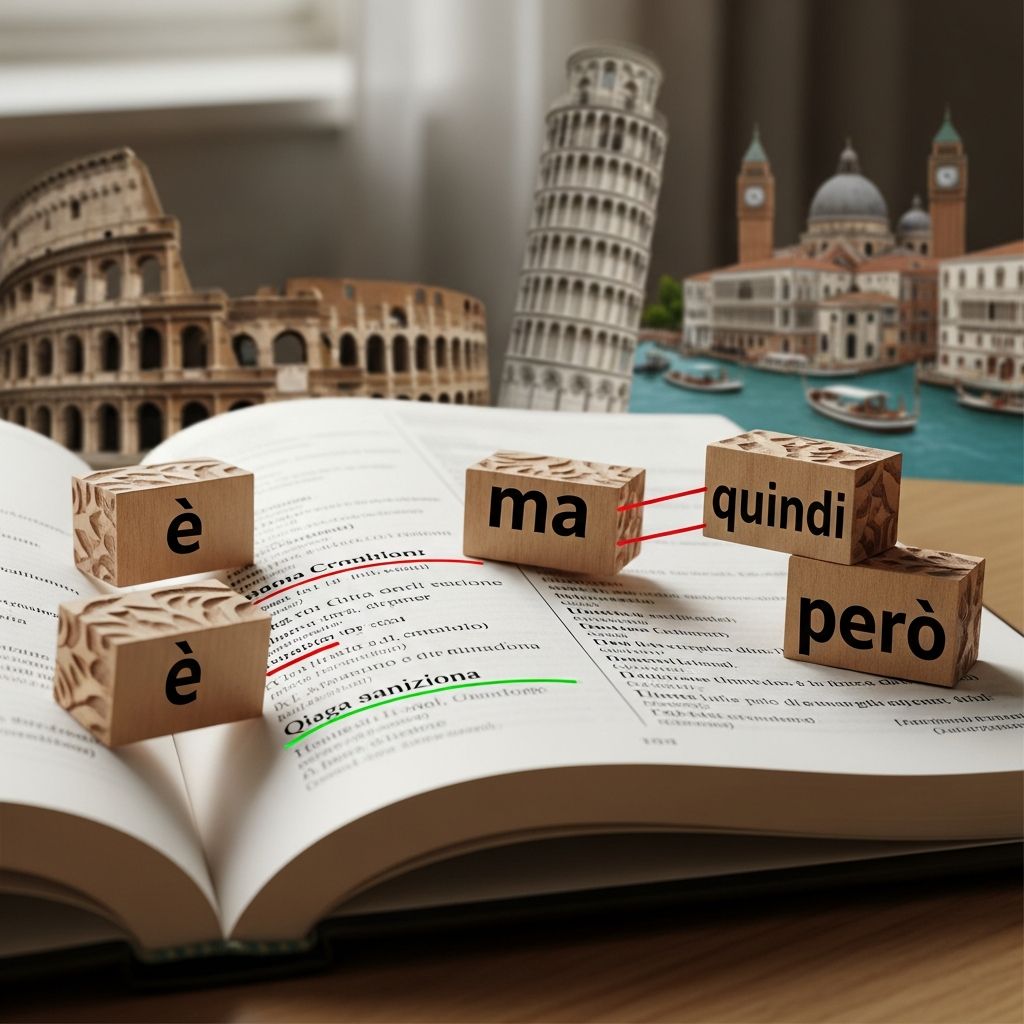
Linking words, known as connettivi or connectors in Italian, are the invisible threads that weave sentences together, creating smooth, natural discourse. Without them, speech sounds choppy and robotic; with them, you sound like a native speaker. This comprehensive guide explores the most crucial Italian connectors, categorized by function, complete with practical examples, usage tips, and strategies to integrate them into your daily practice.
Why Connectors Are Key to Italian Mastery
Italian, like many Romance languages, relies heavily on conjunctions to express relationships between ideas. Coordinative connectors join equal clauses, while subordinative ones introduce dependent ideas. Mastering these elevates simple phrases into sophisticated narratives. For instance, instead of saying “I went to the store. I bought bread,” say “Sono andato al supermercato e ho comprato del pane”—instant fluency boost.
Research from language acquisition studies highlights that frequent use of connectors correlates with perceived native proficiency. Start with basics and build up; consistency turns mechanical speech into effortless flow.
Core Coordinative Connectors: Building Blocks of Equality
Coordinative conjunctions link independent clauses of equal weight. They are the foundation of everyday Italian conversation.
- E (and): The most ubiquitous linker. Use it to add information: “Ho fame e ho sete” (I’m hungry and thirsty).
- Ma (but): Introduces contrast: “Voglio uscire, ma piove” (I want to go out, but it’s raining).
- O (or): Presents alternatives: “Caffè o tè?” (Coffee or tea?).
- Però (however/yet): A softer ‘but’ for spoken Italian: “È caro, però vale la pena” (It’s expensive, however it’s worth it).
- Quindi (therefore/so): Shows logical consequence: “Ho studiato, quindi passerò l’esame” (I studied, therefore I’ll pass the exam).
These five appear in nearly every Italian dialogue, making them non-negotiable for beginners.
Subordinative Connectors: Adding Depth and Nuance
Subordinative connectors introduce clauses that depend on the main idea, often explaining reasons, conditions, or time.
| Connector | English Equivalent | Example Sentence | Usage Context |
|---|---|---|---|
| Perché | Because | Non esco perché sono stanco. | Explaining reasons |
| Se | If | Verrò se non piove. | Conditional scenarios |
| Mentre | While | Leggo mentre mangio. | Simultaneous actions |
| Prima che | Before | Chiama prima che esca. | Sequence of events |
| Dopo che | After | Parleremo dopo che finisci. | Post-event actions |
Practice these in pairs: main clause + subordinative clause, to avoid grammatical hiccups.
Conversational Fillers: The Glue of Natural Italian
Beyond formal grammar, Italians pepper speech with fillers that signal transitions and keep rhythm alive. These are your ticket to sounding authentic.
- Allora: Multi-purpose—’so,’ ‘well,’ ‘then.’ Starts stories: “Allora, ieri sono andato a Roma…”
- Cioè: ‘I mean,’ for clarification: “È bello, cioè, il paesaggio è stupendo.”
- Comunque: ‘Anyway,’ to pivot: “Comunque, cambiamo argomento.”
- Insomma: ‘In short,’ summarizes: “Insomma, è stato divertente.”
- Beh: ‘Well,’ hesitation filler: “Beh, non lo so.”
Listen to podcasts or RAI radio; you’ll hear these every few sentences. Mimic to internalize.
Advanced Logical Connectors for Precision
For essays, debates, or professional talk, logical connectors add precision.
- Infatti (in fact): Supports a point: “È intelligente, infatti vince sempre.”
- Ossia (that is): Rephrases: “Vado in vacanza, ossia a Napoli.”
- Pertanto (therefore): Formal conclusion: “Piove, pertanto resto a casa.”
- Malgrado (despite): Concession: “Malgrado la pioggia, esco.”
- Affinchè (so that): Purpose: “Studio affinché impari.”
These shine in writing; use sparingly in speech to avoid stiffness.
Common Pitfalls and How to Dodge Them
Learners often misuse connectors, leading to confusion. Key errors:
- Overusing e: Vary with poi (then) or più (also).
- Confusing perché (because) with perché (why)—accent matters in writing.
- Neglecting agreement: Subordinative clauses may require subjunctive mood, e.g., “Spero che tu venga” (I hope that you come).
- English direct translation: “So” isn’t always quindi; context rules.
Avoid by shadowing native audio: repeat sentences verbatim from videos.
Practical Drills: From Theory to Muscle Memory
Integrate connectors daily:
- Journaling: Write 5 sentences linking ideas with new words.
- Shadowing: Pause Italian TV, repeat with connectors.
- Substitution Game: Take a simple sentence, swap in variants: “Vado al cinema” → “Vado al cinema perché è venerdì, però se piove resto casa.”
- Conversation Partners: Challenge tandem partners to spot your connectors.
- Reading Aloud: Corriere della Sera articles; underline linkers.
Track progress weekly; aim for 10 new usages per day.
Level-Up Strategies for Intermediate Learners
Once basics click, layer complexity:
Combine types: “Voglio viaggiare (coordinative start), perché sono stanco della routine (subordinative reason), quindi prenoto un volo (logical result), mentre tu studi (time contrast).”
Regional flavors: Northern Italians favor però; Southern lean ma. Adapt via immersion.
FAQs: Quick Answers to Top Connector Questions
Which connector is best for everyday chat?
E, ma, o, però, quindi cover 80% of needs. Start here for instant impact.
Do I need the subjunctive with connectors?
Yes, with doubt/time like se, prima che: “Dubito che venga.” Practice triggers.
How many connectors to learn first?
10-15 core ones. Focus on usage over memorization.
Are there gender/number agreements?
Most don’t agree; exceptions like più (more) do in comparisons.
Resources for more practice?
ItalianPod101, YouTube channels like Learn Italian with Lucrezia, and apps like Duolingo stories.
Transform Your Italian Today
Connectors aren’t just grammar—they’re the rhythm of Italian soul. Commit to using three new ones daily, and in weeks, your speech will flow like the Arno. Persistence pays; fluency awaits.
References
- Italian Connectors: Link Sentences Like a Native Speaker — Migaku Blog. 2023-05-15. https://migaku.com/blog/language-fun/italian-connectors-linking-words
- 70 Must-Know Italian Conjunctions to Improve Your Fluency — StoryLearning. 2022-11-10. https://storylearning.com/learn/italian/italian-tips/italian-connectors
- Most Important Coordinating Conjunctions in Italian and More — ItalianPod101. 2020-01-16. https://www.italianpod101.com/blog/2020/01/16/italian-conjunctions/
- 15 Linking Words to Enhance your Italian! — LearnAmo. 2021-03-22. https://learnamo.com/en/connectors-italian/
- Five Italian Connectors That Will Make You Sound Like a Native — Italiano Soprano Substack. 2023-08-07. https://italianosoprano.substack.com/p/five-italian-connectors-that-will

Medha Deb is an editor with a master's degree in Applied Linguistics from the University of Hyderabad. She believes that her qualification has helped her develop a deep understanding of language and its application in various contexts. Medha specializes in the areas of beauty, health, sports, and wellness and is committed to ensuring that the content on the website is…