
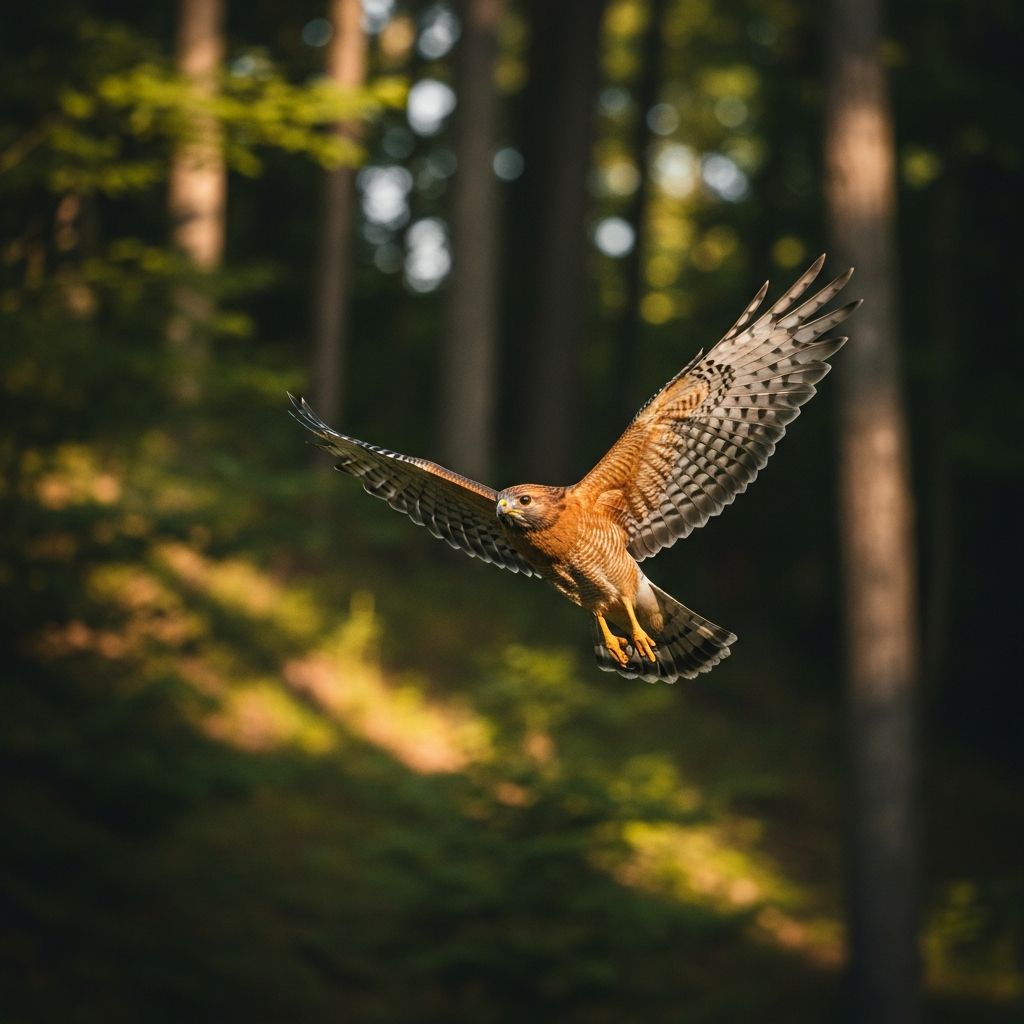
The red-shouldered hawk (Buteo lineatus) stands out as a quintessential woodland raptor, favoring moist forests over open skies. This medium-sized bird of prey embodies the stealthy hunter of dense canopies, with distinctive reddish patches that lend it its name. Unlike broader-ranging hawks, it thrives in proximity to water, making it a reliable indicator of healthy riparian ecosystems.
Physical Characteristics and Identification
Red-shouldered hawks measure 16 to 24 inches in length, with wingspans reaching 3 feet 2 inches to 3 feet 6 inches, and weights between 1.1 and 1.9 pounds. They appear slender compared to bulkier relatives like the red-tailed hawk, exhibiting a lean build suited to navigating thick foliage.
Adults feature dark backs accented by rufous streaking, while their undersides display light plumage with rufous barring on the breast and belly. The namesake reddish shoulders are visible at close range, particularly on the upper wing and wrist areas. Their tails are dark brown with four to five narrow white bands and a white tip, creating a striking pattern in flight.
Juveniles lack the vivid reddish tones, showing browner upperparts and cream-colored underparts heavily streaked with brown, especially on the chest. Tail barring is less defined in young birds. Regional variations exist: Florida populations are paler with gray heads and faint chest barring, while West Coast birds appear redder overall.
In flight, seek the translucent crescent-shaped “window” near the wingtips, a key identifier when the bird soars or glides. They often fly with quick wingbeats followed by short glides, mimicking accipiters more than typical buteos.
| Feature | Adult Range | Juvenile Notes | Regional Variation |
|---|---|---|---|
| Length | 16-24 inches | Similar size | Consistent |
| Wingspan | 38-42 inches | Developing | Slightly broader in north |
| Weight | 1.1-1.9 lbs | Lighter | Paler in Florida |
| Tail Pattern | Black with 4-5 white bands | Indistinct barring | Narrower bands west |
| Shoulders | Reddish rufous | Dull brown | Redder on West Coast |
Habitat Preferences and Distribution
These hawks gravitate toward mature, contiguous forests with open understories, particularly bottomland hardwoods near streams, rivers, swamps, and marshes. They shun open fields, opting for secretive perches in damp woods, river valleys, and wet meadows. Urban adaptability allows sightings in suburban areas and near farmlands, provided wooded cover persists.
Range spans eastern North America from southern Canada to northeastern Mexico, with isolated populations in California and Oregon. In the U.S., they are year-round residents in states like Georgia and Florida, though northern birds may migrate short distances. They signal environmental health, as degraded wetlands reduce their presence.
- Preferred Environments: Wooded swamps, riparian zones, mixed deciduous-coniferous forests.
- Avoided Areas: Fragmented woodlots, open farmlands without tree cover.
- Urban Tolerance: Increasingly common in parks and neighborhoods with mature trees.
Hunting Strategies and Diet
Red-shouldered hawks perch inconspicuously, head tilted downward, scanning for prey. They rarely soar high like red-tails, preferring to drop from cover or pursue through trees using their long, rudder-like tails for agile maneuvers. Active flight involves rapid flaps and glides.
Diet emphasizes small mammals (mice, rabbits, squirrels), reptiles (snakes, lizards), amphibians (frogs, toads), and occasionally crawfish, small birds, or insects. Aquatic prey reflects their wetland affinity. Sharp talons seize victims, and hooked beaks tear flesh.
Superior eyesight detects movement from afar, enabling precise strikes. Broad wings facilitate soaring patrols over territories.
Breeding, Nesting, and Reproduction
Breeding peaks in spring, with pairs defending large territories through vocal displays. Nests, built high in tall trees, use sticks and line with bark or evergreen sprigs. Females lay 2-4 bluish-white eggs, incubating for about 33 days while males provision food.
Nestlings fledge around 5-6 weeks, capable of defecating over nest edges by day five—a telltale sign of occupancy below. Pairs often reuse nests, competing occasionally with broad-winged hawks. Lifespan averages 5 years in wild, with records to 19+ years.
Vocalizations peak during courtship: a sharp “kee-aah” scream, mimicked by blue jays, and softer “kak-kak” notes.
Conservation Status and Threats
Globally least concern (IUCN), populations remain stable or increasing in many areas, though historical declines occurred from 1950s-1970s due to habitat loss. Threats include wetland drainage, forest fragmentation, and pesticides affecting prey. In New Jersey, breeding populations are endangered, non-breeding threatened.
Conservation prioritizes preserving riparian forests and minimizing development impacts. Healthy habitats support their role controlling rodents and pests.
Observing Red-Shouldered Hawks in the Wild
Listen first: their whistled calls betray presence before sightings. Scan mid-canopy perches near water. Migration peaks late October at watch sites, with translucent wing crescents aiding ID.
- Best Times: Spring breeding calls, fall migration.
- Hotspots: Hawk Mountain, wetland parks.
- Tips: Use binoculars for shoulder patches; note tail bands.
Frequently Asked Questions
Where do red-shouldered hawks live?
They inhabit wet forests, swamps, and river edges across eastern North America, with some western populations.
What do red-shouldered hawks eat?
Primarily small mammals, amphibians, reptiles, and occasionally insects or birds.
How can I identify a red-shouldered hawk in flight?
Look for pale crescents on wingtips, banded black-and-white tail, and reddish underparts.
Are red-shouldered hawks endangered?
Least concern overall, but regionally threatened by habitat loss in places like New Jersey.
What is the call of a red-shouldered hawk?
A loud “kee-aah” or “keeyar,” often heard in breeding season.
References
- 15 Amazing Red-Shouldered Hawk Facts — Chattanooga Nature Center. Accessed 2026. https://chattnaturecenter.org/visit/experience/wildlife/animal-facts/red-shouldered-hawk/
- Red-Shouldered Hawk — Florida Fish and Wildlife Conservation Commission. Accessed 2026. https://myfwc.com/wildlifehabitats/profiles/birds/raptors-and-vultures/red-shouldered-hawk/
- Red-shouldered Hawk — Hawk Mountain Sanctuary. Accessed 2026. https://www.hawkmountain.org/raptors/red-shouldered-hawk
- Red-shouldered Hawk — National Audubon Society. Accessed 2026. https://www.audubon.org/field-guide/bird/red-shouldered-hawk
- Red-shouldered Hawk — Cornell Lab of Ornithology. Accessed 2026. https://www.allaboutbirds.org/guide/Red-shouldered_Hawk/overview
- Red-Shouldered Hawk — North Carolina Wildlife Resources Commission. 2026. https://www.ncwildlife.gov/media/1901/open
- Red-shouldered Hawk — Squam Lakes Natural Science Center. Accessed 2026. https://nhnature.org/visit/animal_info_sheets/redshouldered_hawk.php

- Integrated M.A. in Applied Linguistics, University of Hyderabad
- 5+ years in editorial, instructional, SEO, and research-based writing
Sneha is a relationships and lifestyle writer with a strong foundation in applied linguistics and certified training in relationship coaching. She brings over five years of writing experience to theskillvault, crafting thoughtful, research-driven content that empowers readers to build healthier relationships, boost emotional well-being, and embrace holistic living. Her writing and insights reflect the belief that beauty, happiness, and wellness…