
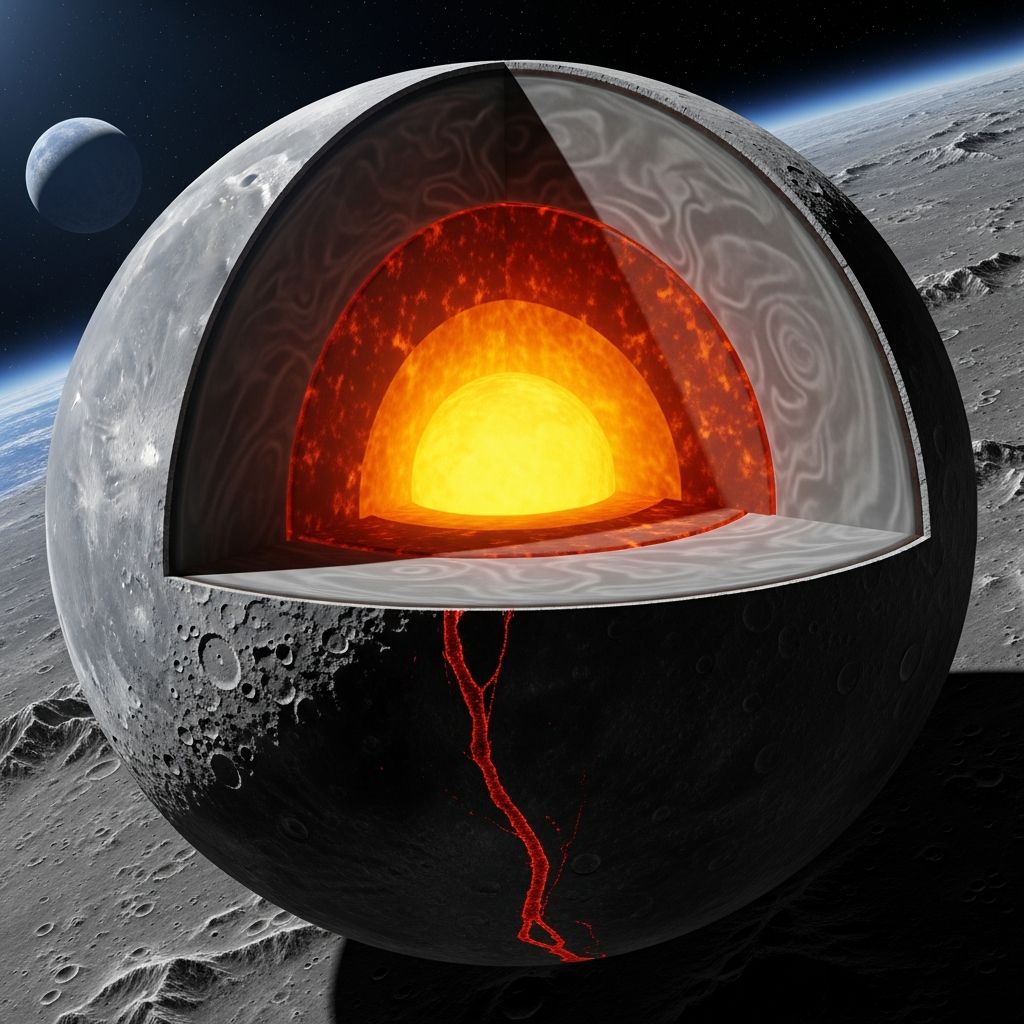
Understanding the Moon’s Internal Organization
The Moon, Earth’s sole natural satellite, represents one of the most studied celestial bodies in our solar system. Its physical makeup bears striking similarities to our own planet, featuring a differentiated structure composed of distinct layers that developed over billions of years. When heavier materials accumulated during the Moon’s formation, they gradually sank toward the center, while lighter substances remained in the outer regions. This process of differentiation created the three primary layers we observe today: the core at the center, the mantle surrounding it, and the thin crust forming the outermost shell. Understanding these layers provides insight into how rocky bodies evolve and helps scientists piece together the Moon’s ancient history.
The Moon’s Innermost Layer: The Core
At the Moon’s center lies a distinctive core composed primarily of iron, with measurable quantities of nickel and sulfur distributed throughout. This core exhibits a fascinating dual structure, consisting of a solid inner core surrounded by a molten outer core. Unlike Earth’s proportionally larger core, the Moon’s core represents only about 20 percent of the Moon’s total diameter from its center to the surface. Scientists attribute this relatively modest core size to the Moon’s violent formation process, which apparently prevented substantial quantities of iron from accumulating at its center. The outer core, which extends approximately 310 miles (500 kilometers) outward from the center, maintains a partially molten state despite the extreme pressures and temperatures in this region. This liquid iron composition distinguishes it from the solid inner core and may contribute to certain seismic phenomena observed on the lunar surface.
The Mantle: The Moon’s Thickest Layer
Encasing the core is the Moon’s mantle, which comprises the majority of the Moon’s volume and extends approximately 1,350 kilometers in depth. This layer presents a complex composition dominated by solid rock, though the zone immediately adjacent to the core exhibits partial melting. The lunar mantle’s primary mineral constituents include olivine, orthopyroxene, and clinopyroxene, minerals that also appear in Earth’s mantle but in different proportions. One particularly noteworthy characteristic of the lunar mantle is its elevated iron content compared to Earth’s mantle, making it geochemically distinct. Scientists theorize that some moonquakes—tremors detected on the Moon’s surface—may originate from the partly molten region where the mantle interfaces with the outer core.
The mantle’s composition reveals important information about the Moon’s early history. Ancient volcanic activity brought material from the mantle to the lunar surface, where it cooled and solidified. These mare basalts, visible today as dark patches on the Moon, provide scientists with tangible evidence of the mantle’s composition. By analyzing these basaltic samples returned by Apollo missions, researchers have developed detailed models of what lies beneath the lunar surface.
The Crust: A Window to the Moon’s Surface
The Moon’s crust, the outermost layer, averages approximately 50 kilometers in thickness and represents roughly 38 to 63 miles (60 to 100 kilometers) in some regional measurements. This rocky shell contains the lightest materials found anywhere on the Moon, primarily composed of oxygen, silicon, magnesium, iron, calcium, and aluminum, with minor quantities of titanium, uranium, thorium, potassium, and hydrogen. A significant proportion of the lunar crust consists of anorthosite, a rock particularly enriched in calcium and aluminum.
The crust exhibits notable regional variations in composition and appearance. The Moon’s relatively bright, elevated highland regions contain elevated concentrations of calcium and aluminum, creating their characteristic lighter appearance. In contrast, the darker depressions, known as maria (Latin for “seas”), display higher iron and titanium content. These maria represent ancient seas of cooled lava that inundated vast impact basins between 4.2 and 1.2 billion years ago, while the lunar highlands represent older crustal material that survived these intense basin-forming impacts.
Regolith: The Moon’s Surface Layer
Blanketing the lunar crust is a distinctive substance called regolith—the Moon’s soil composed of fine dust, broken rock fragments, and pulverized material. Unlike Earth’s regolith, which forms through weathering and erosion processes, lunar regolith develops exclusively through meteorite and asteroid bombardment. Over billions of years, countless impacts have pulverized the Moon’s surface into increasingly fine particles. This regolith layer varies significantly in depth depending on location: in some maria regions, it measures only about 3 meters deep, while in highland areas, it can accumulate to depths of 20 meters or more.
The creation of regolith through impact processes produces remarkable preservation of surface features. Astronaut Neil Armstrong’s famous footprint on the Moon remained visible for extended periods because the fine regolith particles captured and retained the impression with exceptional clarity. The regolith also extends to substantial depths—in certain highland regions reaching up to 66 feet (20 meters)—creating a buffer layer between the solid rock beneath and the vacuum of space above.
Elemental Composition and Mineral Resources
The Moon’s composition encompasses a diverse array of elements that combine to form its rocky structure. The primary constituents include iron, magnesium, aluminum, silicon, and titanium. Beyond these abundant elements, the Moon contains deposits of valuable precious metals, including gold, silver, and mercury, distributed throughout its rocky matrix. These metallic deposits, though present in relatively small quantities, attract considerable scientific and commercial interest.
Perhaps most intriguingly, evidence suggests the presence of water ice in certain lunar locations, particularly in permanently shadowed regions near the poles. This discovery holds profound implications for future lunar exploration and potential human settlement, as water could provide essential resources for drinking, oxygen production, and rocket fuel manufacturing.
Key Elements Found in Lunar Material
- Oxygen – the most abundant element
- Silicon – primary component of lunar rocks
- Magnesium – contributes to mantle composition
- Iron – concentrated in the core and scattered throughout other layers
- Calcium – abundant in highland regions
- Aluminum – present in crustal rocks
- Titanium – found in darker maria regions
- Precious metals – gold, silver, and mercury in trace quantities
Basalt and Ancient Volcanic History
The Moon’s surface displays extensive evidence of ancient volcanic activity through massive deposits of basalt—dark-colored rock that formed when lava cooled and solidified. These basaltic deposits appear as dark regions on the Moon’s surface and collectively create the familiar “man in the moon” pattern visible from Earth. The basalt’s darker appearance compared to the lighter highland rock reflects its different mineral composition and iron content. These ancient lava flows tell a story spanning billions of years, with the most recent volcanic activity having ceased approximately 1.2 billion years ago.
Surface Features and Impact Craters
The lunar surface is not smooth or featureless but rather exhibits an extensively cratered landscape resulting from billions of years of bombardment. These craters range from microscopic to hundreds of kilometers across, each representing an impact event that blasted material from the surface and altered local geology. The Moon lacks an atmosphere and active weather systems that would erode or obscure these features, so the cratering record remains remarkably well-preserved. This absence of erosional processes means that the Moon’s surface preserves a detailed geological record spanning much of the solar system’s history.
The Moon’s Thin Atmosphere
While discussing the Moon’s composition, it merits noting that the Moon possesses a tenuous atmosphere far too thin for human respiration. This exosphere—as scientists more accurately term it—consists of traces of neon, helium, and hydrogen, existing at pressures millions of times lower than Earth’s atmosphere. The extreme thinness of this lunar atmosphere results from the Moon’s relatively weak gravity, which cannot retain lighter gases over geological time. Consequently, any gaseous molecules escape into space, leaving only the faintest remnants of atmospheric material.
Formation Theories and Composition Origins
Current scientific understanding proposes that much of the material composing the Moon originated from Earth itself. This theory suggests that during the solar system’s early formation, a Mars-sized celestial body collided with the young Earth, ejecting substantial quantities of material that eventually coalesced into the Moon. This giant impact hypothesis explains why the Moon’s composition bears such remarkable similarities to Earth’s composition while also accounting for certain chemical differences observed in lunar samples.
Following its formation, the Moon began as a molten body—essentially a sphere of liquid magma. As this primordial magma cooled over time, heavy metals sank progressively toward the center, establishing the core, while lighter rocky materials floated outward and eventually solidified into the crust. This gravitational differentiation process produced the stratified structure we observe today.
Comparison: Moon Versus Earth Composition
| Feature | Moon | Earth |
|---|---|---|
| Core Composition | Solid iron inner core with molten outer core | Solid iron inner core with molten outer core |
| Core Size | ~20% of diameter | ~50% of diameter |
| Mantle Composition | Olivine, pyroxene minerals; more iron-rich | Olivine, pyroxene minerals; less iron-rich |
| Crust Thickness | ~50 km average | ~35-40 km average |
| Primary Crustal Elements | Oxygen, silicon, magnesium, iron, calcium, aluminum | Oxygen, silicon, aluminum, iron, magnesium |
| Atmosphere | Virtually none (exosphere) | Nitrogen, oxygen, argon |
Frequently Asked Questions
Q: Is the Moon made of rock or metal?
A: The Moon consists primarily of rock, with a metallic iron-nickel core at its center. The majority of its volume comprises rocky mantle and crustal material.
Q: Does the Moon have water?
A: Yes, evidence indicates small amounts of water and ice exist on the Moon, particularly in permanently shadowed regions near the poles. This discovery has significant implications for future lunar missions.
Q: Why is the Moon’s core smaller than Earth’s core?
A: The Moon’s relatively small core, representing only 20 percent of its diameter compared to Earth’s 50 percent, results from the violent impact event during the Moon’s formation, which apparently prevented substantial iron accumulation at the lunar center.
Q: What are the dark patches on the Moon called?
A: The dark patches are called maria (plural; singular mare), which are ancient seas of cooled lava that filled impact basins between 4.2 and 1.2 billion years ago.
Q: How deep is the lunar regolith?
A: Lunar regolith depth varies by location, ranging from approximately 3 meters (10 feet) in maria regions to as much as 20 meters (66 feet) in highland areas.
Q: What minerals comprise the Moon’s mantle?
A: The lunar mantle primarily consists of olivine, orthopyroxene, and clinopyroxene minerals, which are iron-rich compared to their Earth counterparts.
References
- What is the Moon Made of? Facts and Exploration — Study.com. 2024. https://study.com/academy/lesson/what-is-the-moon-made-of-lesson-for-kids.html
- Moon Composition — NASA Science. 2024. https://science.nasa.gov/moon/composition/
- The Moon — Natural History Museum. 2024. https://www.nhm.ac.uk/discover/factfile-the-moon.html
- Internal structure of the Moon — Wikipedia. 2024. https://en.wikipedia.org/wiki/Internal_structure_of_the_Moon
- What is the Moon Made Of? — Space.com. 2024. https://www.space.com/19582-moon-composition.html
- Composition and origins of the Moon — Institute of Physics. 2024. https://www.iop.org/explore-physics/moon/composition-and-origins-moon

- Integrated M.A. in Applied Linguistics, University of Hyderabad
- 5+ years in editorial, instructional, SEO, and research-based writing
Sneha is a relationships and lifestyle writer with a strong foundation in applied linguistics and certified training in relationship coaching. She brings over five years of writing experience to theskillvault, crafting thoughtful, research-driven content that empowers readers to build healthier relationships, boost emotional well-being, and embrace holistic living. Her writing and insights reflect the belief that beauty, happiness, and wellness…