
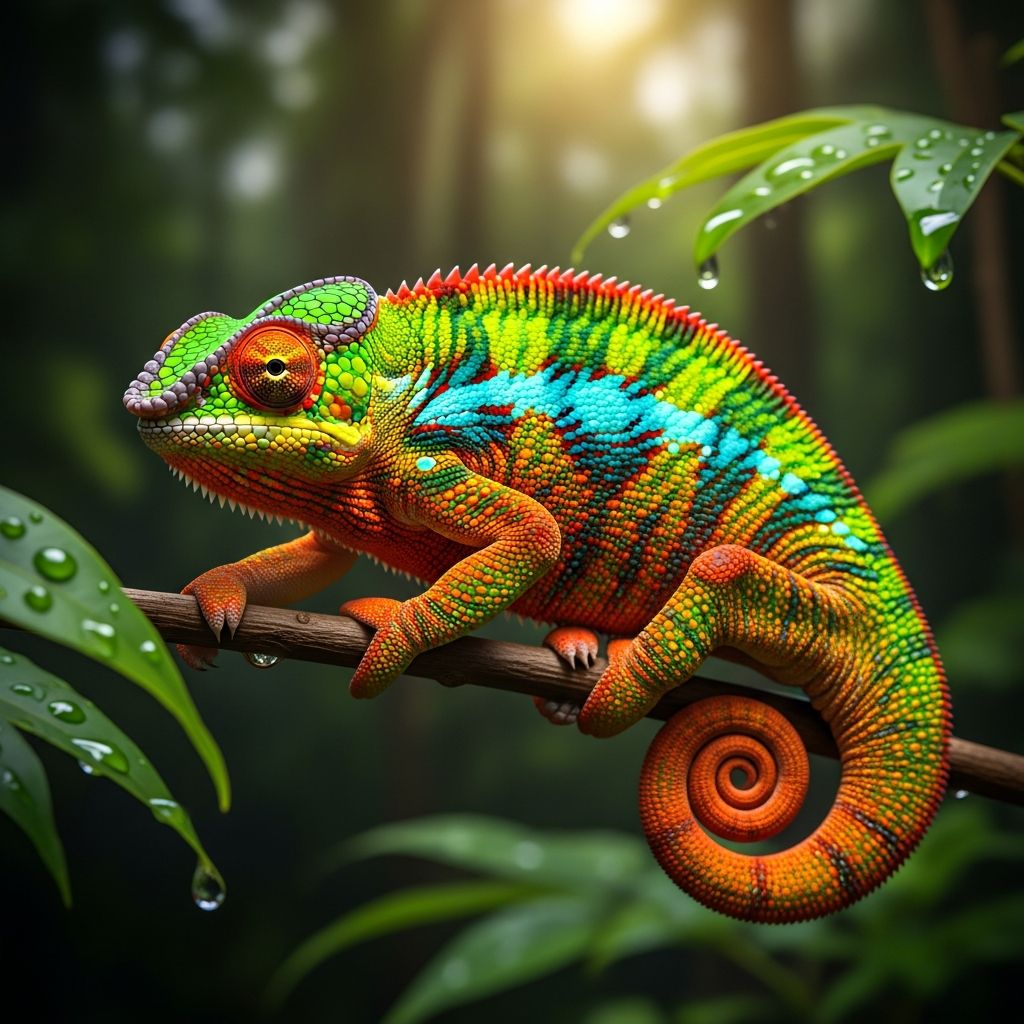
Chameleons captivate observers with their ability to shift hues in seconds, blending into surroundings or signaling emotions. This phenomenon blends biology and physics, driven by specialized skin cells and tunable nanostructures rather than mere pigment dispersion. Beyond nature, you can replicate this magic at home with everyday materials, offering educational insights into animal adaptation.
The Biological Marvel of Chameleon Skin
Chameleon skin features multiple cell layers, each contributing to dynamic color displays. The top layer holds iridophores with guanine nanocrystals arranged in a lattice. These photonic crystals selectively reflect light wavelengths, producing structural colors without pigments. Beneath lie xanthophores with yellow pigments and melanophores with dark melanin, which adjust opacity to modulate overall appearance.
When relaxed, chameleons appear green through yellow pigment overlaying blue-reflecting crystals, creating a composite effect. Excitement triggers crystal expansion, shifting reflection to longer wavelengths like yellow, orange, and red. This active tuning, not pigment spreading, enables rapid changes observed in males during courtship or territorial displays.
Physics Behind the Color Shift
Photonic crystals in chameleon skin function like nanoscale gratings, interfering with light based on spacing. Calm states feature ~130 nm gaps reflecting blue light, combining with yellow pigments for green. Stress or arousal expands gaps via cellular mechanisms, possibly involving osmotic pressure or cytoskeletal adjustments, reflecting redder hues.
Research from the University of Geneva demonstrated this by comparing skin samples: excited chameleons showed wider crystal lattices. Compressing skin mechanically blues the color, confirming structural control. This surpasses passive pigment models, highlighting chameleons’ sophisticated light manipulation.
| State | Crystal Spacing | Reflected Color | Combined Appearance |
|---|---|---|---|
| Calm | Narrow (~130 nm) | Blue | Green (with yellow pigment) |
| Excited | Wide | Yellow/Orange/Red | Bright Yellow/Orange/Red |
This table illustrates how spacing dictates color, with computer simulations matching observations.
Debunking Common Color Change Myths
- Myth: Chameleons match backgrounds perfectly for camouflage. Reality: Changes signal mood or dominance more than pure camouflage; green blends in foliage when calm, but displays are conspicuous.
- Myth: Only pigments cause shifts. Structural colors from nanocrystals dominate, enabling hues like blue absent in pigments.
- Myth: Changes are instant and mood-only. Temperature, light, and health also influence, with nano-tuning taking seconds.
Hands-On: Crafting Your Color-Changing Chameleon
Recreate chameleon magic using paper plates, paints, and ingenuity. This family-friendly project visualizes adaptation, teaching color theory alongside biology.
Gathering Materials
- Two paper plates
- Non-toxic paints (green, blue, yellow, orange, red, black)
- Scissors
- Glue or stapler
- Markers for details
- Paintbrushes
Step-by-Step Construction
- Prepare the body base: Cut one plate into a chameleon shape—elongated body, tail, legs. Paint base green for resting state.
- Create the color-shift layer: On the second plate, paint segments in blue, yellow, orange, red. Cut into movable flaps or a accordion-fold strip representing skin layers.
- Assemble layers: Attach flaps to body with brads or loose staples, allowing sliding or flipping to reveal different colors.
- Add details: Draw eyes, toes, and texture with markers. Black outlines enhance contrast.
- Test the magic: Slide flaps to mimic shifts—blue under yellow for green, or expose red for alert mode.
This build demonstrates overlay effects: blue + yellow paint yields green, echoing nature.
Advanced Variations for Experimenters
Elevate the craft with science twists:
- Thermochromic paints: Use heat-sensitive colors that change with warm water or hairdryer, simulating temperature effects.
- LED integration: Embed color-changing LEDs in the body, controlled by a simple battery circuit for glowing shifts.
- Nano-inspired model: Use diffraction grating film (from old CDs) over colored gels to show structural iridescence.
These extensions bridge art and physics, encouraging hypothesis testing like ‘Does angle affect perceived color?’
Educational Applications in Classrooms
Incorporate chameleon projects into STEM curricula:
- Biology: Discuss adaptation, discussing how color aids survival in Madagascar’s forests.
- Physics: Explore wave interference, using models to measure light reflection.
- Art: Teach color mixing and optical illusions.
Studies show hands-on activities boost retention by 75% in science concepts, making chameleons ideal for engaging learners.
Real-World Inspirations from Chameleon Science
Chameleon tech influences innovations:
- Camouflage materials: Military fabrics with tunable nanostructures for adaptive invisibility.
- Displays: Flexible e-ink screens mimicking skin for energy-efficient devices.
- Biomedicine: Nano-sensors changing color to detect glucose or pH.
Understanding these mechanisms paves ways for sustainable tech.
Frequently Asked Questions
What truly causes chameleons to change color?
Primarily tunable photonic nanocrystals expanding to shift reflected light wavelengths, combined with pigment adjustments.
Can home crafts accurately replicate chameleon skin?
They model overlay and structural effects effectively, though lacking true nanoscale precision.
Why do chameleons display bright colors instead of hiding?
Often for communication—mating or rivalry—rather than constant camouflage.
Are there safety tips for paint crafts with kids?
Use washable, non-toxic paints; supervise scissors; opt for paper over small parts for young children.
How fast do real chameleons change color?
Seconds for structural shifts, driven by neural signals to skin cells.
Conclusion: Bringing Nature’s Tricks to Life
Chameleons exemplify evolutionary ingenuity, merging biology and physics for survival artistry. DIY crafts demystify this, fostering wonder and learning. Experiment today to witness color magic firsthand.
References
- Photonic Crystals Cause Active Colour Change in Chameleons — University of Geneva researchers via Nature Communications. 2015-03-17. https://www.nature.com/articles/ncomms7398
- How Do Chameleons Change Color? — Veritasium (YouTube, based on peer-reviewed research). 2015-04-08. https://www.youtube.com/watch?v=SQggDnScsvI
- Craft a Color Changing Chameleon — PBS KIDS for Parents. Accessed 2026. https://www.pbs.org/parents/crafts-and-experiments/craft-a-color-changing-chameleon

- Integrated M.A. in Applied Linguistics, University of Hyderabad
- 5+ years in editorial, instructional, SEO, and research-based writing
Sneha is a relationships and lifestyle writer with a strong foundation in applied linguistics and certified training in relationship coaching. She brings over five years of writing experience to theskillvault, crafting thoughtful, research-driven content that empowers readers to build healthier relationships, boost emotional well-being, and embrace holistic living. Her writing and insights reflect the belief that beauty, happiness, and wellness…