
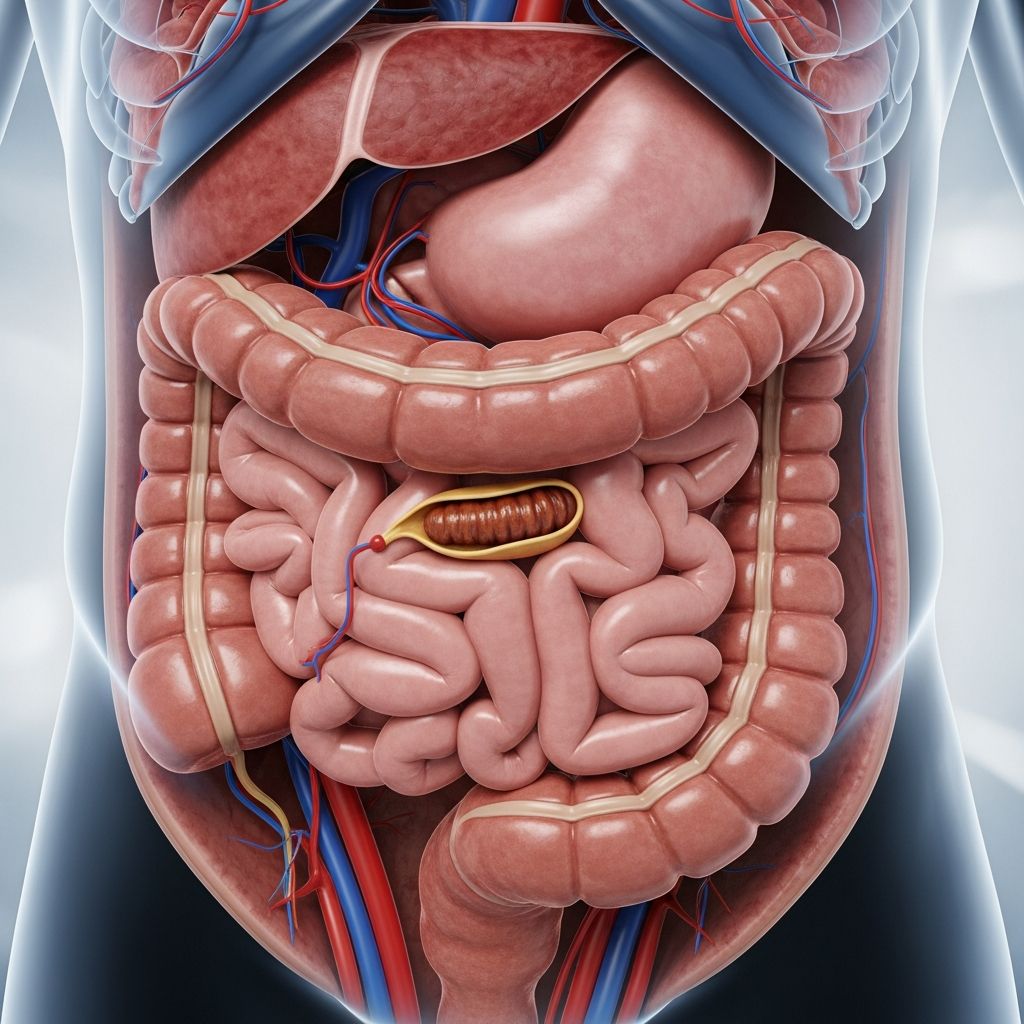
The human appendix, often dismissed as a useless remnant, plays key roles in immune defense and gut microbiome stability. Positioned in the lower right abdomen, this small organ has intrigued scientists for its structure and functions.
Anatomical Position and Basic Features
The appendix extends from the cecum, the pouch-like start of the large intestine, typically 2 cm below the ileocecal valve. This worm-like tube, termed vermiform appendix, averages 9 cm long but varies from 5 to 35 cm, with a diameter of about 6 mm.
Its location aligns with McBurney’s point, a key landmark for diagnosing issues. Variations occur: retrocecal (behind the cecum) in some populations like those in Ghana (67.3%), pelvic in others like Iran (55.8%). Rarely, it’s absent or on the left in situs inversus cases.
- Base: Fixed at the cecum’s posteromedial border.
- Tip: Can point pelvic, retrocecal, subcecal, pre-ileal, or post-ileal.
- Valve: Gerlach’s valve, a mucosal fold at the opening, may prevent reflux.
Detailed Layered Composition
The appendix qualifies as a true diverticulum, featuring all intestinal wall layers: mucosa, submucosa, muscularis propria (longitudinal and circular muscles), and serosa.
| Layer | Description | Key Role |
|---|---|---|
| Mucosa | Innermost lining | Secretes mucus; contains neuroendocrine cells producing hormones. |
| Submucosa | Supports mucosa | Rich in lymphoid tissue with B and T cells for immunity. |
| Muscularis Propria | Muscle layers | Facilitates peristalsis to move contents. |
| Serosa | Outer covering | Protects and anchors the organ. |
This structure distinguishes it from the colon via abundant lymphoid elements.
Developmental Origins
Embryologically, the appendix forms from the midgut’s cecal diverticulum around week 6 of gestation. By week 8, it’s histologically distinct. As the colon elongates and rotates, the appendix descends to the right lower quadrant, developing lymphoid tissue by weeks 14-15.
This timeline underscores its immune priming during early development, when the system is immature.
Vascular and Lymphatic Network
Blood supply comes from the appendicular artery, a terminal branch of the ileocolic artery (from superior mesenteric artery). As an end artery, blockage risks ischemia.
Lymph drains via a single intermediate node to ileocolic then superior mesenteric nodes, supporting immune surveillance.
Evolving Insights into Purpose
Once labeled vestigial due to no immediate effects post-removal, research reveals multifaceted roles. It houses gut-associated lymphoid tissue (GALT), aiding B lymphocyte maturation, IgA production, and T cell responses.
A leading theory posits it as a ‘safe house’ for beneficial bacteria. During diarrhea or antibiotics, it repopulates the gut microbiome, offering evolutionary advantage.
- Immune Hub: Trains cells against pathogens in the bowel.
- Microbiome Reservoir: Stores symbiotic microbes for recolonization.
- Early Defense: Critical in infancy for immune development.
Neuroendocrine cells regulate gut functions via amines and hormones.
Prevalent Health Issues
Appendicitis tops concerns, affecting 7-8% lifetime risk. Obstruction by fecaliths, lymphoid hyperplasia, tumors, or parasites raises intraluminal pressure, compromising venous flow and causing ischemia, bacterial overgrowth, and inflammation.
Untreated, perforation spills bacteria peritoneally, risking peritonitis—a surgical emergency requiring appendectomy.
- Appendicolith: Calcified fecal mass predisposing to obstruction.
- Microbiome Dysbiosis: Imbalanced bacteria sparking inflammation.
- Lymphoid Atrophy: Age-related tissue loss altering function.
Rare but Serious Conditions
Neuroendocrine tumors (carcinoids) arise in 10% at the base, mimicking appendicitis. Distal tip masses (2-3 cm) may secrete serotonin, causing carcinoid syndrome: flushing, diarrhea, wheezing, heart issues.
Appendix cancer or other neoplasms are uncommon but demand vigilance.
Surgical Interventions and Outcomes
Appendectomy, laparoscopic or open, resolves acute cases. Post-removal, most thrive without microbiome or immunity deficits, thanks to redundant gut systems. However, retaining it preserves potential benefits.
Antibiotic therapy succeeds in select non-perforated cases, avoiding surgery.
Global Variations and Epidemiology
Appendicitis peaks in teens/young adults, with dietary (low-fiber), genetic, and hygiene factors implicated. Incidence varies: higher in developed nations possibly from cleaner guts fostering hyperplasia.
| Position | Prevalence Example |
|---|---|
| Retrocecal | 67.3% Ghana, 58.3% Sudan |
| Pelvic | 55.8% Iran, 57.7% Bosnia |
| Other | Subcecal, post-ileal (variable) |
Modern Research Directions
Ongoing studies probe microbiome-immune links. The appendix’s role in innate lymphoid cells and pathogen regulation hints at broader digestive health impacts.
Evolutionary analyses across mammals affirm its persistence for adaptive value, not obsolescence.
Frequently Asked Questions
Is the appendix truly vestigial?
No, evidence shows it supports immunity and gut flora reservoir functions.
What causes appendicitis?
Typically obstruction leading to pressure, ischemia, and infection.
Can you live normally without an appendix?
Yes, most do; recovery is swift post-appendectomy.
Does diet influence appendix health?
Low-fiber diets may raise appendicitis risk via fecaliths.
How is appendicitis diagnosed?
Via pain at McBurney’s point, imaging (CT/ultrasound), blood tests.
Preventive Measures and Awareness
High-fiber diets, hydration, and prompt abdominal pain evaluation aid prevention. Recognizing right lower quadrant pain, nausea, fever as red flags is crucial.
This organ, small yet significant, exemplifies evolving biological understanding.
References
- Appendix: What Side It’s Located On & Function — Cleveland Clinic. 2023-10-20. https://my.clevelandclinic.org/health/body/appendix
- Anatomy, Abdomen and Pelvis: Appendix — StatPearls, NCBI Bookshelf, NIH. 2023-07-24. https://www.ncbi.nlm.nih.gov/books/NBK459205/
- Appendix (anatomy) — Wikipedia. 2026-04-01. https://en.wikipedia.org/wiki/Appendix_(anatomy)
- What is the Appendix? — News-Medical.net. 2023-01-15. https://www.news-medical.net/health/What-is-the-Appendix.aspx
- The Amazing Appendix: An Anatomical Mystery — Visible Body. 2022-05-10. https://www.visiblebody.com/blog/the-amazing-appendix-an-anatomical-mystery
- Evolution of the Appendix: A Biological ‘Remnant’ No More — Duke Health. 2017-02-09. https://corporate.dukehealth.org/news/evolution-appendix-biological-remnant-no-more

Medha Deb is an editor with a master's degree in Applied Linguistics from the University of Hyderabad. She believes that her qualification has helped her develop a deep understanding of language and its application in various contexts. Medha specializes in the areas of beauty, health, sports, and wellness and is committed to ensuring that the content on the website is…