
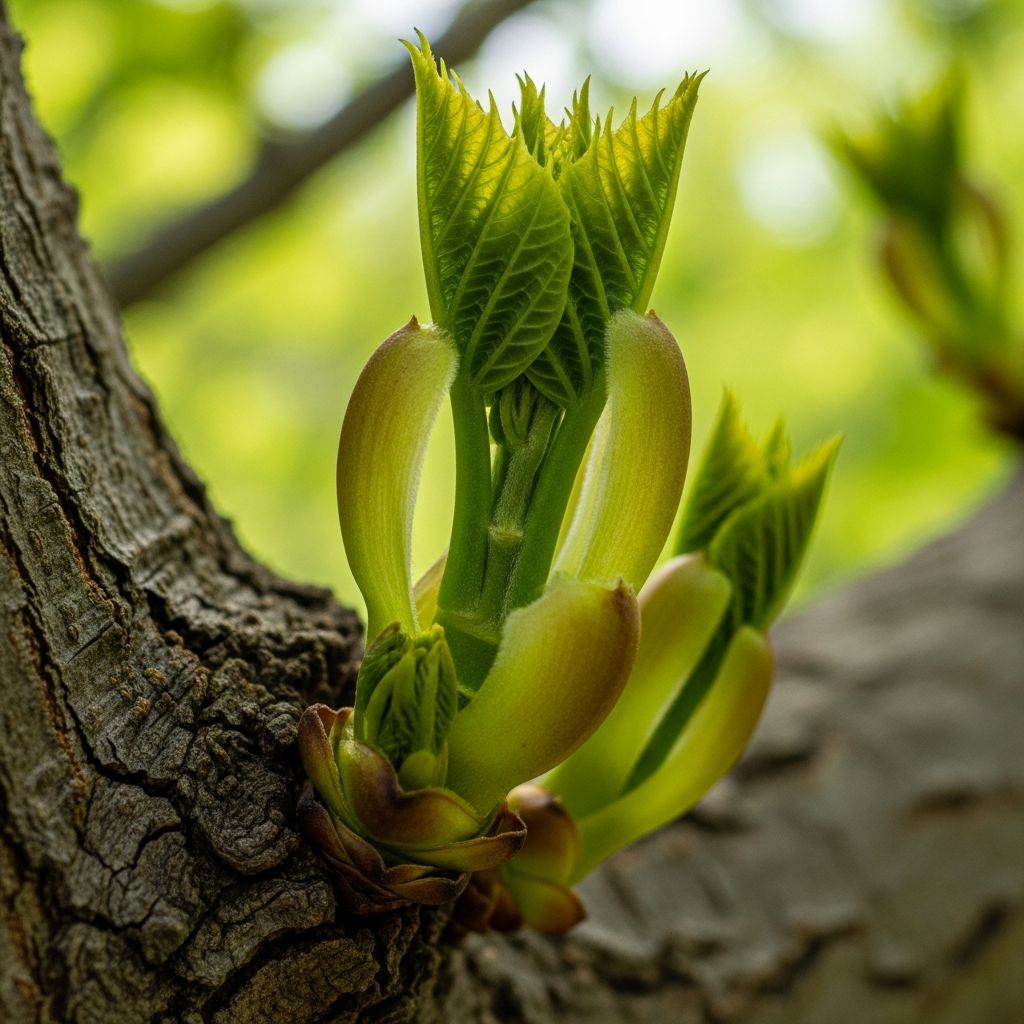
Trees transform sunlight, water, and soil nutrients into towering structures through specialized regions called meristems, which orchestrate both height increases and girth expansion. This article examines the biological engines powering tree development, from root tips to branch ends, revealing how these processes ensure survival and strength.
Primary Engines of Elongation: Apical Meristems
At the forefront of tree expansion are apical meristems, clusters of undifferentiated cells located at the very tips of roots and shoots. These meristems drive primary growth, elongating stems and roots to reach light and water resources efficiently.
In shoots, apical meristems produce new cells that differentiate into leaves, buds, and stem tissues, pushing the tree upward. Root apical meristems similarly extend the root system downward and outward, enhancing anchorage and nutrient absorption. This longitudinal growth forms the foundational architecture of the tree.
- Apical meristems enable trees to compete for canopy space in dense forests.
- They generate precursor cells for secondary tissues, linking primary and secondary growth phases.
- Environmental cues like daylight length trigger bursts of activity in spring.
Lateral Expansion: The Vascular Cambium’s Role
Beneath the bark lies the vascular cambium, a thin cylindrical layer responsible for secondary growth, which thickens trunks, branches, and roots. This meristem divides to produce xylem inward and phloem outward, adding annual growth rings that record environmental history.
Xylem, the woody core, conducts water and minerals upward while providing mechanical support. Phloem transports sugars from photosynthesis downward to fuel growth and storage. Each year, a new layer forms, with earlywood (light, porous) in wet seasons and latewood (dense) in drier periods.
| Tissue Type | Function | Location | Growth Contribution |
|---|---|---|---|
| Xylem | Water transport, support | Inside cambium | Increases diameter, forms rings |
| Phloem | Sugar distribution | Outside cambium | Renews annually |
| Cambium | Cell division | Between xylem/phloem | Drives thickening |
Apical Dominance: Sculpting Tree Architecture
Apical dominance regulates branch development, where terminal buds inhibit lateral buds via hormones like auxins, promoting a strong central leader. Species with strong dominance, such as conifers, form excurrent shapes—tall, conical structures ideal for wind resistance.
Conversely, weak dominance in maples or oaks leads to decurrent forms with multiple leaders, creating broader crowns but potential structural weaknesses if codominant stems develop narrow angles. Pruning can mimic or enhance natural dominance to foster resilient forms.
Root Systems: Underground Growth Dynamics
Tree roots grow via apical meristems at tips, extending taproots deeply and lateral roots widely for stability and uptake. Mycorrhizal fungi often associate with roots, expanding absorption surfaces in exchange for carbohydrates.
Secondary growth in roots mirrors aboveground processes, with cambium thickening larger roots. Soil oxygen is crucial; compaction or flooding hinders meristem activity, stunting overall tree health.
Seasonal Rhythms and Growth Rings
Tree growth pulses with seasons: spring awakens meristems, summer swells tissues, autumn stores reserves, and winter dormancy protects against cold. Growth rings reflect these cycles—wide in favorable years, narrow in stress.
Fixed-growth species like pines pre-form buds in prior seasons, while free-growth types extend based on current conditions. This adaptability helps trees endure droughts or storms.
Branch Attachments: Engineering Strength
Strong branches arise from wide attachment angles (>45°), forming robust branch collars with interlocking wood grains. Narrow angles (<30°) trap bark, creating failure-prone inclusions.
- Proper pruning targets narrow-angled stems early.
- Branch bark ridges indicate healthy unions.
- Codominant leaders often split in storms due to included bark.
Environmental Influences on Growth
Light, water, nutrients, and temperature modulate meristem activity. Photosynthesis fuels everything, with stomata regulating CO2 intake and transpiration cooling leaves.
Competition, pests, or wounds redirect growth; trees compartmentalize decay via chemical barriers, preserving meristems. Urban trees face compaction and pollution, underscoring the need for informed care.
Practical Applications for Arborists and Homeowners
Understanding growth zones guides pruning: cut outside branch collars to preserve cambium health. Structural pruning during dormancy minimizes stress on meristems.
Select species matching site conditions—strong-dominance types for windy areas, adaptable ones for varied soils. Mulching and watering support root meristems without excess moisture.
Frequently Asked Questions
Where does most tree growth actually happen?
Growth occurs in meristems: apical tips for length, cambium for width. Leaves and fruit expand but aren’t permanent tissue.
How can I tell a tree’s age?
Count annual rings in a cross-section; each ring represents one year’s cambium growth, varying by climate.
Why do some branches break easily?
Narrow attachments with included bark lack strong wood interweaving, weakening under load.
Can pruning affect tree growth patterns?
Yes, reducing apical dominance encourages laterals; target weak attachments to build superior structure.
Do all trees grow the same way?
No, excurrent (conical) vs. decurrent (rounded) forms depend on genetics and dominance strength.
Advanced Insights: Hormonal Regulation
Auxins from apical meristems suppress side buds, while cytokinins promote branching. Gibberellins elongate stems, abscisic acid induces dormancy. These orchestrate synchronized growth across vast canopies.
In tropics, multiple rings form per year; temperate trees align with seasons. Climate change may alter ring patterns, offering dendrochronology insights into past environments.
Tree form evolves over decades: young saplings prioritize height, matures balance crown and roots. Genetic programming sets limits, but site modifies outcomes.
For forestry, selecting meristem-vigorous hybrids boosts yields. Urban forestry emphasizes codominant stem reduction to avert failures.
Roots often mirror crowns in spread, with fine absorptive types dominating uptake. Mycorrhizae can double efficiency, critical in poor soils.
Bark evolves as protection: cork layers seal wounds, preventing pathogen entry to cambium. Secondary phloem sloughs off, renewed yearly.
Wood density rises inward; heartwood clogs vessels for durability, sapwood stays functional. This gradient ensures flexibility at periphery, rigidity centrally.
Storm resilience ties to taper: gradual diameter reduction from trunk to tip via cambium. Hazards like girdling disrupt phloem flow, starving roots.
In restoration, inoculating mycorrhizae aids seedlings. Monitoring growth via dendrometers tracks health non-invasively.
Trees as carbon sinks rely on meristem productivity; expanding forests sequesters more via xylem. Sustainable management preserves these zones.
References
- Tree Growth Explained: The Magic of Meristems — Green Arborists. 2023-05-15. https://greenarborists.com/tree-growth-explained-magic-meristems/
- Understanding Tree Growth Patterns and Structural Pruning — ArborTech NH. 2024-02-10. https://arbortechnh.com/blog/tree-growth-patterns-structural-pruning/
- How Trees Grow — University of Florida IFAS Extension. 2022-11-08. https://hos.ifas.ufl.edu/woody/how-trees-grow.shtml
- Tree Anatomy 101 — Iowa State University Extension. 2023-07-20. https://naturalresources.extension.iastate.edu/forestry/tree_biology/101.html
- How Trees Grow — Texas A&M Forest Service. 2021-09-12. http://texastreeid.tamu.edu/content/howtreesgrow/
- Anatomy of a Tree — Arbor Day Foundation. 2024-01-05. https://www.arborday.org/tree-guide/anatomy-tree

Medha Deb is an editor with a master's degree in Applied Linguistics from the University of Hyderabad. She believes that her qualification has helped her develop a deep understanding of language and its application in various contexts. Medha specializes in the areas of beauty, health, sports, and wellness and is committed to ensuring that the content on the website is…