
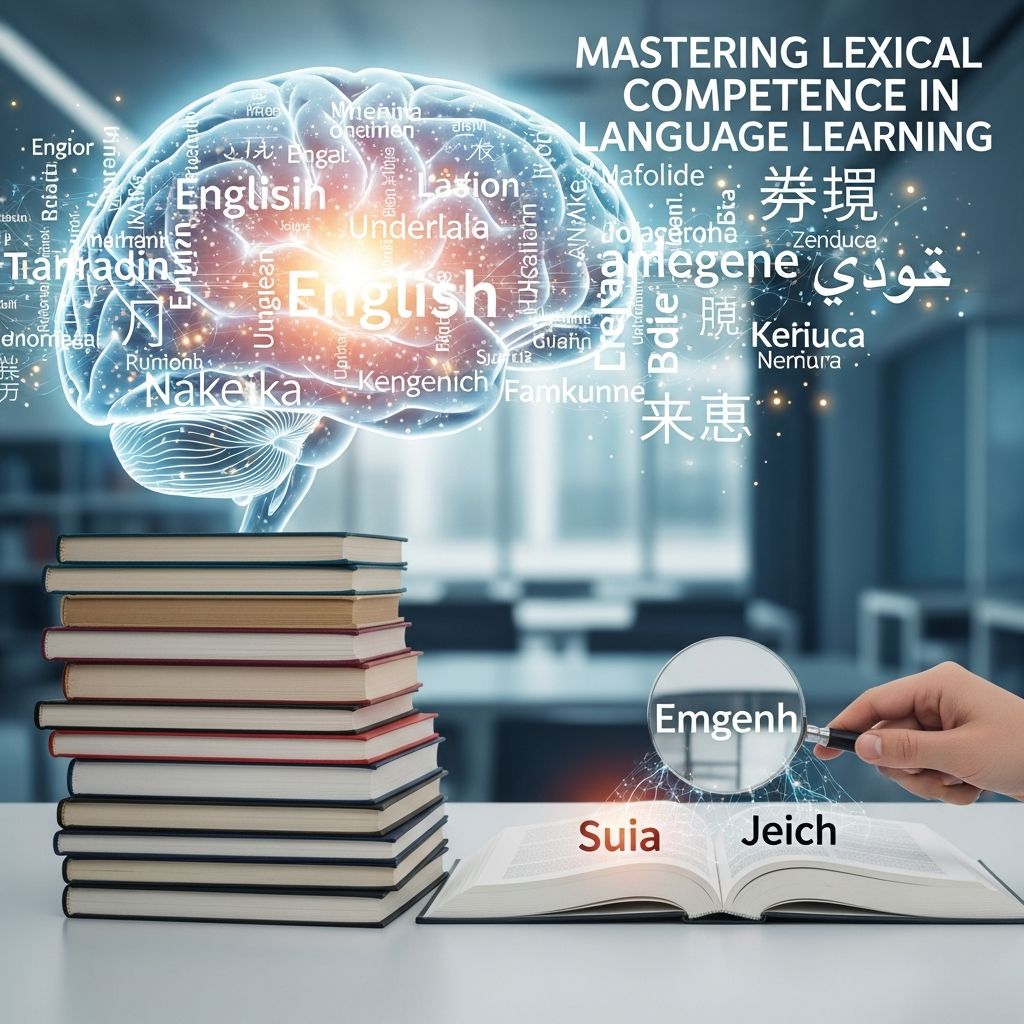
Understanding Lexical Competence: The Foundation of Language Mastery
Language proficiency extends far beyond memorizing isolated vocabulary items. At its core lies lexical competence, a multifaceted linguistic skill that encompasses the knowledge and ability to recognize, understand, and deploy words appropriately across diverse communicative contexts. This fundamental component of language learning determines whether learners can not only recall words but use them with precision, awareness of nuance, and contextual appropriateness.
Lexical competence represents more than simple word recognition; it involves a complex network of interconnected knowledge about how words function within a language system. When speakers possess true lexical competence, they demonstrate an intuitive understanding of word relationships, semantic boundaries, and the subtle distinctions that separate near-synonyms. This sophisticated level of word knowledge develops gradually as learners encounter words repeatedly in varied contexts and build mental representations that capture multiple dimensions of meaning and use.
The Core Dimensions of Word Knowledge
Effective lexical competence rests upon three essential pillars: form, meaning, and use. These dimensions work in concert to create comprehensive word knowledge that supports genuine communicative ability.
Form Recognition and Production
The formal dimension of lexical competence involves recognizing and producing the phonetic and orthographic characteristics of words. Learners must develop the ability to identify words when encountered in listening or reading contexts, then retrieve and articulate them during speaking or writing activities. This goes beyond simple pronunciation or spelling; it requires awareness of word boundaries, stress patterns, morphological variations, and the relationships between related word forms. For instance, understanding the word “create” simultaneously means recognizing its connection to “creation,” “creative,” and “creativity,” and knowing how these forms function grammatically and semantically.
Semantic Depth and Breadth
Meaning constitutes perhaps the most obvious dimension of word knowledge, yet it proves far more intricate than learners initially perceive. True semantic competence involves understanding not only a word’s primary definition but also its secondary meanings, connotations, and associations. Many high-frequency words carry multiple distinct meanings depending on context. The word “run,” for example, functions as a verb with dozens of meanings: to move quickly, to operate a machine, to manage an organization, to be a candidate for office, and many others. Lexically competent speakers navigate this semantic complexity intuitively, selecting the appropriate meaning based on contextual cues.
Contextual and Social Appropriateness
Perhaps the most sophisticated dimension of lexical competence involves understanding when and where specific words belong. This aspect encompasses register awareness—the recognition that certain vocabulary choices suit formal academic contexts while others belong exclusively to casual conversation, technical fields, or specific communities. A lexically competent speaker knows the difference between formal synonyms and understands which words carry emotional weight, which sound dated, and which align with particular regional or cultural variations of the language.
Building Lexical Networks in the Mental Lexicon
Language learners store words not as isolated entries but as interconnected nodes within a vast organizational structure known as the mental lexicon. This mental dictionary functions through associative relationships that link words by meaning, form, function, and context. Strong lexical competence correlates directly with the development of rich, well-organized mental lexicons where words activate multiple connections.
When learners develop lexical competence, they construct what researchers call lexical networks—clusters of related words that activate simultaneously. Encountering the word “ocean” activates associated concepts: water, waves, sailing, deep, blue, vast, and countless other interconnected meanings. These networks facilitate rapid comprehension during listening and reading, and they support more nuanced expression during production tasks. Learners with sophisticated lexical networks can draw upon multiple related words to express subtle distinctions and adapt their vocabulary choices to specific communicative goals.
Distinguishing Between Vocabulary Size and Depth
Researchers distinguish between two measurable aspects of lexical competence: breadth and depth. Understanding this distinction proves essential for language learners seeking to develop genuine proficiency.
Breadth: The Span of Known Words
Lexical breadth refers to the total number of words a learner recognizes and can retrieve. This quantifiable measure determines whether learners possess passive familiarity with a word or active control over its use. Vocabulary size matters considerably for comprehension; learners who recognize more words encounter fewer obstacles when reading or listening. Research suggests that recognition of approximately 8,000-9,000 word families enables comfortable engagement with most everyday English, while academic or specialized contexts may demand 10,000 or more.
Depth: The Quality of Word Knowledge
Lexical depth encompasses the richness and sophistication of understanding for each known word. A learner might recognize 5,000 words yet possess shallow knowledge of each one. Conversely, another learner might recognize only 3,000 words but understand each extensively—knowing multiple meanings, related word forms, collocations, and appropriate contexts for use. Depth of knowledge correlates more strongly with actual communicative ability than simple vocabulary size, particularly for advanced learners and for production tasks requiring precise expression.
The Role of Collocational Competence
Truly lexically competent speakers recognize that words rarely function in isolation. Instead, certain words consistently appear alongside particular companions, creating predictable sequences called collocations. English speakers might say “make a decision” but rarely “do a decision,” and they “break the ice” but never “crack the ice” in this figurative sense.
Collocational competence—the ability to recognize and produce these word partnerships—represents a crucial component of lexical mastery. Native speakers develop an intuitive sense for which words naturally co-occur. When non-native speakers lack this knowledge, their speech and writing sound awkward or unnatural despite using individually appropriate words. Building collocational awareness requires extensive exposure to words in authentic contexts and deliberate attention to word partnerships as learners advance toward higher proficiency levels.
Distinguishing Referential and Inferential Competence
Linguistic researchers recognize that lexical competence actually comprises two distinct but complementary abilities. Referential competence involves the capacity to connect words with their real-world referents—to understand that “apple” refers to a specific type of fruit and to recognize or identify apples when encountered. This bidirectional ability permits both naming (producing the word “apple” in response to seeing the fruit) and application (selecting an apple in response to hearing the word).
Inferential competence operates differently, enabling speakers to draw meaningful inferences from words and derive new information from linguistic relationships. If someone learns that “x is an apple,” they can immediately infer that “x is a fruit” through understanding categorical relationships embedded in the lexicon. This type of competence supports reasoning, problem-solving, and the extension of knowledge to unfamiliar contexts.
Importantly, these two competencies remain partially independent. Neuropsychological evidence demonstrates cases where individuals exhibit one form of competence while lacking the other, suggesting they develop through somewhat distinct cognitive processes and may be damaged independently through brain injury or disease.
The Process of Lexical Acquisition and Development
Lexical competence does not emerge suddenly but develops gradually through repeated encounters with words in meaningful contexts. Initial exposure creates superficial familiarity—learners recognize a word exists and associate it with a general meaning. With subsequent encounters, learners refine their understanding, discovering multiple meanings, learning appropriate contexts, and integrating the word into their mental lexicons.
Researchers conceptualize vocabulary knowledge as existing on a continuum from surface-level recognition to sophisticated, context-sensitive use. Early stages involve encountering the word in isolation or with explicit definitions. Intermediate stages involve understanding the word when encountered in authentic texts and being able to produce it with conscious effort. Advanced stages feature automatic recognition and retrieval, appropriate selection based on communicative context, and the ability to manipulate word forms and meanings flexibly.
This developmental trajectory means that learners should not expect immediate mastery from single exposures. Instead, sustained engagement with words across multiple contexts—reading, listening, conversation, and writing—gradually builds the rich, nuanced understanding that characterizes true lexical competence.
Implications for Language Teaching and Learning
Understanding the multidimensional nature of lexical competence has profound implications for how languages are taught and learned. Rather than treating vocabulary as a peripheral element to be addressed through memorization exercises, educators increasingly recognize lexical competence as a core component deserving explicit attention and strategic development.
Effective vocabulary instruction moves beyond presenting isolated word lists with translations. Instead, it provides learners with opportunities to encounter words in rich contexts, manipulate them in varied communicative situations, and build understanding across all three dimensions: form, meaning, and use. Teaching approaches that integrate vocabulary development with authentic communication, that explicitly highlight word relationships and collocations, and that revisit words across multiple contexts prove substantially more effective than traditional methods.
Assessment of Lexical Competence
Measuring lexical competence presents distinct challenges because it encompasses multiple dimensions that cannot be fully captured through single assessment methods. Vocabulary size tests measure breadth but not depth. Contextual comprehension tasks assess certain aspects of competence but not the ability to produce words appropriately. Authentic communication samples reveal practical competence but prove difficult to quantify reliably.
Comprehensive assessment of lexical competence typically employs multiple measures: recognition tasks that estimate vocabulary breadth, production tasks that reveal active control, collocation exercises that probe word relationship knowledge, and communicative performance samples that demonstrate integrated competence. This multifaceted approach provides more complete understanding of where learners stand in their lexical development and reveals specific areas requiring additional attention.
Strategies for Developing Robust Lexical Competence
Contextual Exposure and Reading
Engaging with authentic texts exposes learners to words in natural contexts where meaning is supported by surrounding information. Wide reading builds vocabulary breadth while authentic contexts support deeper understanding of word use and meaning nuances.
Active Production and Speaking
Using words actively in speaking and writing forces learners to retrieve words from memory and deploy them appropriately, strengthening the memory traces and contextual associations that support competence.
Deliberate Study of Word Relationships
Explicit attention to synonyms, antonyms, word families, and semantic fields helps learners understand how words relate within the language system, building more sophisticated mental lexicons.
Collocation Awareness Training
Learning and practicing common word partnerships helps learners produce language that sounds natural and native-like.
Spaced Repetition and Review
Revisiting words at strategically spaced intervals strengthens memory and moves words from short-term familiarity to long-term secure knowledge.
Frequently Asked Questions
Q: What is the difference between lexical competence and vocabulary?
A: Vocabulary typically refers to lists of words and their meanings, while lexical competence encompasses the sophisticated, multidimensional knowledge and ability to understand and use words appropriately in various contexts, including awareness of meaning, form, use, and word relationships.
Q: How long does it take to develop true lexical competence?
A: Lexical competence develops gradually over years of language exposure and use. Learners may develop surface familiarity with words relatively quickly, but sophisticated competence—characterized by nuanced understanding and flexible use—typically requires sustained engagement across multiple contexts over extended periods.
Q: Can learners have high vocabulary size but low lexical competence?
A: Yes, absolutely. Learners might recognize many words (high breadth) but understand each one superficially, lacking awareness of multiple meanings, appropriate contexts, and word relationships. True lexical competence requires both breadth and depth of knowledge.
Q: How does lexical competence relate to overall language proficiency?
A: Lexical competence forms a foundational component of overall language proficiency. Strong lexical competence enables comprehension of authentic texts, supports more precise and natural-sounding expression, and facilitates successful communication across diverse contexts and situations.
References
- Lexis, Lexical Competence and Lexical Knowledge: A Review — Academy Publication. 2014. https://www.academypublication.com/issues2/jltr/vol08/02/01.pdf
- Lexical Competence: The Referential and Inferential Distinction — Philosophy of Brains Blog. 2006. https://philosophyofbrains.com/2006/11/13/lexical-competence.aspx
- Lexical Competence Underlying Second Language Word Association Tasks — Cambridge University Press. 2021. https://www.cambridge.org/core/journals/studies-in-second-language-acquisition/article/lexical-competence-underlying-second-language-word-association-tasks/7A66C5F0E6A256D166F3A6E1551C990D
- Competence and Lexical Competence — Scribd. https://www.scribd.com/document/372330729/Competnce-and-Lexical-Competence
- Lexical Competence and Lexical Proficiency: Defining and Assessing — Taylor & Francis. https://www.taylorfrancis.com/chapters/lexical-competence-lexical-proficiency-agnieszka-le%C5%84ko-szyma%C5%84ska/10.4324/9780429321993-2
- Lexical Competence as a Necessary Basis for Foreign Language Learning — Zenodo. https://zenodo.org/records/14204276/files/179.%20Article.pdf

- Integrated M.A. in Applied Linguistics, University of Hyderabad
- 5+ years in editorial, instructional, SEO, and research-based writing
Sneha is a relationships and lifestyle writer with a strong foundation in applied linguistics and certified training in relationship coaching. She brings over five years of writing experience to theskillvault, crafting thoughtful, research-driven content that empowers readers to build healthier relationships, boost emotional well-being, and embrace holistic living. Her writing and insights reflect the belief that beauty, happiness, and wellness…