
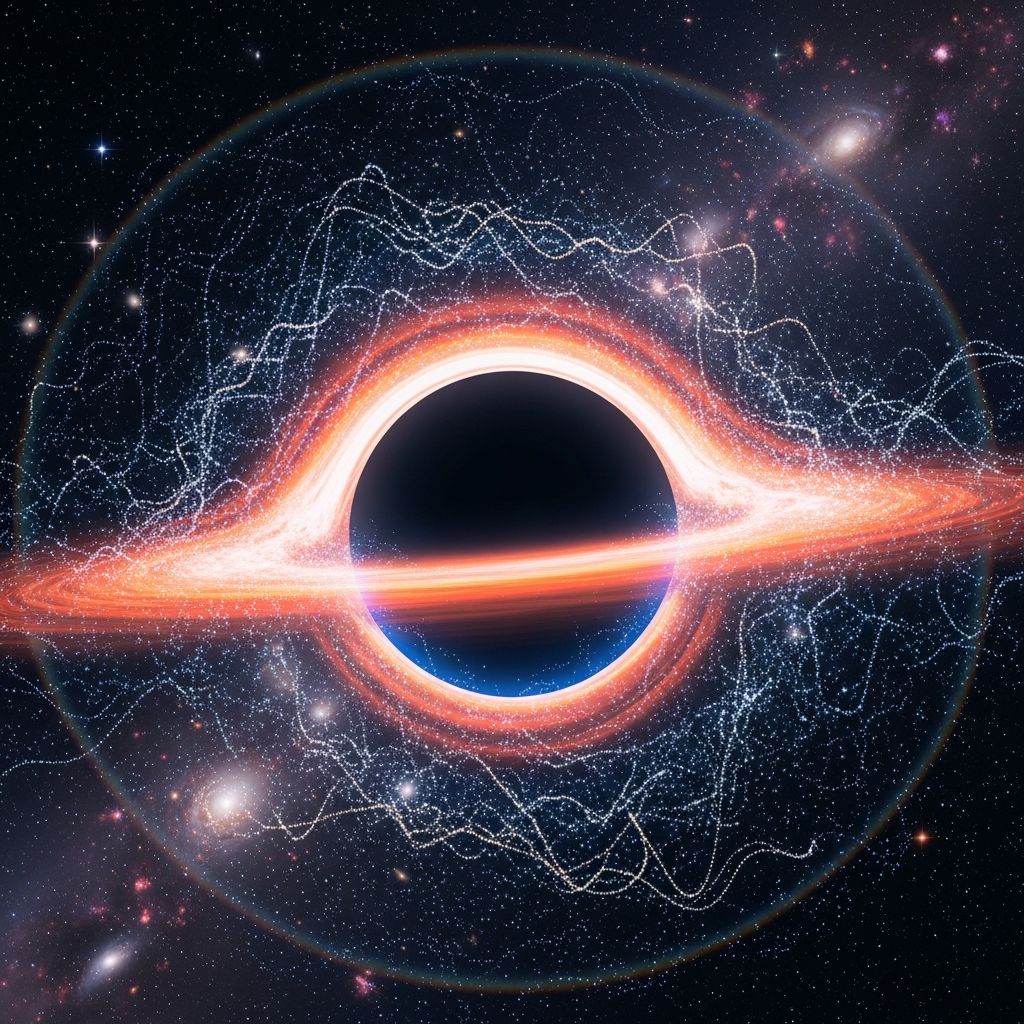
Black holes, once thought to be inescapable voids that grow indefinitely, reveal a surprising quantum secret: they emit radiation and can slowly evaporate. This phenomenon, known as Hawking radiation, bridges general relativity and quantum mechanics, suggesting black holes have a finite lifespan.
Origins in Quantum Field Theory
Hawking radiation emerges from applying quantum field theory in the intense gravitational field near a black hole’s event horizon. In flat space, virtual particle-antiparticle pairs briefly pop into existence due to the Heisenberg uncertainty principle before annihilating. Near the curved spacetime of a black hole, this process alters dramatically.
Stephen Hawking’s 1974 breakthrough calculated the vacuum energy differences between flat space far from the black hole and the highly curved region nearby. This mismatch results in real particles escaping to infinity, observed as thermal black-body radiation.
Virtual Particles and the Event Horizon
The popular analogy involves particle pairs forming just outside the event horizon—the point of no return. If one particle falls in while the other escapes, the escaping one becomes real radiation, and the infalling one carries negative energy, reducing the black hole’s mass.
However, this picture oversimplifies. Radiation actually originates from a volume spanning about 10-20 Schwarzschild radii around the horizon, where spacetime curvature significantly deviates from flatness. It’s not emitted precisely at the horizon but from this extended region, tapering off with distance.
- Key Insight: Hawking radiation consists mostly of photons, not equal particle-antiparticle mixes, due to quantum field calculations.
- Unruh Effect Connection: An accelerating observer near the horizon perceives a thermal bath of particles, linking local acceleration to global radiation via the equivalence principle.
The Mathematical Foundation
The temperature of Hawking radiation, dubbed the Hawking temperature, is given by the formula:
\[ T = \frac{\hbar c^3}{8\pi G M k_B} \]
where \( \hbar \) is the reduced Planck constant, \( c \) is the speed of light, \( G \) is the gravitational constant, \( M \) is the black hole mass, and \( k_B \) is Boltzmann’s constant.
This inverse mass dependence means smaller black holes are hotter and radiate more intensely. For a solar-mass black hole, \( T \) is about 60 nanokelvin—colder than the cosmic microwave background (2.7 K), so it absorbs more than it emits.

Medha Deb is an editor with a master's degree in Applied Linguistics from the University of Hyderabad. She believes that her qualification has helped her develop a deep understanding of language and its application in various contexts. Medha specializes in the areas of beauty, health, sports, and wellness and is committed to ensuring that the content on the website is…