
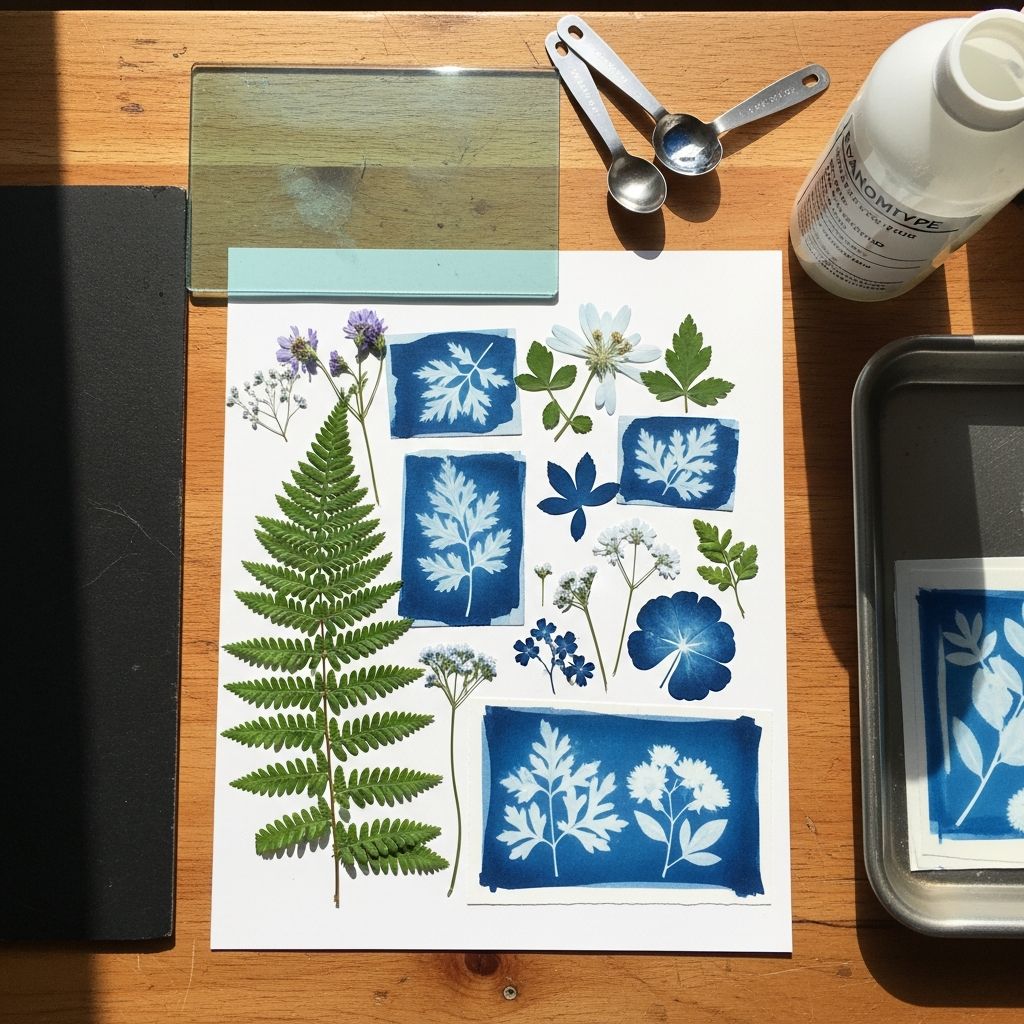
Creating your own cyanotype prints, often known as blueprints, is an accessible way to delve into photochemistry using everyday materials and sunlight. This process, which produces vivid blue images on paper, relies on light-sensitive chemicals that react under ultraviolet exposure to form insoluble Prussian blue. Ideal for artists, educators, and hobbyists, it offers a tangible connection to 19th-century photography techniques while requiring minimal equipment.
Understanding the Science of Cyanotypes
The cyanotype method harnesses a photochemical reaction between two iron compounds: ammonium iron(III) citrate and potassium ferricyanide. In darkness, these remain stable, but UV light reduces the iron(III) to iron(II), which then complexes with ferricyanide to precipitate Prussian blue—a durable pigment. This negative-positive process yields white lines on a blue field, mimicking traditional blueprints used in engineering.
John Herschel pioneered this in 1842 for copying documents, predating modern photography. Today, it’s valued for its simplicity and eco-friendliness, as the chemicals are low-toxicity and water-soluble. Key factors include paper absorbency, UV intensity, and exposure duration, all influencing print quality.
Gathering Materials for Success
To start, assemble these essentials:
- Plain watercolor or cotton rag paper (A4 or 8.5×11 inches; avoid glossy types)
- Cyanotype kit (Part A: potassium ferricyanide; Part B: ammonium iron(III) citrate)
- Measuring tools: pipettes, graduated cylinders, or syringes (5-10ml each)
- Brushes, gloves, goggles, and trays for safe handling
- Transparency film or tracing paper for negatives
- UV source: sunlight or 5000-lumen LED lamp
- Distilled water, hydrogen peroxide (for development), plexiglass or glass sheet
Procure chemicals from educational suppliers; they’re irritants, so prioritize safety. Total cost for a starter kit supports dozens of prints.
Preparing Light-Sensitive Paper
Work in a dim room to prevent premature exposure. Cover surfaces with newspaper and paper towels.
- Mix equal parts (e.g., 5ml) of Solutions A and B in a dark container; stir gently.
- Brush the mixture evenly onto paper, coating all edges; excess drips off naturally.
- Dry flat under red safelight or in complete darkness for 1-2 hours.
Coated sheets store in black envelopes for weeks. Uniform application ensures even sensitivity.
Designing Your Negative Image
Select high-contrast, black-and-white graphics: line art, logos, or photograms (objects like leaves). Print on transparency film using a laser printer for opacity; ink blocks UV, preserving white areas.
- Best practices: High resolution (300 DPI+), solid blacks, minimal grays.
- Alternatives: Hand-draw on tracing paper or arrange physical objects directly.
For photograms, dampen objects slightly to prevent shifting during exposure.
Exposure Techniques and Timing
Layer the negative atop sensitized paper, secure with plexiglass to eliminate gaps. Expose outdoors on a sunny day or under artificial UV for 1-5 minutes (sun) or 1.5 hours (LED).
| Light Source | Distance | Time | Notes |
|---|---|---|---|
| Sunlight | Direct | 1-5 min | Clouds extend time; test strips advised |
| LED (5000 lumens) | 15 inches | 60-90 min | Consistent; adjustable |
| UV Lamp | 6-12 inches | 2-10 min | Short-wave preferred |
Overexposure deepens blue; underexposure leaves gray haze. Monitor with test strips.
Developing and Fixing the Print
Submerge in distilled water for 5 minutes to dissolve unexposed salts, revealing the image. Add 1-2% hydrogen peroxide to accelerate blue formation—agitate gently.
- Rinse twice in fresh water (5 min each) to halt reaction.
- Optional: Sodium carbonate bath clears yellow tones.
- Air-dry flat or hang; full color stabilizes in days.
Result: Archival prints resistant to further light changes.
Troubleshooting Common Issues
Encounter problems? Consult this guide:
- Uneven blue: Poor coating; re-brush uniformly.
- Faint lines: Insufficient exposure or transparent negative; increase time or ink density.
- Yellow residue: Inadequate rinse; extend washing to 10+ minutes.
- Paper curling: Dry under weight; use heavyweight stock.
Safety note: Dispose of solutions per local regulations; neutralize with bleach if needed.
Advanced Variations and Projects
Elevate basics with these ideas:
- Fabric cyanotypes: Treat silk or cotton for scarves; pre-wash fabrics.
- Toned prints: Soak in tannic acid (tea) for purple-brown hues post-development.
- Large-scale: Scale up to posters using contact frames and projectors.
- Photograms: Layer ferns, lace for abstract art.
Experiment with exposure gradients for painterly effects.
Historical Impact and Modern Uses
Cyanotypes revolutionized document reproduction in architecture and botany (e.g., Anna Atkins’ algae books). Today, artists like Binh Danh embed prints in resin, while educators teach photochemistry. Digital negatives expand possibilities via inkjet printing.
Frequently Asked Questions (FAQs)
What safety precautions are essential for cyanotypes?
Wear gloves and goggles; work in dim light. Chemicals irritate skin—rinse spills immediately.
Can I use regular printer paper?
No; it absorbs unevenly. Opt for matte art paper.
How long do prints last?
Indefinitely if fixed properly; Prussian blue is lightfast.
Alternatives to sunlight?
UVB lamps or high-lumen LEDs work indoors reliably.
Is this kid-friendly?
Supervised teens yes; adult handling of chemicals required.
Scaling Up: Classroom or Workshop Tips
For groups, pre-coat sheets and batch-expose. Use trays for communal rinsing. Track variables in logs to teach scientific method. Budget: $0.50/print at scale.
Integrate with biology (plant shadows) or history (Herschel’s legacy). Digital tools like GIMP create custom negatives.
References
- How to Make Real Blueprints: 7 Steps (with Pictures) — Instructables. 2018-05-15. https://www.instructables.com/How-to-Make-Real-Blueprints/
- Making and using blueprint paper — Royal Society of Chemistry Education. 2023-01-10. https://edu.rsc.org/resources/making-and-using-blueprint-paper/1591.article
- Blueprints and Cyanotypes at Home! — Herreshoff Marine Museum. 2020-07-20. https://herreshoff.org/2020/07/blueprints-and-cyanotypes-at-home/

- Integrated M.A. in Applied Linguistics, University of Hyderabad
- 5+ years in editorial, instructional, SEO, and research-based writing
Sneha is a relationships and lifestyle writer with a strong foundation in applied linguistics and certified training in relationship coaching. She brings over five years of writing experience to theskillvault, crafting thoughtful, research-driven content that empowers readers to build healthier relationships, boost emotional well-being, and embrace holistic living. Her writing and insights reflect the belief that beauty, happiness, and wellness…