
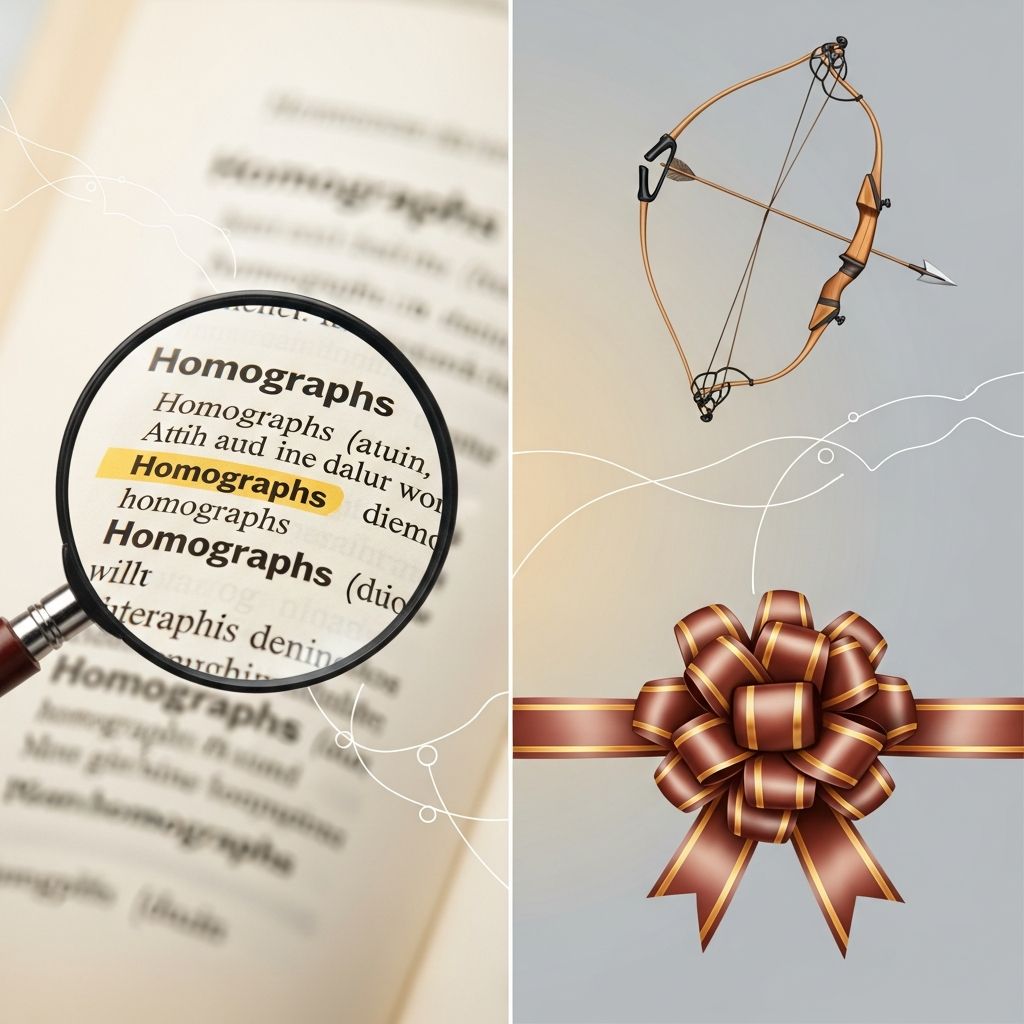
Homographs represent one of the most intriguing aspects of the English language, where identical spellings conceal entirely different concepts. These versatile words demand careful attention to context, pronunciation, and usage to avoid confusion in communication. This comprehensive guide delves deep into their nature, providing definitions, classifications, abundant examples, and strategies for effective application in everyday language, writing, and creative expression.
Defining Homographs in Modern Linguistics
In linguistic terms, a homograph is a word that shares its spelling with another but diverges in meaning, and often in pronunciation or etymological roots. Derived from Greek roots meaning ‘same writing,’ homographs highlight how English borrows from multiple sources, creating layers of ambiguity that enrich expression but challenge learners.
Unlike homophones, which sound alike but differ in spelling—like ‘pair’ and ‘pear’—homographs focus solely on visual similarity. This distinction is crucial for precise language use. For instance, authoritative dictionaries such as Merriam-Webster define them as words ‘spelled alike but different in meaning or derivation or pronunciation,’ exemplified by ‘bow’ as in a ship’s front or a weapon.
Homographs fall under the broader category of homonyms, which encompass both same-spelling (homographs) and same-sounding (homophones) words with distinct meanings. Grammar experts emphasize that context is king when disambiguating them, as sentence structure and surrounding words provide the necessary clues.
Key Characteristics That Set Homographs Apart
- Identical Spelling: The core trait; both words appear exactly the same on the page.
- Differing Meanings: Each carries unique definitions, often from separate origins.
- Variable Pronunciation: Not always present, but common in heteronyms—a subset where sounds differ markedly.
- Context Dependency: Meaning emerges only within a sentence or phrase.
- Part-of-Speech Flexibility: Many switch between noun, verb, adjective, etc.
These features make homographs powerful tools for puns, poetry, and rhetoric, yet pitfalls for non-native speakers and hasty writers.
Heteronyms: The Pronunciation Puzzle Within Homographs
A fascinating subcategory, heteronyms are homographs pronounced differently based on meaning. The Oxford lexicographical tradition classifies them distinctly to aid clarity in dictionaries. Pronunciation shifts often align with stress patterns: first-syllable emphasis for nouns, second for verbs.
| Word | Pronunciation 1 (Meaning) | Pronunciation 2 (Meaning) | Example Sentence 1 | Example Sentence 2 |
|---|---|---|---|---|
| Lead | /liːd/ (to guide) | /lɛd/ (metal) | She will lead the team to victory. | Pipes were once made of lead. |
| Tear | /tɪər/ (rip) | /tɛər/ (eye drop) | Don’t tear the paper. | A tear rolled down her cheek. |
| Wind | /wɪnd/ (air current) | /waɪnd/ (to twist) | The wind blew fiercely. | Wind the clock carefully. |
| Bow | /baʊ/ (weapon/ribbon) | /boʊ/ (bend forward) | He tied a bow on the gift. | Take a bow after the show. |
| Row | /roʊ/ (paddle) | /raʊ/ (quarrel) | They row across the lake. | They had a loud row. |
This table illustrates how subtle sound changes transform meaning, a phenomenon rooted in English’s evolution from Old English, Latin, and other influences.
Homographs with Identical Pronunciations
Not all homographs alter pronunciation; some are pronounced uniformly despite divergent meanings. These are simpler yet still require contextual discernment.
- Bark: Tree covering (/bɑːrk/) or dog’s sound (/bɑːrk/).
- Rose: Flower (/roʊz/) or past tense of rise (/roʊz/).
- Band: Musical group (/bænd/) or strip of material (/bænd/).
- Object: Thing (/ˈɒbdʒɪkt/) or to protest (/əbˈdʒɛkt/)—note slight stress shift.
Such words demonstrate English’s polysemy, where one form accrues multiple senses over time.
Comprehensive List of 30 Common Homographs
To build mastery, familiarize yourself with these frequently encountered examples, grouped by theme for easier recall:
Nature and Actions
- Bark (tree skin / dog sound)
- Wave (ocean motion / hand gesture)
- Rock (stone / to sway)
- Fair (just / carnival)
Objects and Verbs
- Book (volume / to reserve)
- Can (container / able to)
- Park (green space / to stop vehicle)
- Match (game / fire starter)
Body and Measurements
- Arm (limb / weapon branch)
- Minute (tiny / 60 seconds)
- Polish (from Poland / shine)
- Close (near / to shut)
Abstract and Concrete
- Content (happy / material inside)
- Desert (arid land / abandon)
- Produce (farm goods / to make)
- Refuse (garbage / to decline)
Expanding to 30, including bass (fish/instrument), conduct (behavior/lead), and entrance (door/delight), equips writers with versatile vocabulary.
Historical Evolution of Homographs
English homographs arose from its hybrid history: Anglo-Saxon base merged with Norman French, Latin, and Greek post-1066 Conquest. Words like ‘bow’ trace to Old English ‘boga’ (arch) and ‘būgan’ (bend), converging in spelling over centuries. Chaucer’s era saw early polysemous forms, proliferating in Shakespearean puns—’will’ as desire, document, and verb.
Modern dictionaries, per Merriam-Webster, catalog thousands, reflecting ongoing semantic drift. Digital corpora from universities like Oxford confirm their density in idioms and literature.
Practical Strategies for Using Homographs Effectively
Mastery involves these techniques:
- Contextual Clues: Analyze surrounding words; verbs often follow subjects, nouns precede articles.
- Part-of-Speech Identification: Nouns typically stressed first; verbs second.
- Reading Aloud: Pronunciation aids disambiguation.
- Dictionary Reliance: Check entries for numbered senses.
- Writing Practice: Compose sentences toggling meanings.
In professional writing, precision prevents misreads; tools like Grammarly flag potential ambiguities.
Homographs in Literature, Puns, and Poetry
Authors exploit homographs for wit: Lewis Carroll’s ‘Alice’ riddles with ‘wave’ dualities. Puns like ‘Time flies like an arrow; fruit flies like a banana’ leverage them. Poetry gains rhythm—Emily Dickinson’s ‘row’ evokes boating strife.
Journalism and ads thrive on them: ‘Polish your skills’ (shine/from Poland). Understanding elevates appreciation of wordplay.
Common Pitfalls and How to Avoid Them
ESL learners stumble on heteronyms; natives overlook in haste. Pitfalls include:
- Mispronouncing ‘read’ (present / past).
- Confusing ‘record’ (noun/verb).
- Ambiguous sentences without modifiers.
Avoid by proofreading aloud and using unambiguous synonyms when clarity trumps style.
Frequently Asked Questions About Homographs
What distinguishes homographs from homophones?
Homographs share spelling but not necessarily sound; homophones share sound but not spelling.
Are all heteronyms homographs?
Yes, but not vice versa—heteronyms specifically differ in pronunciation.
How many homographs exist in English?
Thousands, per dictionaries; exact count varies by definition.
Why do homographs confuse spell-checkers?
They rely on context, which software often misses.
Can homographs be proper nouns?
Rarely; they typically apply to common words.
Exercises to Sharpen Your Homograph Skills
Test knowledge:
- Fill blanks: The _____ (wind) blew hard; please _____ (wind) the toy.
- Identify: ‘Bass’ as fish or low sound?
- Create puns using three homographs.
Solutions: 1. wind/wind; 2. Context-dependent.
Regular practice cements fluency, transforming confusion into command.
References
- What Is a Homograph? Definition and Examples — Grammarly. 2023-10-15. https://www.grammarly.com/blog/grammar/homograph/
- Examples of Homographs — BYJU’S. 2024-01-20. https://byjus.com/english/homographs/
- Homographs in English: Meaning, Definition, List & Examples — CuriousJR. 2023-05-12. https://www.curiousjr.com/blogs/homographs-in-english
- What is a Homograph? Examples, Definition and Uses — Twinkl. 2024-02-28. https://www.twinkl.com/teaching-wiki/homograph
- List of English homographs — Wikipedia (informed by primary linguistic sources). 2026-03-10. https://en.wikipedia.org/wiki/List_of_English_homographs
- HOMOGRAPH Definition & Meaning — Merriam-Webster. 2026-04-01. https://www.merriam-webster.com/dictionary/homograph
- 30 Homographs Examples for Writers — Writer’s Digest. 2023-11-05. https://www.writersdigest.com/write-better-fiction/homographs-examples-for-writers

Medha Deb is an editor with a master's degree in Applied Linguistics from the University of Hyderabad. She believes that her qualification has helped her develop a deep understanding of language and its application in various contexts. Medha specializes in the areas of beauty, health, sports, and wellness and is committed to ensuring that the content on the website is…