
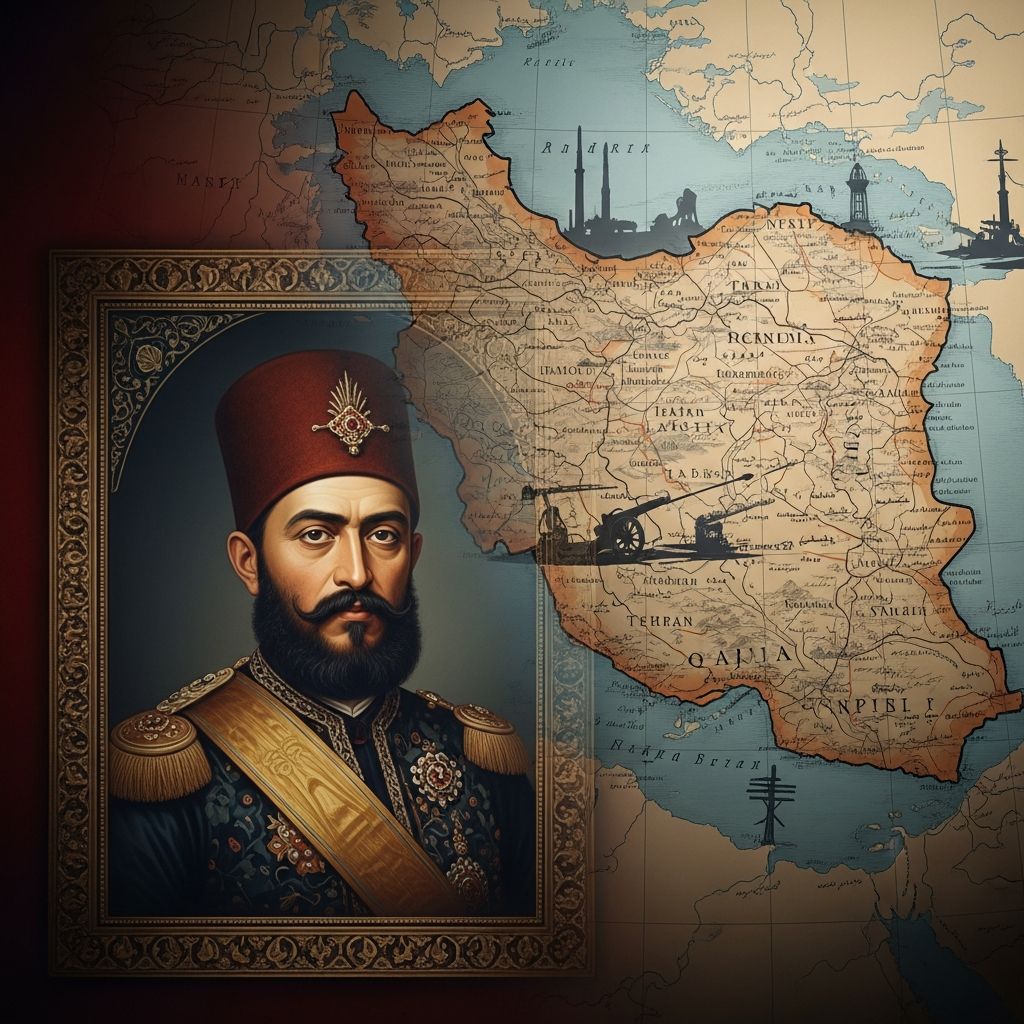
The Qajar Dynasty governed Iran from 1789 to 1925, a period defined by the reconsolidation of a fragmented nation, relentless foreign encroachments, and the stirrings of modern reform movements. Emerging from the chaos after the Zand dynasty’s collapse, the Qajars navigated internal rivalries and external threats from expanding Russian and British empires, ultimately shaping Iran’s path toward constitutional governance and the 20th-century monarchy.
Origins and the Ruthless Unification of Iran
In the late 18th century, Iran lay in disarray following the fall of the Safavids and the short-lived Zand rule. Agha Mohammad Khan Qajar, leader of the Turkic Qajar tribe, seized the moment after Karim Khan Zand’s death in 1779. Through a campaign of calculated brutality, he eliminated rivals from the Zand and Afsharid lines, sacking cities and executing opponents. Notably, in Kerman, he ordered the blinding of 20,000 defenders as punishment for resistance, cementing his fearsome reputation.
By 1794, Agha Mohammad had crushed all major competitors, including Lotf Ali Khan, the last Zand ruler. He reasserted control over the Caucasus, Georgia, and Turkmenistan, moving the capital to Tehran for its strategic central location near ancient Ray. Crowned Shah in 1796, his reign lasted only a year before assassination, but it laid the foundation for Qajar dominance.
Rulers and Key Reigns: A Timeline of Power
The Qajar rulers varied in competence and legacy, facing escalating challenges. Here’s a table summarizing the main shahs:
| Shah | Reign | Key Events |
|---|---|---|
| Agha Mohammad Khan | 1789–1797 | Unification of Iran; capital to Tehran; Caucasus campaigns. |
| Fath-Ali Shah | 1797–1834 | Russo-Persian Wars; Treaty of Gulistan (1813); territorial losses. |
| Mohammad Shah | 1834–1848 | Herat campaigns; British intervention; internal reforms attempted. |
| Naser al-Din Shah | 1848–1896 | Longest reign; European travels; concessions to foreigners; assassination. |
| Mozaffar ad-Din Shah | 1896–1907 | |
| Mohammad Ali Shah | 1907–1909 | Bombed Majles; civil war; deposed. |
| Ahmad Shah | 1909–1925 | Child ruler; foreign occupations; coup by Reza Khan. |
Wars, Territorial Losses, and the Great Game
Fath-Ali Shah’s era saw the first major clashes with Russia. The Russo-Persian Wars (1804–1813 and 1826–1828) resulted in humiliating defeats. The Treaty of Gulistan (1813) ceded Georgia, Dagestan, and most of Azerbaijan, while the Treaty of Turkmenchay (1828) added Armenia and more territories, imposing heavy indemnities.
Conflicts with Britain arose over Afghanistan and Herat. British forces intervened in 1856, forcing retreat and highlighting Iran’s military obsolescence. The 19th century’s ‘Great Game’ saw Russia and Britain vie for influence, culminating in the 1907 Anglo-Russian Convention partitioning Iran into spheres: Russian north, British south, neutral center. This undermined sovereignty without direct conquest.
- Russo-Persian Wars: Loss of Caucasus regions, weakening northern borders.
- Anglo-Persian Tensions: Herat War (1856); tobacco and tariff concessions to Britain.
- Central Asia: Russia annexed Turkmen lands by late 1800s.
These losses reduced Iran’s territory by over 300,000 square miles, fueling resentment and reform calls.
Cultural Flourishing and Modernization Efforts
Amid decline, the Qajars fostered a cultural renaissance. Naser al-Din Shah (r. 1848–1896), the longest-reigning monarch, traveled to Europe thrice, introducing photography, telegraphy, and printing presses. Tehran saw new palaces, mosques, and Dar ul-Funun (Polytechnic Institute, 1851), Iran’s first modern school blending European curricula with Persian studies.
Art thrived with Qajar painting featuring vivid portraits, lacquerware, and tilework depicting court life, hunts, and fantasies. Literature evolved with newspapers like Vaghayeh Ettefaghieh (1851), sparking public discourse. Women of the harem wielded influence, though veiling persisted; royal consorts like Taj ol-Molouk shaped policy indirectly.
However, modernization was uneven. Concessions like the 1872 Reuter loan for railways (revoked under protest) and 1890 tobacco monopoly (canceled after boycott) exposed corruption and foreign exploitation.
The Constitutional Revolution: Dawn of Modern Iran
By Mozaffar ad-Din Shah’s time (1896–1907), debt from loans crippled the treasury. Protests erupted over the 1903 loan from Russia. In 1905–1906, merchants, clerics, and intellectuals demanded a Majles (parliament) and constitution, inspired by European models and Ottoman reforms.
The 1906 Constitution limited monarchical power, established a National Consultative Assembly, and enshrined rights like free speech. Mohammad Ali Shah (r. 1907–1909), opposing it, bombarded the Majles in 1908, igniting civil war. Constitutionalists, aided by tribal forces, deposed him, enthroning 12-year-old Ahmad Shah.
World War I exacerbated chaos: Russian, British, and Ottoman occupations fragmented Iran, despite neutrality. Famine killed millions; ethnic massacres occurred under Ottoman incursions.
Decline, Foreign Domination, and Overthrow
Ahmad Shah’s reign (1909–1925) saw paralysis. The 1919 Anglo-Persian Agreement aimed at British protectorate status but failed amid protests. Reza Khan, a Cossack Brigade officer, staged a 1921 coup, becoming prime minister then shah in 1925, founding the Pahlavi dynasty.
The Qajars’ fall stemmed from military weakness, economic woes, and failure to adapt. Yet, they preserved Iran’s independence, albeit tenuously, and ignited nationalist sentiments.
Daily Life, Society, and Economy Under Qajar Rule
Society retained feudal structures: shah at apex, landowners (chulovners), clerics, merchants (bazaaris), artisans, nomads, and peasants. Tehran grew from village to 200,000-population hub by 1900, with avenues, trams, and gas lamps.
Economy relied on agriculture (carpets, silk, opium), handicrafts. Qanat irrigation sustained arid lands. Trade caravans linked to India, Russia via Silk Road remnants. Currency woes and capitulations (extraterritorial rights for foreigners) hampered growth.
Religion intertwined with politics; Shi’a ulama wielded power, allying with constitutionalists against absolutism. Ethnic diversity—Tajiks, Azeris, Kurds, Lurs—challenged unity, but Persian language unified elites.
Legacy: Foundations of Contemporary Iran
The Qajars bridged medieval and modern Iran, losing territory but fostering identity. Their rule saw oil discovery (1908, Masjed Soleyman), presaging wealth and geopolitics. The Constitutional Revolution birthed Iran’s democracy experiment, influencing the 1979 Revolution.
Critics decry territorial concessions and repression; admirers note cultural patronage and survival against empires. Qajar art adorns museums worldwide, symbols like the Lion and Sun endured.
Frequently Asked Questions (FAQs)
What marked the start of the Qajar Dynasty?
Agha Mohammad Khan unified Iran post-1779 Zand collapse, crowning himself in 1796 after defeating rivals.
Why did the Qajars lose Caucasus territories?
Defeats in Russo-Persian Wars led to Treaties of Gulistan (1813) and Turkmenchay (1828), ceding lands to Russia.
What was the Constitutional Revolution?
A 1905–1911 movement forcing a constitution and Majles, limiting shah’s power amid foreign debt protests.
How did the Qajars fall?
Reza Khan’s 1921 coup and 1925 deposition of Ahmad Shah amid WWI chaos and weakness.
What cultural impacts did the Qajars leave?
Introduced modern education, photography, press; flourished in painting, architecture, and European-inspired arts.
References
- Qajar Iran — Wikipedia. 2024-01-15. https://en.wikipedia.org/wiki/Qajar_Iran
- Qajar Dynasty History, Rulers & Downfall — Study.com. 2023-08-20. https://study.com/academy/lesson/qajar-dynasty-history-rulers-legacy.html
- From Ashes to Empire: How the Qajar Dynasty Came to Rule Iran — The Lion and The Sun. 2022-11-10. https://thelionandthesun.org/422/from-ashes-to-empire-how-the-qajar-dynasty-came-to-rule-iran/
- Qajar Dynasty — Encyclopædia Britannica. 2024-03-05. https://www.britannica.com/topic/Qajar-dynasty
- What Happened to the Qajar Dynasty of Iran? — History Hit. 2023-05-12. https://www.historyhit.com/what-happened-to-the-qajar-dynasty-of-iran/
- Qajar dynasty — Wikipedia. 2024-02-28. https://en.wikipedia.org/wiki/Qajar_dynasty

Medha Deb is an editor with a master's degree in Applied Linguistics from the University of Hyderabad. She believes that her qualification has helped her develop a deep understanding of language and its application in various contexts. Medha specializes in the areas of beauty, health, sports, and wellness and is committed to ensuring that the content on the website is…