
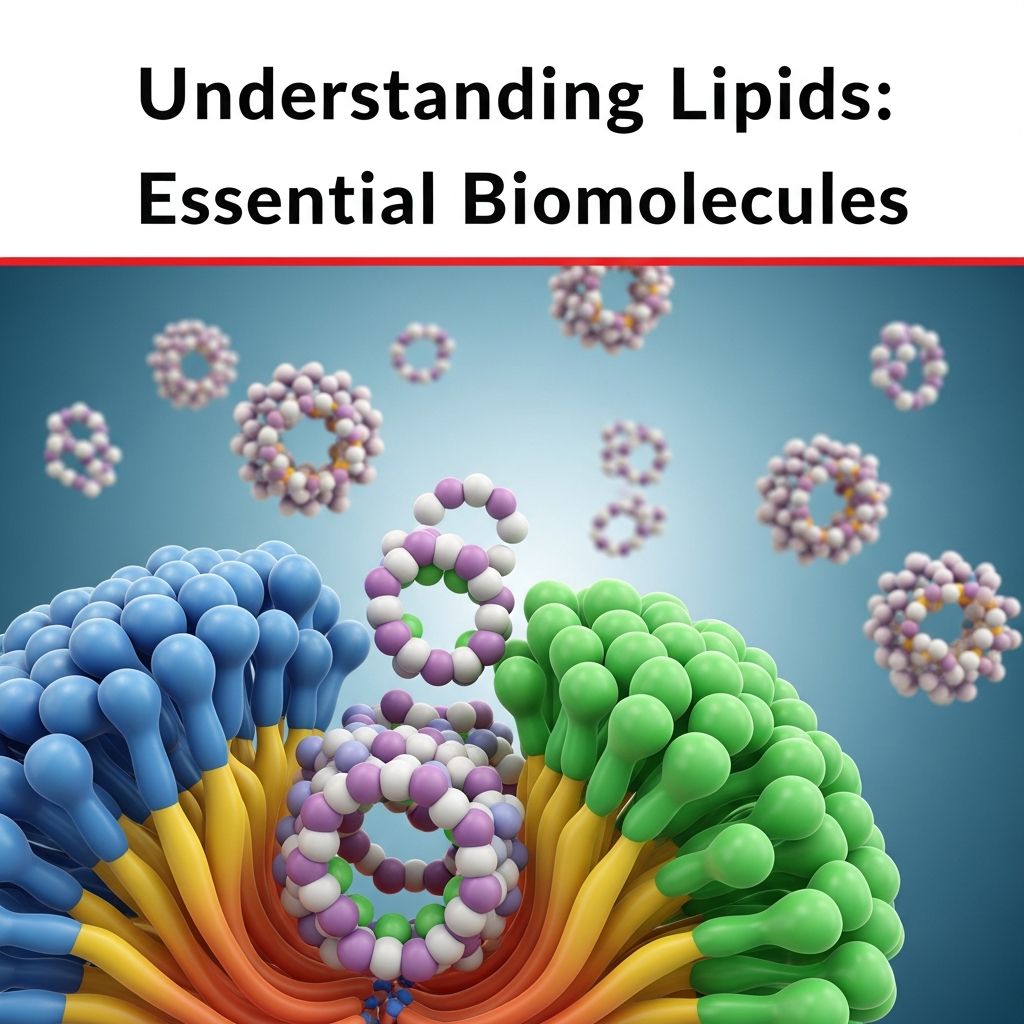
Lipids form a diverse class of organic molecules characterized by their hydrophobicity, playing pivotal roles in biological systems from energy reserves to structural components.
The Fundamental Nature of Lipids
Lipids encompass a wide array of compounds, including fats, oils, waxes, steroids, and phospholipids, united by their insolubility in water and solubility in nonpolar solvents. Unlike proteins or carbohydrates, lipids lack a uniform structure, defined instead by shared chemical properties that make them greasy or oily. These molecules primarily consist of carbon, hydrogen, and oxygen, often featuring long hydrocarbon chains that render them nonpolar.
In living organisms, lipids serve as high-efficiency energy stores, yielding more than twice the energy per gram compared to carbohydrates or proteins upon oxidation. They also constitute critical parts of cell membranes, hormones, and vitamins, underscoring their indispensability.
Core Building Blocks: Fatty Acids and Glycerol
At the heart of many lipids lie fatty acids, linear chains of hydrocarbons capped by a carboxylic acid group. Fatty acids vary in chain length and saturation: saturated ones feature single bonds between carbons, packing tightly for solidity at room temperature, as in butter; unsaturated types have double bonds, creating kinks that result in liquids like olive oil.
- Saturated fatty acids: Straight chains, higher melting points (e.g., palmitic acid, 16 carbons).
- Monounsaturated: One double bond (e.g., oleic acid in avocados).
- Polyunsaturated: Multiple double bonds (e.g., omega-3 in fish oils).
Glycerol, a three-carbon alcohol, often links with fatty acids to form more complex lipids via ester bonds. This combination yields triglycerides, the primary fat storage form.
Major Classes of Lipids
Lipids diversify into several categories, each with specialized functions.
Triglycerides: Powerhouses of Energy Storage
Comprising glycerol esterified with three fatty acids, triglycerides (or triacylglycerols) dominate adipose tissue, insulating and cushioning organs while stockpiling calories. During fasting, enzymes hydrolyze them, releasing fatty acids for beta-oxidation in mitochondria, generating ATP.
Excess dietary triglycerides elevate blood levels, contributing to cardiovascular risks when oxidized LDL accumulates in arteries.
Phospholipids: Architects of Cellular Boundaries
These amphipathic molecules feature two fatty acid tails and a phosphate head, self-assembling into bilayers that form cell membranes. The hydrophobic tails cluster inward, shielding interiors from aqueous environments, while hydrophilic heads face outward.
Phospholipids like phosphatidylcholine enable selective permeability, regulating nutrient entry and waste exit. They comprise 20-80% of membrane mass, varying by cell type.
Steroids: Regulators and Stabilizers
Steroids boast a four-ring carbon skeleton, exemplified by cholesterol, which modulates membrane fluidity and serves as a precursor for bile acids, vitamin D, and hormones like cortisol and estrogen. Absent in plants, cholesterol stiffens animal membranes.
Other Lipid Varieties
- Waxes: Esters of long-chain fatty acids and alcohols, forming protective coatings on leaves and skin.
- Fat-soluble vitamins: A, D, E, K, absorbed via lipids for vision, bone health, and clotting.
- Glycolipids: Lipids with sugar attachments, aiding cell recognition in immune responses.
Biological Roles and Metabolic Pathways
Lipids orchestrate multifaceted physiological processes.
| Lipid Type | Primary Function | Examples |
|---|---|---|
| Triglycerides | Energy storage/transport | Adipose fats, blood lipids |
| Phospholipids | Membrane structure | Lecithin, sphingomyelin |
| Steroids | Signaling, fluidity | Cholesterol, hormones |
| Fatty acids | Energy production | Omega-3, palmitic |
Lipogenesis in the liver and adipocytes synthesizes lipids from excess carbs, while lipolysis mobilizes stores. Essential fatty acids like linoleic and alpha-linolenic cannot be produced de novo, necessitating dietary intake.
Lipids in Nutrition and Health
Diets rich in healthy unsaturated fats from nuts, seeds, and fish support heart health, reducing inflammation via eicosanoids. Conversely, trans fats from processed foods promote atherosclerosis.
Blood lipid panels measure cholesterol (total, HDL, LDL), triglycerides to assess risks. High LDL correlates with plaque buildup; HDL aids clearance.
Industrial and Emerging Applications
Beyond biology, lipids feature in foods as emulsifiers, cosmetics for moisturizing, and nanotechnology for drug delivery vehicles. Phospholipid liposomes encapsulate pharmaceuticals, enhancing targeted release.
Frequently Asked Questions (FAQs)
Are all lipids unhealthy?
No, lipids are essential; unsaturated fats protect health, while excess saturated/trans fats pose risks.
How do lipids differ from fats?
Fats are triglycerides, a lipid subset; lipids broadly include phospholipids, steroids.
Why can’t lipids dissolve in water?
Their nonpolar hydrocarbon chains repel polar water molecules.
What role do lipids play in cell membranes?
They form the bilayer, providing structure and selective barriers.
Can the body make all needed lipids?
No, essential fatty acids must come from diet.
Advanced Insights: Lipid Signaling and Disease
Lipids mediate signaling: steroid hormones traverse membranes to bind nuclear receptors, altering gene expression. Eicosanoids from arachidonic acid drive inflammation.
Dyslipidemias link to obesity, diabetes; statins lower cholesterol by inhibiting HMG-CoA reductase. Research explores lipid rafts—membrane microdomains—for pathogen insights.
Lipids influence neuroscience: myelin sheaths, lipid-rich, insulate axons for rapid impulses. Disruptions cause demyelinating diseases like multiple sclerosis.
References
- Biochemistry, Lipids — StatPearls, NCBI Bookshelf, NIH. 2023-08-28. https://www.ncbi.nlm.nih.gov/books/NBK525952/
- Lipid — Wikipedia (informed by primary sources). 2026-04-04. https://en.wikipedia.org/wiki/Lipid
- What are lipids? — Cleveland Clinic. 2022-11-03. https://my.clevelandclinic.org/health/body/24425-lipids
- Lipids Definition — BYJU’S Biology. Accessed 2026. https://byjus.com/biology/lipids/
- What are Lipids? — News-Medical.net. 2023-10-10. https://www.news-medical.net/life-sciences/What-are-Lipids.aspx
- Lipids (article) — Khan Academy Biology. 2025. https://www.khanacademy.org/science/biology/macromolecules/lipids/a/lipids
- Introduction to lipids — Khan Academy High School Biology. 2024. https://www.khanacademy.org/science/hs-bio/x230b3ff252126bb6:energy-and-matter-in-biological-systems/x230b3ff252126bb6:biomolecules-and-reactions/v/introduction-to-lipids

Medha Deb is an editor with a master's degree in Applied Linguistics from the University of Hyderabad. She believes that her qualification has helped her develop a deep understanding of language and its application in various contexts. Medha specializes in the areas of beauty, health, sports, and wellness and is committed to ensuring that the content on the website is…