
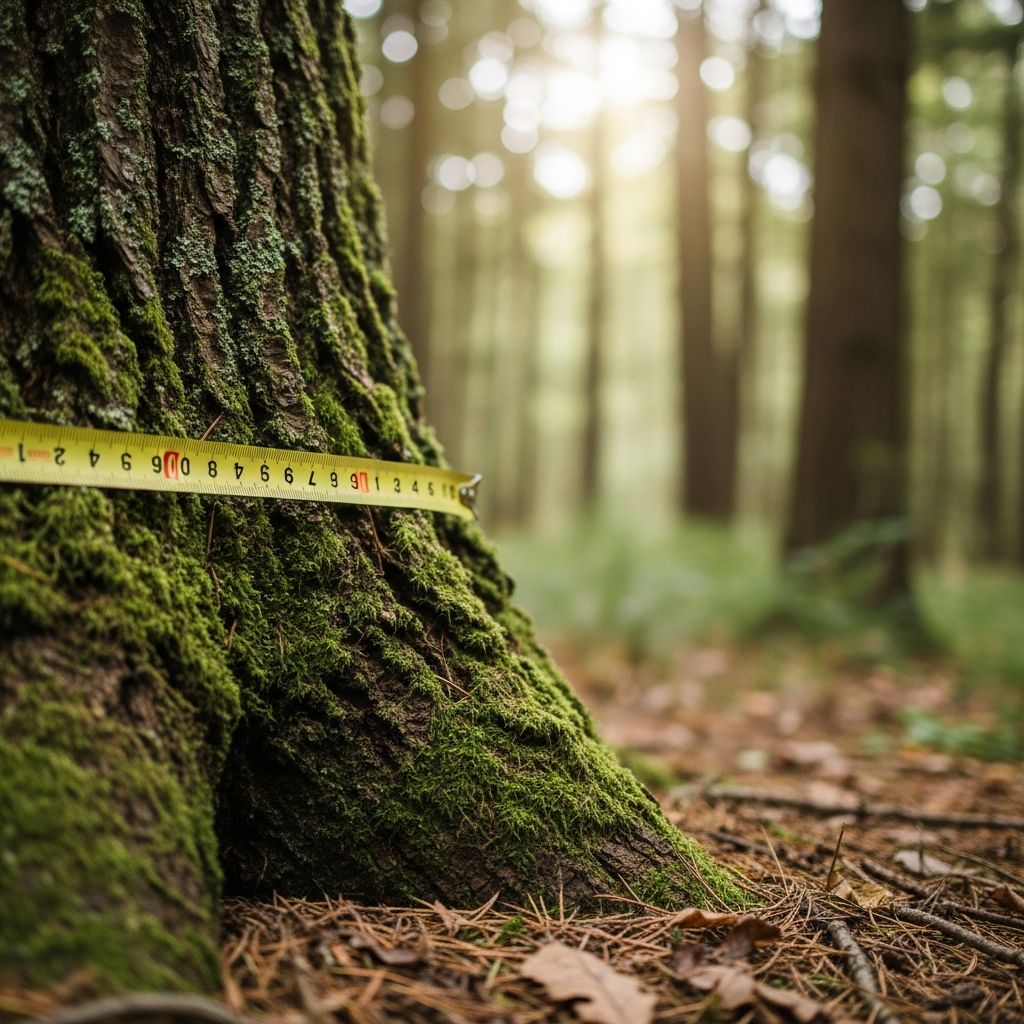
Tree diameter tapes, often called D-tapes or pi tapes, are specialized measuring instruments designed to simplify the process of determining a tree’s diameter at breast height (DBH). These tools convert circumference readings directly into diameter values, saving time and reducing errors in field conditions. Foresters, arborists, and land managers rely on them for timber volume estimation, growth monitoring, and health assessments.
Understanding DBH: The Standard for Tree Measurement
Diameter at Breast Height (DBH) is the universally accepted metric for evaluating tree size. It is measured at a height of 4.5 feet (1.37 meters) above the ground on the uphill side for sloped terrain. This standardization ensures consistency across inventories and research.
Why 4.5 feet? This height avoids root swell at the base and buttresses higher up, providing a reliable indicator of a tree’s productive trunk volume. DBH correlates strongly with total height, crown size, and biomass, making it foundational for forest management.
- Benefits of DBH: Enables quick volume calculations using formulas like V = 0.005454 * DBH² * Height.
- Global Variations: Some regions use 1.3 meters (4.27 feet), but 1.37m is standard in North America.
- Applications: Timber sales, carbon sequestration estimates, and urban tree inventories.
How Tree Diameter Tapes Work: The Pi Magic
Unlike regular tapes, diameter tapes feature dual scales: one for circumference and a specialized scale divided by π (3.14159). Wrapping the tape around the trunk yields a direct diameter reading where the zero mark aligns.
For example, a 100 cm circumference reads as approximately 31.8 cm diameter on the pi scale, eliminating manual math. Tapes often include a hook for large trees, ensuring taut application without slippage.
| Method | Steps | Accuracy | Time |
|---|---|---|---|
| Pi Tape (D-Tape) | Wrap, read directly | High (±0.1 inch) | 10-20 sec |
| Standard Tape | Wrap, measure C, divide by π | Medium (calc error) | 1-2 min |
| Caliper | Measure across bark | Very High | 30 sec |
Step-by-Step Guide to Accurate DBH Measurement
- Locate Breast Height: On flat ground, 4.5 ft up. On slopes, measure from uphill ground level.
- Prepare the Tree: Clear vines or debris. For irregular bark, press tape firmly into grooves.
- Apply the Tape: Hold zero end against trunk, wrap clockwise with right hand, catch with left. Pull taut and level.
- Read the Value: Cross the loose end over zero; note diameter where they overlap on the upper scale.
- Record Averages: Take two perpendicular readings for non-round trunks, average them.
For multi-stem trees: If forks are above 4.5 ft, measure as one; below, measure each stem separately.
Handling Challenging Tree Measurements
Real-world trees aren’t perfect cylinders. Swells, leans, forks, and wounds require adaptations.
- Leaning Trees: Measure on the lean’s pivot side at 4.5 ft, perpendicular to axis.
- Swollen Bases: Use the smallest diameter above swell but at standard height.
- Forks at DBH: Measure just below fork; if above, standard DBH.
- Deformities: Average multiple points or use calipers for precision.
Video demonstrations show hooking the tape into bark for girth >2m, ensuring straight pulls.
Alternatives to Diameter Tapes
Not everyone carries a D-Tape. Reliable backups exist.
| Tool | Pros | Cons | Best For |
|---|---|---|---|
| String + Tape | Cheap, accessible | Less precise, stretchy | DIY inventories |
| Dendrometer Calipers | Direct diameter, durable | Bulky, two-person use | Research plots |
| Laser Rangefinders | Non-contact, fast | Expensive, training needed | Large-scale surveys |
| Half-Diameter Method | Uses regular tape | Requires marks | Field expediency |
Half-diameter: Mark two opposite points at DBH, measure distance, double it. String method: Wrap, mark, measure length, divide by π.
Selecting the Right Tree Diameter Tape
Quality varies. Look for fiberglass construction (flexible, weatherproof), dual inch/cm scales, and 30-40m lengths for big trees.
- Budget Models: $10-20, plastic, for casual use.
- Professional: $30-100, metal-reinforced, with cases.
- Features: Zero locks, curved hooks, glow-in-dark scales.
Calibration tip: Test on known cylinders like pipes.
Applications in Modern Forestry and Beyond
DBH tapes underpin sustainable practices. They calculate board feet (e.g., International 1/4-inch log rule), track growth rates (annual DBH increment ~0.5-1 cm), and assess mortality risks.
In urban settings, DBH informs pruning cycles and hazard trees. Conservation uses include biomass for carbon credits and biodiversity indices. Emerging tech like drones supplements but doesn’t replace tapes for precision.
Timber Yield Estimation
Formulas like Smalian’s volume use DBH inputs: Accurate DBH ±1 inch can swing yield estimates by 10-20%.
Forest Health Monitoring
Re-measure plots every 5 years to detect declines (e.g., DBH growth <0.2 cm/yr signals stress).
Frequently Asked Questions (FAQs)
What is the exact height for DBH measurement?
4.5 feet (1.37m) above ground on the uphill side for slopes.
Can I use a regular tape measure for DBH?
Yes, measure circumference and divide by 3.1416, but D-tapes are faster and more accurate.
How do you measure forked trees?
If fork above DBH, measure as single; below, each stem separately at 4.5 ft.
What’s the accuracy of diameter tapes?
Typically ±0.1-0.25 inches when used correctly; average perpendicular readings for best results.
Are diameter tapes only for forestry?
No, used for pipes, poles, and urban trees too.
Maintenance and Best Practices
Store coiled loosely to prevent creases. Clean bark residue with mild soap. Recalibrate yearly against standards. Always wear gloves for rough bark.
Safety: Watch for hazards like widowmakers. Measure in pairs for large trees.
References
- How to use a diameter tape — Minnesota Department of Natural Resources. Accessed 2026. https://files.dnr.state.mn.us/education_safety/education/plt/activity_sheets/howToUseADiameterTape.pdf
- Measurement of Tree Diameter — EREN PFPP. 2012-06-11. https://erenweb.org/wp-content/uploads/2012/06/EREN-PFPP_Appendix-VI_TreeDBHGuide_11June2012.pdf
- Measuring diameter of trees using a DBH tape — YouTube (Biol 312). Accessed 2026. https://www.youtube.com/watch?v=z_LTRevV4eA
- How to Measure a Tree — Portland.gov. Accessed 2026. https://www.portland.gov/trees/tree-care-and-resources/how-measure-tree
- Diameter Tapes 101 — Perfect Measuring Tape. Accessed 2026. https://perfectmeasuringtape.com/blog/diameter-tapes/diameter-tapes-101/
- How do scientists measure trees? What is DBH? — Harvard Arboretum. 2020-07. https://arboretum.harvard.edu/wp-content/uploads/2020/07/HowToMeasureTrees_TeacherGuide.pdf
- Measuring Trees — USDA Forest Service (FSH 2409.12). Accessed 2026. https://www.fs.usda.gov/im/directives/fsh/2409.12/2409.12_10.pdf

Medha Deb is an editor with a master's degree in Applied Linguistics from the University of Hyderabad. She believes that her qualification has helped her develop a deep understanding of language and its application in various contexts. Medha specializes in the areas of beauty, health, sports, and wellness and is committed to ensuring that the content on the website is…