
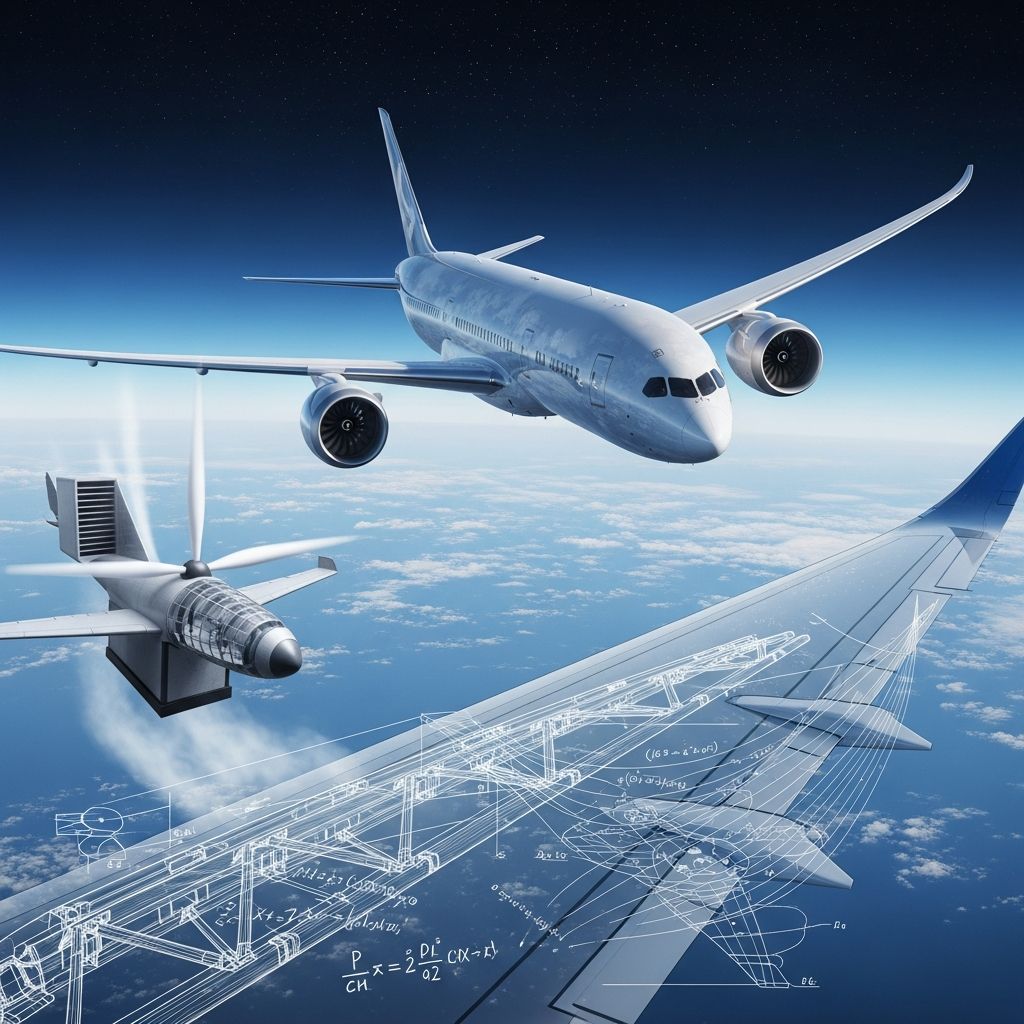
Aerospace engineering is a specialized discipline dedicated to the design, development, testing, production, and maintenance of aircraft, spacecraft, satellites, missiles, and associated systems. This field merges principles from physics, mathematics, and multiple engineering domains to advance technologies for transportation, exploration, defense, and communication.
Core Branches of Aerospace Engineering
The discipline divides into two primary, interconnected branches: aeronautical engineering and astronautical engineering. Aeronautical engineering concentrates on vehicles operating within Earth’s atmosphere, such as airplanes, helicopters, and drones. Astronautical engineering targets spacecraft, rockets, and satellites designed for outer space operations.
- Aeronautical Engineering: Involves creating and optimizing flight vehicles propelled by air-breathing engines, addressing atmospheric flight challenges like lift, drag, and stability.
- Astronautical Engineering: Focuses on non-atmospheric vehicles using rocket propulsion, tackling issues like orbital mechanics, vacuum dynamics, and re-entry heating.
- Avionics Engineering: A related subdomain emphasizing electronics, navigation, and control systems integral to both branches.
These branches overlap significantly, especially in hybrid projects like reusable launch vehicles that transition from atmosphere to space.
Fundamental Principles and Disciplines
Aerospace engineers rely on a multidisciplinary foundation to ensure vehicles withstand extreme conditions, including pressure changes, high speeds, and structural loads. Key areas include:
- Aerodynamics and Fluid Dynamics: Studies airflow over vehicles to minimize drag and maximize efficiency. Critical for both atmospheric flight and launch/re-entry phases.
- Propulsion Systems: Encompasses air-breathing engines for aircraft and rocket engines for spacecraft, optimizing thrust and fuel efficiency.
- Structures and Materials: Designs lightweight yet durable frameworks using composites and alloys to handle aerodynamic loads, vibrations, and thermal stresses.
- Control and Avionics: Develops flight controls, autopilots, guidance systems, and sensors for precise navigation and stability.
- Orbital Mechanics and Flight Dynamics: Essential for spacecraft trajectories, satellite positioning, and mission planning.
| Discipline | Aeronautical Focus | Astronautical Focus |
|---|---|---|
| Aerodynamics | Wing lift, drag reduction | Launch heating, re-entry drag |
| Structures | Gusts, landing impacts | Vibrations, space durability |
| Propulsion | Jet/turbofan engines | Rocket engines, thrusters |
This table illustrates how core disciplines adapt across branches, ensuring robust vehicle performance.
Daily Responsibilities of Aerospace Engineers
Aerospace professionals engage in diverse tasks throughout the lifecycle of flight vehicles. They conceptualize designs using computer-aided tools, simulate performance, prototype components, conduct tests, and oversee manufacturing.
- Conceptualizing and modeling systems with CAD software and simulations.
- Analyzing data from wind tunnels, flight tests, and computational models.
- Selecting materials for strength-to-weight ratios and environmental resistance.
- Integrating subsystems like avionics and propulsion for seamless operation.
- Ensuring compliance with safety regulations and certification standards.
Specializations include structures engineers who test airframe integrity, propulsion experts optimizing engine efficiency, and controls specialists programming flight algorithms.
Educational Pathways and Required Skills
Entry into aerospace engineering typically requires a bachelor’s degree in aerospace engineering or a related field like mechanical or electrical engineering. Programs cover calculus, physics, fluid mechanics, and specialized aerospace courses.
Advanced roles often demand master’s or PhD degrees, particularly in research or leadership positions. Hands-on experience through internships, co-ops, or capstone projects is invaluable.
Essential skills include:
- Proficiency in programming (e.g., MATLAB, Python) for simulations.
- Strong analytical abilities for data interpretation and problem-solving.
- Team collaboration, as projects involve multidisciplinary teams.
- Creativity to innovate amid evolving technologies like electric propulsion and hypersonics.
Career Opportunities and Industry Landscape
Aerospace engineers work in aviation companies, space agencies, defense contractors, and research institutions. Major employers include NASA, Boeing, SpaceX, Lockheed Martin, and Airbus.
Career paths span design, testing, manufacturing, and operations. Emerging areas include urban air mobility (e.g., eVTOL drones), sustainable aviation fuels, and commercial space tourism.
Job growth is steady, driven by demand for efficient aircraft and space infrastructure. Median salaries exceed national averages, reflecting the field’s technical demands.
Innovations Shaping the Future
The aerospace sector is advancing rapidly with electric and hybrid propulsion reducing emissions, AI-enhanced autonomy for drones and spacecraft, and reusable rockets lowering space access costs.
Hypersonic vehicles promise faster global travel, while small satellites enable global connectivity. Engineers are also pioneering Mars habitats and lunar bases, integrating robotics and life support systems.
Sustainability drives innovations like hydrogen-powered aircraft and recyclable composites, addressing climate impacts of aviation.
Frequently Asked Questions
What distinguishes aeronautical from astronautical engineering?
Aeronautical engineering deals with atmospheric flight vehicles like planes, while astronautical focuses on space vehicles like rockets and satellites.
What tools do aerospace engineers use daily?
Common tools include CAD software, finite element analysis (FEA), computational fluid dynamics (CFD) simulators, and wind tunnel testing setups.
Is a graduate degree necessary for aerospace careers?
A bachelor’s suffices for many entry-level roles, but advanced degrees enhance prospects in research, management, or specialized fields.
How does aerospace engineering contribute to defense?
It develops missiles, drones, and surveillance satellites, integrating stealth, precision guidance, and secure communications.
What role does sustainability play in modern aerospace?
Engineers prioritize fuel-efficient designs, electric propulsion, and lightweight materials to minimize environmental impact.
Challenges in Aerospace Engineering
Professionals face hurdles like extreme testing conditions, stringent regulations, and high-stakes safety requirements. Balancing cost, performance, and reliability remains paramount, especially with supply chain complexities and geopolitical factors.
Adapting to rapid tech shifts, such as additive manufacturing and machine learning for predictive maintenance, demands continuous learning.
References
- What does an aerospace engineer do? – CareerExplorer — CareerExplorer. 2023. https://www.careerexplorer.com/careers/aerospace-engineer/
- What is Aerospace Engineering? — Penn State University Department of Aerospace Engineering. 2024. https://www.aero.psu.edu/academics/undergraduate/what-is-aerospace-engineering.aspx
- What is Aerospace Engineering? – Introduction to Aerospace Flight Vehicles — Embry-Riddle Aeronautical University. 2023. https://eaglepubs.erau.edu/introductiontoaerospaceflightvehicles/chapter/what-is-aerospace-engineering/
- What is Aerospace Engineering? | University of North Dakota — University of North Dakota. 2024. https://und.edu/blog/what-is-aerospace-engineering.html
- Aerospace Engineers : Occupational Outlook Handbook — U.S. Bureau of Labor Statistics. 2025-01-08. https://www.bls.gov/ooh/architecture-and-engineering/aerospace-engineers.htm
- How to Become an Aerospace Engineer — Michigan Technological University. 2024. https://www.mtu.edu/mechanical-aerospace/aerospace/how-become/

- Integrated M.A. in Applied Linguistics, University of Hyderabad
- 5+ years in editorial, instructional, SEO, and research-based writing
Sneha is a relationships and lifestyle writer with a strong foundation in applied linguistics and certified training in relationship coaching. She brings over five years of writing experience to theskillvault, crafting thoughtful, research-driven content that empowers readers to build healthier relationships, boost emotional well-being, and embrace holistic living. Her writing and insights reflect the belief that beauty, happiness, and wellness…