
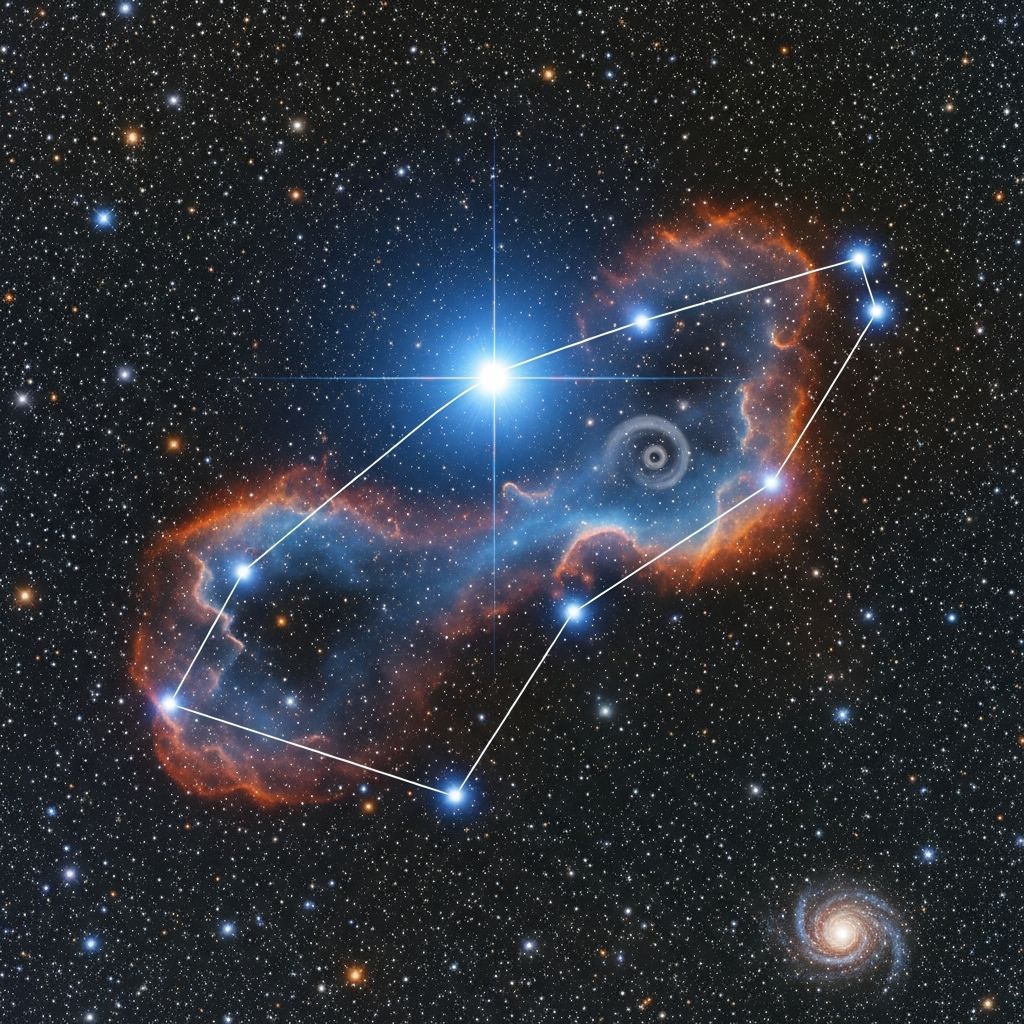
The Lyra constellation, often called the Harp, shines as one of the most recognizable patterns in the northern summer sky. Representing a small stringed instrument from ancient mythology, Lyra captivates stargazers with its brilliant star Vega and a collection of intriguing deep-sky objects. This guide provides everything you need to locate Lyra, understand its features, and enhance your celestial observations.
Understanding Lyra’s Place in the Cosmos
Lyra occupies a modest 286 square degrees, ranking it as the 52nd largest among the 88 modern constellations. Visible primarily in the Northern Hemisphere from latitudes 90°N to 40°S, it belongs to the NQ4 quadrant. Its position near the celestial north pole makes it a reliable marker for navigators and astronomers alike.
Historically, Lyra traces back to ancient Greek lore, symbolizing the lyre crafted by Hermes and played by Orpheus, whose music could charm animals and move stones. Ptolemy cataloged it in the 2nd century, cementing its place in Western astronomy. Today, it serves as a gateway for amateur astronomers due to its prominent stars and accessibility.
Prime Viewing Seasons and Locations
Lyra emerges in the eastern sky around late spring, peaking in visibility during midsummer evenings. For Northern Hemisphere observers, May heralds its appearance, with optimal views from June through September when it soars overhead around midnight. By October, it dips below the horizon earlier.
In the Southern Hemisphere, Lyra graces winter skies, visible low on the northern horizon. Seek dark sites away from city lights—rural fields or mountain observatories yield the clearest vistas. Apps like Stellarium or SkySafari can predict exact rise and set times for your coordinates.
- Best Months (Northern Hemisphere): June to September
- Peak Altitude: July-August evenings
- Ideal Conditions: Clear, moonless nights
- Neighboring Aids: Cygnus, Aquila, Hercules
Step-by-Step Guide to Spotting Lyra
Finding Lyra begins with its crown jewel: Vega, the fifth-brightest star in the night sky at magnitude 0.03. This bluish-white beacon dominates the constellation.
- Scan for Vega: On summer evenings, face east after sunset. Vega gleams high, often near the zenith by 10 PM in July.
- Identify the Parallelogram: Below Vega, a compact quadrilateral of fainter stars (magnitudes 3-5) forms the harp’s body. Beta, Gamma, Delta, and Zeta Lyrae outline this shape.
- Complete the Harp: Vega caps the pattern like a harp’s yoke. A small triangle nearby marks Epsilon Lyrae, the famous Double Double.
- Use the Summer Triangle: Connect Vega with Deneb (Cygnus) and Altair (Aquila) for a large asterism that anchors Lyra at its apex.
Practice under dark skies: Allow 20 minutes for dark adaptation. Binoculars reveal fainter details.
The Radiant Stars of Lyra
Vega (Alpha Lyrae) lies just 25 light-years away, spinning rapidly and surrounded by a dust disk hinting at possible planets. It’s a benchmark for astronomical measurements.
| Star | Magnitude | Distance (ly) | Notable Feature |
|---|---|---|---|
| Vega (α Lyr) | 0.03 | 25 | 5th brightest star, rapid rotator |
| β Lyr (Sheliak) | 3.4 | 960 | Eclipsing binary |
| γ Lyr (Sulafat) | 3.2 | 620 | Forms parallelogram |
| δ Lyr | 4.3 | 1560 | Multiple star system |
| ε Lyr (Double Double) | 4.1-4.7 | 162 | Resolvable double with telescope |
Sheliak varies in brightness due to its binary nature, while Epsilon Lyrae challenges observers with two tight doubles, earning its nickname.
Deep-Sky Treasures Within Lyra
Beyond stars, Lyra hosts M57, the Ring Nebula—a planetary nebula resembling a smoke ring, 2,300 light-years distant. Telescopes at 100x magnification reveal its glowing shell of ionized gas.
Other gems include:
- M56: Globular cluster, magnitude 8.2, for mid-sized scopes.
- NGC 6791: Open cluster, 13,000 light-years away, rich in red giants.
- Variable Stars: RR Lyrae, prototype for its class, pulses every 13.6 hours.
These objects showcase stellar evolution, from dying stars to ancient clusters.
Lyrid Meteors: Lyra’s Fiery Display
Annually in April, the Lyrids peak around the 22nd, radiating from Lyra’s position near Vega. Dust from Comet C/1861 G1 (Thatcher) streaks at 30 miles/second, yielding 10-20 meteors per hour under ideal conditions. No tails or trains typically, but bright fireballs occur.
Tip: Observe post-midnight in moonless skies. Lyra’s radiant rises early evening.
Tools and Techniques for Optimal Observation
Start naked-eye for Vega, then binoculars for the parallelogram. A 6-inch telescope unveils M57’s ring and Epsilon’s doubles. Star charts, apps, or planetarium software pinpoint positions.
- Apps: Stellarium (free), SkySafari (paid).
- Equipment: Red flashlight preserves night vision; star finder wheel.
- Safety: Avoid light pollution; check weather.
Mythology and Cultural Echoes of the Harp
In Greek myth, Orpheus’s lyre, gifted to Zeus, became Lyra after his death. Chinese astronomy saw Vega as Zhi Nu, the Weaver Girl, separated by the Milky Way from her lover.
Modern culture nods to it in sci-fi, like the starship Enterprise‘s lyre shape.
Frequently Asked Questions
What makes Lyra easy to find?
Vega’s brilliance and the Summer Triangle asterism make it accessible even for beginners.
Can I see Lyra from the Southern Hemisphere?
Yes, low on the northern horizon during winter months, down to 40°S.
What’s the best telescope for Lyra’s objects?
A 4-8 inch reflector resolves the Ring Nebula and Double Double effectively.
When do Lyrids peak?
Around April 22nd, best after midnight.
Is Vega visible year-round?
Circumpolar for northern latitudes above 40°N, but highest in summer.
Advanced Observing Projects
Challenge yourself: Sketch M57, time RR Lyrae’s variability, or photograph the Summer Triangle. Join astronomy clubs for star parties.
Lyra’s blend of myth, stars, and nebulae offers endless wonder. Step outside tonight—Vega awaits.
References
- Lyra Constellation: How to Find It, What to See, and Why It Matters — Astrophotons. 2023-06-15. https://astrophotons.com/lyra-constellation
- How to Find Lyra the Harp Constellation — YouTube (In-the-Deep). 2022-07-20. https://www.youtube.com/watch?v=TZQG2pIsaeQ
- Lyra Constellation: The Ultimate Guide — Label Stars. 2024-01-10. https://labelstars.com/en/constellations-list/lyra-constellation
- How to Find Lyra The Harp Constellation — YouTube (Learn the Sky). 2021-08-05. https://www.youtube.com/watch?v=TLGDzXiOr7w
- Lyra the Harp contains Vega, a summer gem — EarthSky. 2025-03-12. https://earthsky.org/constellations/lyra-the-harp-vega-summer/
- Lyra Constellation Guide — Love the Night Sky. 2023-11-28. https://lovethenightsky.com/lyra-constellation-guide/
- How to Find Lyra – Night Sky with Naz — YouTube (Kielder Observatory). 2024-04-15. https://www.youtube.com/watch?v=W4C2gmSq_jo

Medha Deb is an editor with a master's degree in Applied Linguistics from the University of Hyderabad. She believes that her qualification has helped her develop a deep understanding of language and its application in various contexts. Medha specializes in the areas of beauty, health, sports, and wellness and is committed to ensuring that the content on the website is…