
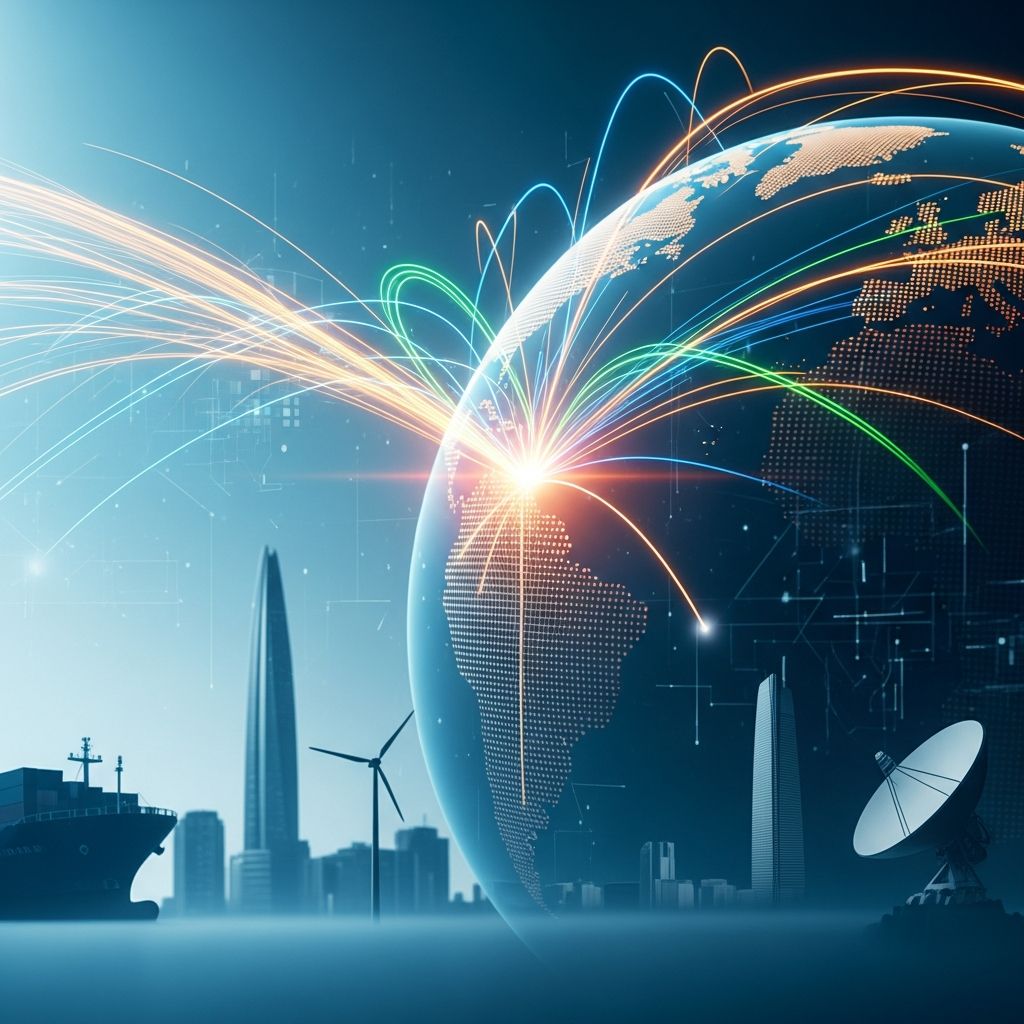
Globalization represents the escalating interconnectedness of economies, cultures, and societies through cross-border flows of goods, services, capital, people, and ideas. This phenomenon has transformed how nations interact, fostering a more integrated world economy while presenting both opportunities and hurdles.
The Core Elements of Global Connectivity
At its heart, globalization involves the expansion of international trade, investment, migration, and knowledge dissemination. The International Monetary Fund outlines four primary aspects: trade in goods and services, capital movements, labor mobility, and the spread of technology and information. These elements create a web of dependencies where events in one country ripple across the globe.
Economic integration forms the backbone, with national markets merging into a unified global marketplace. This process reduces barriers like tariffs, enabling efficient resource allocation based on comparative advantage, where countries specialize in their strengths.
Historical Foundations and Evolutionary Phases
Globalization is not a modern invention but a historical progression accelerated by technological and policy shifts. Early waves began with ancient trade routes like the Silk Road, evolving through colonial expansions and the Industrial Revolution, which enhanced transportation and communication.
The post-World War II era marked a pivotal acceleration, with institutions like the IMF and World Bank promoting trade liberalization. The 1980s and 1990s saw explosive growth due to containerization, the internet, and agreements like NAFTA and the WTO, integrating economies further.
- Pre-20th Century: Maritime explorations and colonial trade networks laid initial foundations.
- 1945-1980: Bretton Woods system and decolonization spurred multilateral trade.
- 1980s-Present: Digital revolution and deregulation fueled hyper-globalization.
Today, undersea cables and satellite networks exemplify this evolution, connecting even remote regions.
Key Drivers Fueling Global Interdependence
Several forces propel globalization forward. Technological advancements in transport—such as jet aircraft and massive container ships—and communication, including fiber optics and 5G, have slashed time and costs for cross-border exchanges.
Policy decisions play a crucial role: governments have dismantled trade barriers, signing thousands of bilateral and multilateral agreements. Multinational corporations further drive this by establishing global supply chains, optimizing production worldwide.
| Driver | Description | Impact Example |
|---|---|---|
| Technology | Internet and logistics innovations | Real-time global stock trading |
| Trade Policies | Tariff reductions and FTAs | Increased exports from developing nations |
| Capital Flows | Foreign direct investment | Tech hubs in emerging markets |
These drivers have made goods cheaper and more accessible, benefiting consumers globally.
Economic Advantages and Growth Opportunities
Globalization boosts efficiency through competition and specialization. Countries export what they produce best, importing the rest, leading to lower prices and higher living standards. Developing economies experience rapid growth as exports create jobs and attract investment.
For instance, efficiency gains from global markets allow specialization, reducing costs and promoting innovation. The Peterson Institute notes that this comparative advantage lowers prices, particularly aiding lower-income households. Multinationals scale operations, spreading technology and management practices.
- Job Creation: Export sectors in Asia and Latin America have lifted millions from poverty.
- Consumer Benefits: Wider product variety at reduced prices.
- Innovation Spillover: Knowledge transfer enhances local capabilities.
Overall, these dynamics have contributed to a more prosperous world, with global GDP growth accelerating since the 1990s.
Cultural and Social Dimensions of a Connected World
Beyond economics, globalization weaves cultural fabrics together. Media, migration, and tourism disseminate ideas, languages, and traditions, creating hybrid cultures. Hollywood films, K-pop, and global cuisine illustrate this fusion.
Socially, it promotes tolerance and shared values but risks cultural homogenization. Anthony Giddens describes it as intensified worldwide social relations linking distant locales. Migration flows enrich societies with diverse perspectives while challenging integration.
Political and Environmental Intersections
Politically, globalization fosters international cooperation via organizations like the UN and WTO, addressing transnational issues like climate change. However, it can undermine sovereignty as global rules supersede national policies.
Environmentally, increased trade heightens resource demands and pollution but also enables green technology diffusion. Global standards, such as those from the Paris Agreement, emerge from this interconnectedness.
Challenges and Criticisms Facing Globalization
Despite benefits, globalization exacerbates inequalities. Wealth concentrates in urban elites and multinationals, while rural and low-skill workers face job losses from outsourcing. The 2008 financial crisis highlighted vulnerabilities in interconnected systems.
Cultural critics argue it erodes local identities, promoting Western dominance. Labor standards vary, leading to exploitation in sweatshops. Environmental degradation from shipping and production intensifies climate risks.
| Aspect | Pros | Cons |
|---|---|---|
| Economic | Growth and efficiency | Inequality and job displacement |
| Cultural | Diversity and exchange | Homogenization |
| Environmental | Tech sharing | Pollution increase |
Backlash includes protectionism, as seen in recent trade wars, reflecting public discontent.
The Future Trajectory of Global Integration
Looking ahead, globalization faces headwinds from nationalism, pandemics, and geopolitical tensions. Yet, digital technologies like AI and blockchain promise deeper integration. Sustainable practices and inclusive policies could mitigate downsides.
Emerging markets will drive future growth, with Africa and Asia leading trade surges. Policymakers must balance openness with protections for vulnerable groups.
Frequently Asked Questions (FAQs)
What are the main benefits of globalization?
Key benefits include economic growth through trade, lower consumer prices, job creation in export sectors, and cultural enrichment via idea exchange.
Does globalization increase inequality?
Yes, it can widen gaps between skilled and unskilled workers, and between nations, though targeted policies can address this.
How has technology driven globalization?
Innovations in communication and transport have reduced barriers, enabling instant global transactions and supply chains.
Is globalization reversible?
While slowdowns occur, underlying forces like technology make full reversal unlikely; adaptations are more probable.
What role do international organizations play?
They facilitate trade rules, provide aid, and coordinate on global challenges like health and climate.
References
- Globalization — Wikipedia. 2026 (Accessed). https://en.wikipedia.org/wiki/Globalization
- Globalization: A Brief Overview — International Monetary Fund. 2008-05-30. https://www.imf.org/external/np/exr/ib/2008/053008.htm
- Defining Globalization — Library of Congress. N/A. https://guides.loc.gov/globalization/definition
- What is globalization anyway? — World Economic Forum. 2017-01-19. https://www.weforum.org/stories/2017/01/what-is-globalization-explainer/
- What Is Globalization in Business? — Harvard Business School Online. N/A. https://online.hbs.edu/blog/post/what-is-globalization-in-business
- What Is Globalization? — Peterson Institute for International Economics. N/A. https://www.piie.com/microsites/globalization/what-is-globalization
- What Is Globalization? — Indiana Journal of Global Legal Studies. N/A. https://ijgls.indiana.edu/about/what-were-about/

- Integrated M.A. in Applied Linguistics, University of Hyderabad
- 5+ years in editorial, instructional, SEO, and research-based writing
Sneha is a relationships and lifestyle writer with a strong foundation in applied linguistics and certified training in relationship coaching. She brings over five years of writing experience to theskillvault, crafting thoughtful, research-driven content that empowers readers to build healthier relationships, boost emotional well-being, and embrace holistic living. Her writing and insights reflect the belief that beauty, happiness, and wellness…