
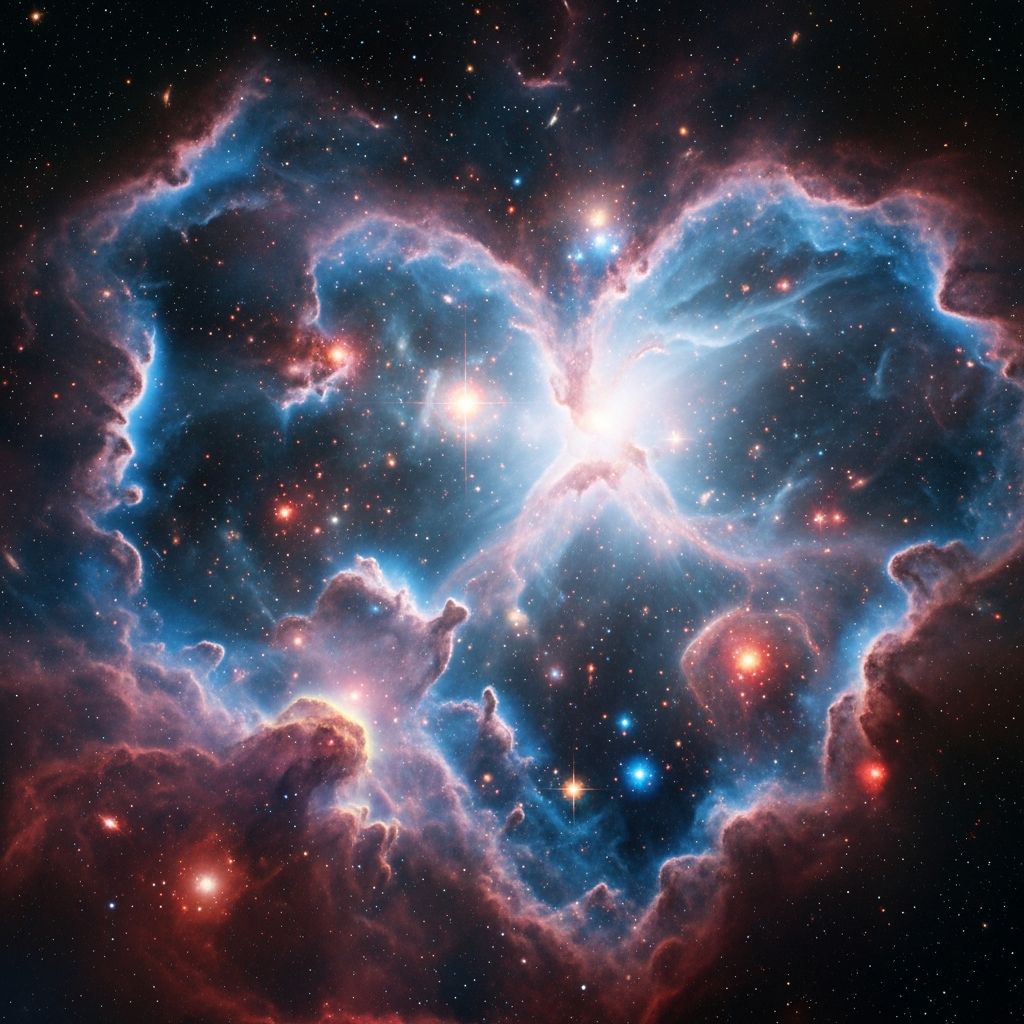
The **interstellar medium (ISM)** represents the diffuse material—gas, dust, plasma, and radiation—that occupies the enormous gaps between stars in galaxies like our Milky Way. Far from being a perfect vacuum, this medium constitutes about 10-15% of a galaxy’s total mass and serves as the birthplace of stars and the repository of stellar remnants.
Composition and Abundance of Interstellar Matter
The ISM is predominantly gaseous, with roughly 99% of its mass in the form of hydrogen and helium atoms or molecules, mirroring the universe’s primordial composition from the Big Bang. Hydrogen accounts for approximately 90% of atoms by number (70% by mass), helium 8-9% (28% by mass), and trace ‘metals’ (elements heavier than helium) making up the rest at about 1-2%. These heavier elements originate from stellar nucleosynthesis, ejected via supernovae, stellar winds, and planetary nebulae, gradually enriching the ISM over galactic time.
Dust grains, comprising just 1% of the ISM’s mass, are tiny solid particles of silicates, carbon compounds, and ices—essential for shielding molecules from destructive ultraviolet radiation and facilitating cooling in star-forming regions. Cosmic rays, high-energy particles, and photons from various wavelengths permeate the medium, influencing its ionization and dynamics. Despite densities as low as 1 atom per cubic centimeter—millions of times less than Earth’s atmosphere—the ISM’s vast volume yields a substantial total mass, equivalent to 15% of the Milky Way’s stellar mass.
Phases of the Interstellar Medium
Astronomers classify the ISM into distinct thermal phases based on temperature, density, and ionization state, maintained in approximate pressure equilibrium. These phases occupy different volumes and host unique physical processes.
- Cold Neutral Medium (CNM): Temperatures near 50-100 K, densities 20-50 atoms/cm³. These molecular clouds, shielded by dust, occupy ~1% of volume but ~50% of gas mass. Ideal for H₂ formation and star birth.
- Warm Neutral Medium (WNM): 6,000-10,000 K, ~0.1 atoms/cm³. Fills much of the volume; heated by starlight.
- Warm Ionized Medium (WIM): Similar temperatures, ionized by young stars’ UV.
- Hot Ionized Medium (HIM/Coronal Gas): >10⁶ K, very low density. Created by supernovae shocks, occupies ~50% volume but minimal mass.
This multiphase structure arises from heating by stars and supernovae balanced by radiative cooling, creating a turbulent, dynamic environment.
Role in Star Formation and Galactic Cycles
The ISM is the crucible of stellar birth. In giant molecular clouds (10⁴-10⁶ solar masses, spanning 10-100 light-years), gravity overcomes turbulence and magnetic fields, collapsing dense cores into protostars. NASA’s observations confirm these clouds’ cold temperatures (~10 K) enable molecular formation, clumping gas into high-density pockets.
Stars reciprocate by returning enriched material: massive ones explode as supernovae, injecting energy and metals; all shed mass via winds. This cycle determines elemental abundances and fuels ongoing star formation, with spiral arms concentrating ~20% of galactic mass in ISM. The Sun currently plows through the Local Interstellar Cloud (warm neutral medium) within the low-density Local Bubble carved by ancient supernovae.
Observing the Elusive ISM
Direct imaging is challenging due to low density and dust obscuration. Multi-wavelength astronomy reveals its secrets:
| Wavelength | Reveals | Example |
|---|---|---|
| Radio | 21-cm HI line, molecular lines (CO) | Maps neutral/atomic gas |
| Infrared | Dust emission, warm gas | Star-forming regions |
| Optical/UV | H II regions, absorption lines | Ionized plasma |
| X-ray | Hot coronal gas | Supernova remnants |
These techniques, from NRAO radio telescopes to NASA’s infrared observatories, map ISM structure across the Milky Way.
Interstellar Dust: Tiny Builders of Worlds
Dust grains (0.01-1 μm) absorb visible light, reddening starlight and enabling infrared re-emission. Composed of silicates, graphite, and polycyclic aromatic hydrocarbons (PAHs), they catalyze H₂ formation on surfaces and accrete ices (H₂O, CO, CH₄) in cold regions. In protoplanetary disks, dust aggregates into pebbles, then planetesimals—the seeds of planets like Earth. Dust cycles through destruction in hot environments and reformation in outflows.
Cosmic Rays and Magnetic Fields in the ISM
Cosmic rays—protons and nuclei accelerated to near-light speeds—ionize gas, heat it, and drive turbulence. Galactic magnetic fields (~few μG) thread the ISM, regulating collapse and shaping cloud morphology. Together, they maintain the ISM’s dynamic equilibrium.
ISM in Other Galaxies and the Bigger Picture
While studied most in the Milky Way, the ISM governs evolution across galaxies. Starburst galaxies show intense ISM compression fueling rapid star formation; quiescent ellipticals have depleted gas. The ISM blends into the intergalactic medium, hinting at larger cosmic structures.
Frequently Asked Questions
What fills the space between stars?
Primarily hydrogen and helium gas (99%), plus 1% dust, cosmic rays, and radiation—collectively the ISM.
How dense is the interstellar medium?
Averages 0.1-1 atoms/cm³, but molecular clouds reach hundreds to thousands.
Why is the ISM important for astronomy?
It recycles elements, births stars, and traces galactic history via chemical enrichment.
Can we see the ISM with the naked eye?
Indirectly via nebulae like Orion; most requires telescopes.
How does dust affect observations?
Absorbs visible light, necessitating infrared and radio astronomy.
References
- Exploring the Interstellar Medium: The Space Between Stars — Jason Kendall, YouTube. 2023. https://www.youtube.com/watch?v=RPFoTAKsyoE
- What is interstellar space and where does it begin? — Space.com. 2023-10-24. https://www.space.com/interstellar-space-definition-explanation
- Interstellar medium | Gas, Dust & Radiation — Britannica. 2024. https://www.britannica.com/science/interstellar-medium
- Interstellar medium — Wikipedia (citing primary sources). 2024. https://en.wikipedia.org/wiki/Interstellar_medium
- Chapter 20 – Between the Stars: Gas and Dust in Space — OpenStax Astronomy. 2023. https://www.theexpertta.com/book-files/OpenStaxAstronomy/Astronomy_OP_Chapter20.pdf
- From the interstellar medium to the formation and evolution of stars and planets — University of Groningen Kapteyn Institute (.edu). 2024. https://www.rug.nl/research/kapteyn/onderzoek/areas/ism_spf?lang=en

Medha Deb is an editor with a master's degree in Applied Linguistics from the University of Hyderabad. She believes that her qualification has helped her develop a deep understanding of language and its application in various contexts. Medha specializes in the areas of beauty, health, sports, and wellness and is committed to ensuring that the content on the website is…