
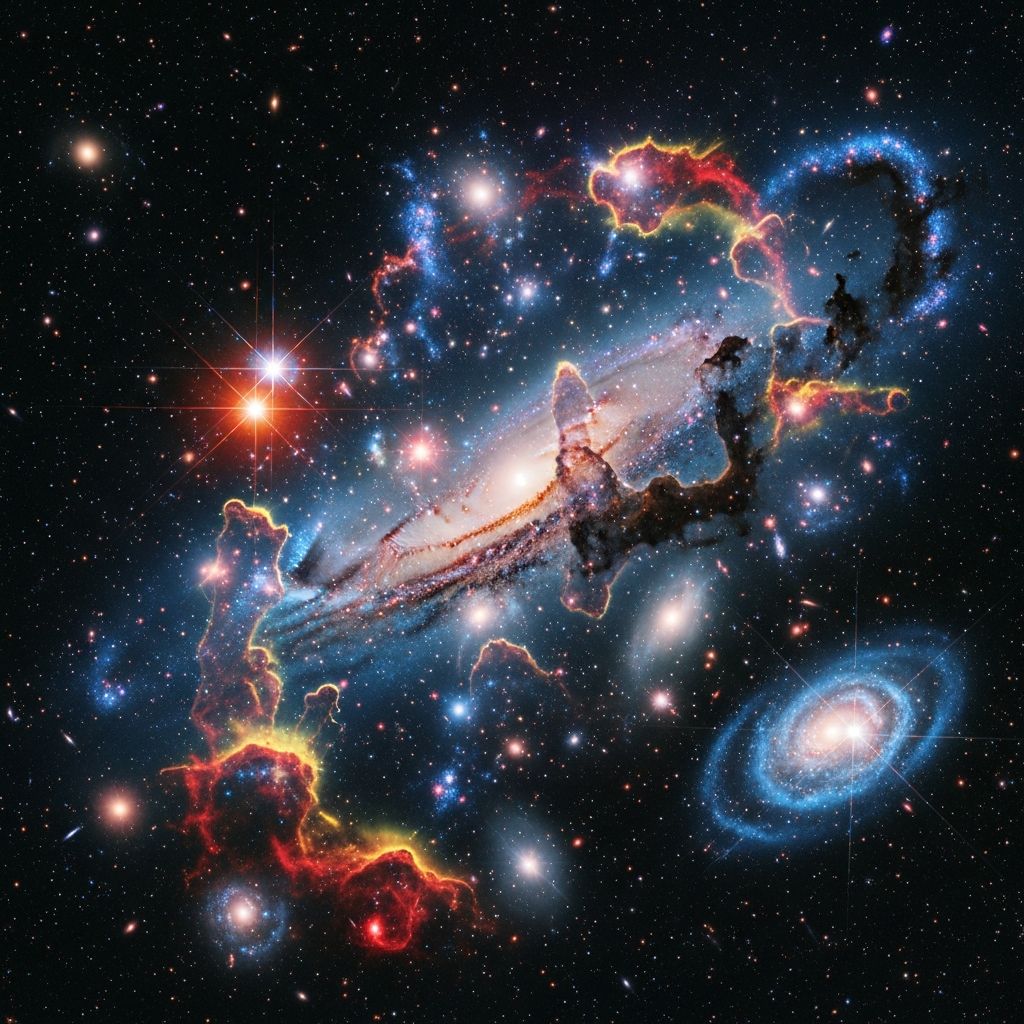
Starburst galaxies represent some of the most dynamic environments in the universe, where stars are born at rates far exceeding those in typical galaxies. These cosmic powerhouses can produce up to 100 solar masses of new stars per year, compared to the Milky Way’s modest 3 solar masses annually. This frenzy of activity lasts only about 100 million years before fuel runs out, making them rare snapshots of galactic evolution.
Defining the Explosive Nature of Starbursts
At their core, starburst galaxies are defined by three key elements: an elevated star formation rate (SFR), abundant molecular gas reserves, and a depletion timescale much shorter than the galaxy’s age. Normal galaxies convert gas to stars over 1-2 billion years, but starbursts exhaust theirs in just 0.1 billion years. Surface densities of star formation in these regions reach 0.1 to 10 solar masses per year per square kiloparsec—orders of magnitude higher than the Milky Way’s average.
This intensity follows the Schmidt law, where SFR scales with gas density raised to a power of about 1.4, explaining why denser environments yield more stars. Unlike steady spiral arms, starbursts concentrate activity in compact nuclear regions, often 100-1000 parsecs across, fueled by dense molecular gas clouds.
Triggers Igniting the Starburst Frenzy
Interactions between galaxies are prime catalysts. Tidal forces from close encounters or mergers compress gas, stripping angular momentum and driving it inward. This leads to rapid cloud collapse and star birth, as seen in the Antennae Galaxies, where two spirals collide to spark a widespread burst.
Internal dynamics also play roles. Nuclear bars destabilize gas orbits, funneling it to centers, while supernova winds and instabilities inject energy to stir molecular clouds. In the local universe, these nuclear starbursts hint at merger remnants, with gas inflows creating centrally peaked formation.
- Galaxy mergers: Most common trigger, enhancing SFR by 30% on average, up to 10-fold in extremes.
- Tidal interactions: Distort disks, accumulate gas in nuclei without full mergers.
- Bar instabilities: Channel gas inward in isolated galaxies.
- High gas accretion: In early universe, smooth inflows fueled disk-wide bursts.
Evolution of Star Formation Across Cosmic Time
Starburst behavior has shifted dramatically. Billions of years ago, during ‘cosmic noon’ (redshift z~2), these galaxies formed stars evenly from core to edges, thanks to high gas accretion rates supplying fuel galaxy-wide. Today, activity clusters in centers, likely from interactions compressing gas locally.
This transition reflects declining gas supplies and rising merger rates in the modern era. Passive galaxies, meanwhile, quench from inside out, with central black holes expelling gas via feedback. Post-starburst galaxies (PSBs) emerge when fuel depletes, showing spectra of recent massive star death but no ongoing formation; they resemble quiescent ellipticals morphologically.
| Era | Star Formation Pattern | Likely Cause |
|---|---|---|
| Early Universe (z>3) | Disk-wide, even distribution | High gas accretion |
| Local Universe (z<1) | Central concentration | Merger-driven inflows |
| Quenched Galaxies | Inside-out cessation | Black hole feedback |
Observing the Hidden Firestorms
Dust shrouds optical views, but massive stars pump ultraviolet light, absorbed and re-emitted as infrared—making starbursts prime infrared luminaries. Telescopes like Spitzer and JWST pierce this veil, revealing polycyclic aromatic hydrocarbon (PAH) features strong in pure starbursts but weak near active galactic nuclei (AGNs).
High-ionization lines flag AGNs, while mid-IR continua from hot dust distinguish them. HST images, like NGC 3049’s center, show compact bursts rivaling entire galaxy SFRs in small areas. Superclusters within reach magnitudes of MV=-15, analogs to early universe formation sites.
Consequences of the Stellar Onslaught
The burst’s vigor self-limits. Supernovae and winds from massive stars sweep gas away, halting formation after ~10^8 years. This leaves ‘fossil’ remnants: shells, ripples, and young populations in merger debris.
Starbursts power galactic winds, enriching intergalactic medium with metals. They may seed supermassive black hole growth via dense gas inflows. As local analogs to high-redshift galaxies, they inform early universe assembly, though selection biases complicate direct comparisons.
Notable Examples Lighting the Cosmos
The Antennae (NGC 4038/39) exemplify merger-driven bursts, with tidal tails and nuclear clusters. NGC 3310 displays UV-bright shells from past interactions. NGC 4569’s nucleus once hit MV=-19. These span spirals in pairs, showing 30-1000% SFR boosts, often nuclear but sometimes disk-wide.
Starbursts in the Broader Cosmic Narrative
These galaxies bridge normal and extreme formation modes. High-redshift surveys find UV spectra matching young bursts, suggesting starbursts dominated early star formation peaks. Their brevity underscores episodic galaxy building: quiet phases punctured by violent episodes reshaping morphology and content.
Future observations with JWST and ELT will probe fainter, distant bursts, refining models of gas physics and feedback. Understanding starbursts illuminates how galaxies like the Milky Way grew through ancestral mergers.
Frequently Asked Questions
What causes a galaxy to become a starburst?
Primarily galaxy interactions or mergers that compress gas into dense clouds, triggering rapid star formation.
How long does a starburst phase last?
Typically 10-100 million years, until gas is depleted by star formation and outflows.
Are starbursts visible to the naked eye?
No, dust obscures them optically; they shine brightest in infrared.
Do all starbursts lead to quenched galaxies?
Many evolve into post-starburst then quiescent states, but some reignite.
How do starbursts differ from AGN?
Starbursts show strong PAH features and lack high-ionization lines; AGNs have hard continua.
References
- Evolving star formation patterns in starburst galaxies over time — Astro3D. 2023. https://astro3d.org.au/evolving-star-formation-patterns-in-starburst-galaxies-over-time/
- Starburst galaxy — Wikipedia (sourced from peer-reviewed refs). 2023. https://en.wikipedia.org/wiki/Starburst_galaxy
- Star Formation in Starburst Galaxies — Claus Leitherer, STScI. 1999. https://www.stsci.edu/science/starburst/Preprints/eslab99.pdf
- Starburst Galaxy — Centre for Astrophysics & Supercomputing, Swinburne University. N/A. https://astronomy.swin.edu.au/cosmos/*/Starburst+Galaxy
- Starburst Galaxies — University of Alabama Astronomy. N/A. https://pages.astronomy.ua.edu/keel/galaxies/starburst.html
- Star formation & starburst galaxies — LAMOST. N/A. http://lifeng.lamost.org/courses/astr553/Topic11/Lecture_11.html

- Integrated M.A. in Applied Linguistics, University of Hyderabad
- 5+ years in editorial, instructional, SEO, and research-based writing
Sneha is a relationships and lifestyle writer with a strong foundation in applied linguistics and certified training in relationship coaching. She brings over five years of writing experience to theskillvault, crafting thoughtful, research-driven content that empowers readers to build healthier relationships, boost emotional well-being, and embrace holistic living. Her writing and insights reflect the belief that beauty, happiness, and wellness…