
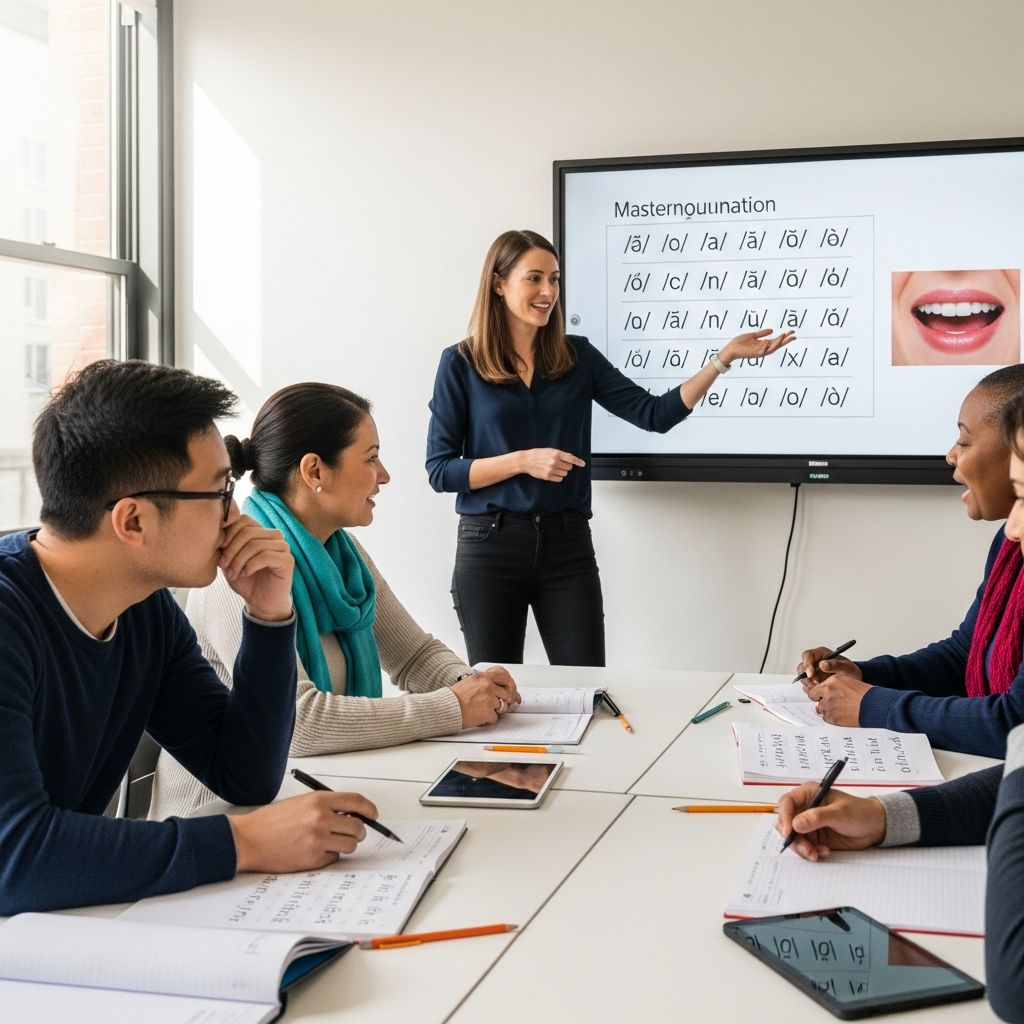
Pronunciation forms the foundation of effective communication in any language learning environment. When learners master clear speech patterns, they gain confidence, improve comprehension, and connect more authentically with native speakers. This guide equips educators with innovative strategies drawn from established linguistic research and classroom-proven practices to transform pronunciation lessons into engaging, results-driven sessions.
Understanding the Essentials of Speech Sounds
At the core of pronunciation teaching lies a deep grasp of phonetics—the study of speech sounds and their production. Educators must first familiarize students with the building blocks of their target language, distinguishing between vowels, consonants, and suprasegmental features like stress and intonation. Research highlights that explicit instruction in these areas significantly enhances articulatory accuracy and listening discrimination.
Begin by introducing the International Phonetic Alphabet (IPA), a universal system for transcribing sounds. This tool allows learners to visualize and replicate precise articulations that may not exist in their native tongue. For instance, demonstrating tongue position for alveolar sounds like /t/ and /d/—placed just behind the upper front teeth—helps learners avoid common errors influenced by languages like Italian, where dental placement is standard.
- Visual Aids: Use cross-sectional diagrams of the vocal tract to illustrate places and manners of articulation.
- Hands-On Demo: Mirror exercises where students watch and copy mouth shapes for tricky phonemes.
- Progression: Start with isolated sounds, then blend into syllables and words.
Integrating articulatory phonetics not only builds muscle memory but also fosters self-awareness, enabling students to self-correct over time.
Imitation and Shadowing: Replicating Native Fluency
One of the simplest yet most powerful techniques is mimicry, where students imitate native speakers to internalize rhythm, intonation, and stress. Studies from as early as 1988 confirm that shadowing—repeating audio immediately after hearing it—leads to natural prosody acquisition, mimicking musical practice for speech.
Incorporate this by selecting high-quality audio clips or videos of clear native speech. Have students shadow short dialogues, focusing on matching timing, pitch variations, and linking sounds. Tools like Sanako Connect facilitate online repetition for remote classes. Advanced learners can tackle TED Talks, transcribing and shadowing segments to build endurance.
| Level | Duration | Focus | Example Material |
|---|---|---|---|
| Beginner | 5-10 seconds | Individual sounds | Simple words like “ship/sheep” |
| Intermediate | 15-30 seconds | Sentences with stress | Daily greetings dialogues |
| Advanced | 1-2 minutes | Full speeches | TED excerpts on familiar topics |
Regular sessions, 15-20 minutes several times weekly, acclimate ears to diverse accents and styles, boosting overall fluency.
Minimal Pairs: Sharpening Sound Discrimination
Minimal pairs—words differing by a single phoneme, such as “ship” and “sheep” (/ɪ/ vs. /iː/)—are invaluable for honing auditory perception and production. These exercises train the brain to detect subtle contrasts often missed due to native language interference.
Present pairs auditorily first: Play recordings and have students identify or select the correct word via flashcards or Bingo games. Transition to production by choral repetition, then individual practice. Peer feedback amplifies learning, as classmates spot errors missed by the teacher.
- Game Integration: Flashcard races or board games for kinesthetic engagement.
- Customization: Tailor pairs to students’ L1 challenges, e.g., /θ/ vs. /ð/ for Spanish speakers (think/this).
- Assessment: Record and playback for self-evaluation.
This method not only clarifies confusable sounds but also builds confidence in real conversations.
Drilling Techniques for Muscle Memory
Drilling involves repetitive choral and individual practice to automate correct forms, creating ‘muscle memory’ for pronunciation. Despite seeming rote, its efficacy in reinforcing intonation, rhythm, and phoneme accuracy is well-documented in language pedagogy.
Select challenging items like “thorough” or “squirrel,” absent in many L1s. Start slow, emphasizing articulators, then accelerate while varying intonation (questioning, exclamatory). Gradually introduce connected speech reductions (“gonna,” “wanna”) for natural flow.
Combine with physical gestures: Clap syllables for stress or wave hands for intonation contours. This multimodal approach—auditory, visual, kinesthetic—caters to diverse learning styles.
Suprasegmentals: Stress, Rhythm, and Intonation
Beyond individual sounds, suprasegmentals—word/sentence stress, rhythm, and intonation—are crucial for intelligibility, especially in stress-timed languages like English. Neglecting these leaves speech sounding robotic or incomprehensible.
Teach syllable stress rules (e.g., nouns often stress first syllable) with color-coding or clapping. For sentences, highlight content words while reducing function words. Intonation practice via role-plays simulates real-life scenarios: rising for yes/no questions, falling for statements.
| Pattern | Example | Purpose |
|---|---|---|
| Word Stress | REcord (noun) vs. reCORD (verb) | Meaning distinction |
| Sentence Stress | I WANT to go. (emphasis) | Highlight key info |
| Intonation Rise | Are you coming?↗ | Yes/no questions |
Early integration prepares students for authentic interactions.
Interactive Activities: Role-Plays and Games
Contextualize practice through role-plays (ordering food, directions) and dialogues, where peers provide pronunciation feedback. Songs and tongue twisters target fun, multi-sound challenges: Start slow, speed up, and compete.
- Tongue Twisters: “She sells seashells” for /ʃ/ and /s/.
- Songs: Sing-alongs for rhythm.
- Role-Plays: Authentic scenarios via pairs or apps.
Recordings for self/peer review reveal discrepancies between production and perception.
Feedback and Progress Tracking
Effective feedback is specific, positive, and multimodal. Encourage self-correction via recordings, celebrate micro-gains, and track with rubrics focusing on clarity over accent perfection. Differentiate by level: Beginners on sounds, advanced on fluency.
Frequently Asked Questions (FAQs)
What is the best age to start pronunciation training?
Pronunciation benefits all ages, but younger learners excel with play-based methods, while adults leverage analytical approaches like IPA.
How often should pronunciation be practiced?
Integrate 15-20 minutes daily or thrice weekly for optimal retention and habit formation.
Can technology aid pronunciation teaching?
Yes, apps for IPA practice, shadowing tools, and AI feedback enhance accessibility and repetition.
Should teachers aim for native-like accents?
No, prioritize intelligibility and confidence; diverse accents enrich communication.
How do I handle fossilized errors?
Use targeted minimal pairs, recordings, and consistent feedback to overwrite ingrained habits.
References
- Teaching pronunciation: a practical guide for language educators — Sanako. 2023. https://sanako.com/teaching-pronunciation-a-practical-guide-for-language-educators
- How to Teach Pronunciation (Step-by-Step) — Barefoot TEFL Teacher. 2023. https://www.barefootteflteacher.com/p/how-to-teach-pronunciation
- Tips and activities for teaching pronunciation — Grade University. 2024. https://grade-university.com/blog/tips-and-activities-for-teaching-pronunciation
- How to Teach Pronunciation — My Tutor Source. 2023. https://ksa.mytutorsource.com/blog/how-to-teach-pronunciation/
- How to Teach ESL Pronunciation and Phonics — BridgeTEFL. 2024. https://bridge.edu/tefl/blog/esl-pronunciation-and-phonics/
- Seven Suggestions of Highly Successful Pronunciation Teaching — JALT Publications. 2021-02. https://jalt-publications.org/tlt/articles/2102-seven-suggestions-highly-successful-pronunciation-teaching
- Essential tips for teaching pronunciation: part 1 — Cambridge English. 2020-09-29. https://www.cambridge.org/elt/blog/2020/09/29/essential-tips-for-teaching-pronunciation-from-elementary-to-advanced-levels-part-1/

Medha Deb is an editor with a master's degree in Applied Linguistics from the University of Hyderabad. She believes that her qualification has helped her develop a deep understanding of language and its application in various contexts. Medha specializes in the areas of beauty, health, sports, and wellness and is committed to ensuring that the content on the website is…