
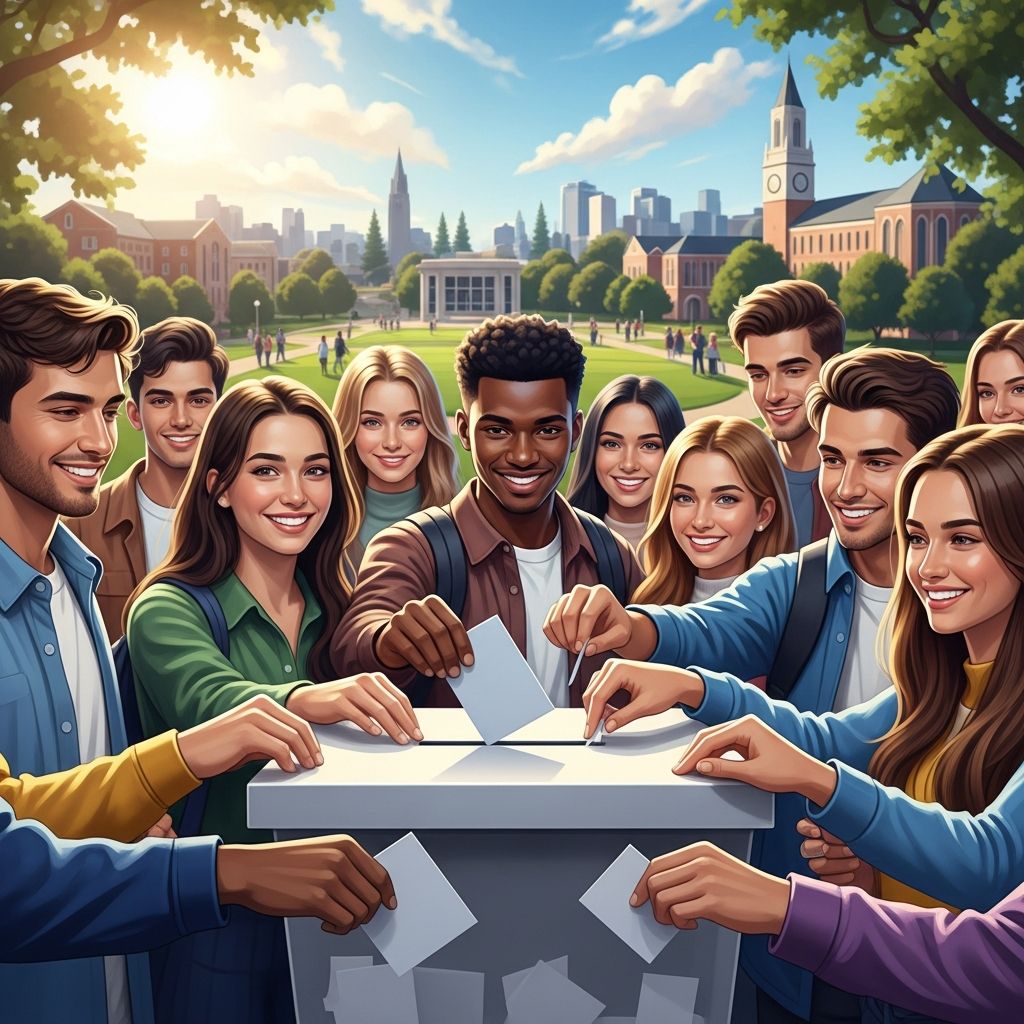
College students represent a dynamic force in American democracy, yet their participation in elections remains lower than other groups. With nearly 18 million students enrolled in higher education, their collective voice could redefine policy landscapes on education, housing, climate, and jobs. This article delves into the critical reasons why voting is not just a right but a responsibility for every college student, backed by data and real-world examples.
The Civic Foundation: Voting as a Democratic Pillar
Voting stands as the cornerstone of participatory democracy, granting citizens the ability to choose leaders and influence governance. For college students, exercising this right fulfills a fundamental civic duty, especially in a nation where many lack such freedoms. The 26th Amendment in 1971 lowered the voting age to 18, recognizing young adults’ stake in society amid the Vietnam War era, affirming that those eligible for the draft deserve a say in leadership.
Higher education institutions have long embraced this mission. A 1947 report by President Truman’s Commission on Higher Education called universities ‘democracy’s necessity,’ preparing students for active citizenship. Today, programs like the ALL IN Campus Democracy Challenge engage over nine million students in nonpartisan voting efforts, linking academics to real-world policy.
Your Ballot’s Direct Line to Student Life Policies
Elections at federal, state, and local levels directly shape college experiences. Federal votes impact Pell Grants, student loans, and work-study programs, which billions of dollars fund annually. State representatives decide university budgets from tax revenues, affecting tuition, campus services, and aid.
Consider housing and transportation: Local policies on affordable rentals and public transit ease student commutes and living costs. Minimum wage laws and job creation initiatives, often debated in midterms, support post-graduation stability. In 2020, about 50% of 18-29-year-olds and 66% of college students voted in the presidential election, demonstrating growing influence despite barriers.
| Election Level | Key Student Issues Affected | Examples |
|---|---|---|
| Federal | Student aid, loans | Pell Grants, work-study funding |
| State | University budgets, tuition | Tax-based higher ed support |
| Local | Housing, transit | Affordable rentals, bus routes |
Amplifying Influence: The Power of the Student Voting Bloc
College students form a formidable bloc—around 18 million strong—capable of tipping elections. Recent midterms show youth turnout surging: from 19% in 2014 to 40% in 2018, outpacing general increases by 7 points. Close races, sometimes decided by hundreds of votes, underscore individual impact.
Diverse demographics amplify this: Nearly half of public college students are non-White, with many low-income or first-generation, closing equity gaps through voting advances representation. In 2024, with 33 Senate seats and all 435 House seats contested, plus a presidential race, young voters could sway outcomes.
- Historical low turnout due to mobility, no ID, or campaign oversight.
- Recent rises via campus programs prove change possible.
- Trust in universities boosts registration when nonpartisan info provided.
Breaking Barriers: Common Hurdles and Solutions
Many students skip voting citing disconnection—57% of 18-24-year-olds express democratic dissatisfaction—or logistics like deadlines and relocation. Gerrymandering and complex systems add friction.
Solutions abound: Universities offer registration drives, absentee voting guides, and early polling. The Student Voting Bill of Rights advocates fair access for all eligible students. Presidential commitments via ALL IN push 100% registration goals.
Habit formation starts early; school encouragement yields lifelong patterns. Civic education separates facts from fiction, fostering informed leaders.
Broader Societal Ripples: Beyond the Ballot Box
Voting sparks deeper engagement—volunteering, advocacy, attending meetings. Issues like climate, justice, and health tie to policy at every level. Students studying these fields see direct links: environmental regs from Congress, local equity from city halls.
Nonparticipation silences voices on debt relief, mental health funding, or tech jobs. Collective action via campus challenges reached millions, promoting holistic democracy.
Action Steps: From Registration to Polling Day
- Register: Use campus drives or online portals; update for new addresses.
- Research: Compare candidate stances on student priorities via nonpartisan sites.
- Plan: Check early/absentee options; many states allow campus voting.
- Engage: Join voter drives, educate peers.
- Vote: Turnout builds power—your participation inspires others.
Key Statistics on Student Voting Trends
| Year/Event | Student Turnout | Comparison | Source |
|---|---|---|---|
| 2020 Presidential | 66% (college students) | 50% (18-29 overall) | |
| 2018 Midterms | 40% | +7 pts over national | |
| 2014 Midterms | 19% | Baseline low |
These figures highlight momentum; sustaining it requires action.
Frequently Asked Questions (FAQs)
Why does my single vote matter in national elections?
Races often hinge on slim margins—local and state levels especially. Millions of students amplify impact.
Can I vote if I’m registered in my home state but at college elsewhere?
Yes, via absentee or change registration; check state rules for options.
How do universities help with voting?
Many host drives, provide info, and commit to full registration via initiatives like ALL IN.
What if I’m an international student?
Only U.S. citizens vote; others engage through advocacy.
Does voting affect financial aid or campus life?
Indirectly yes—policies on aid, housing stem from elected officials.
References
- Why College Students Should Vote — University of Tennessee at Chattanooga. 2023. https://www.utc.edu/enrollment-management-and-student-affairs/dean-of-students/mocs-go-vote/why-vote
- Importance of Voting in 2024: Why It Should Top Your College To-Do List — St. John’s University. 2024-10-01. https://www.stjohns.edu/news-media/johnnies-blog/importance-of-voting-2024-why-it-matters
- Why College Student Voting Matters — National Study of Learning, Voting, and Engagement (NSLVE), Tufts University. 2023. https://nslve.tufts.edu/about-us/our-work/why-college-student-voting-matters
- The Student Vote: Why It Counts and How Colleges Can Help — Fair Elections Center via University Business. 2022-01-05. https://fairelectionscenter.org/media/the-student-vote-why-it-counts-and-how-colleges-can-help-in-the-process/
- Why Student Voters Matter — Campus Vote Project. 2024. https://campusvoteproject.org/why-student-voters-matter/
- A Nonpartisan Initiative Empowers College Students to Go ALL IN as Voters — Andrew W. Mellon Foundation. 2023. https://www.mellon.org/grant-story/a-nonpartisan-initiative-empowers-college-students-to-go-all-in-as-voters
- College Students Don’t Turn Out to Vote. Here’s How to Change That — Harvard Kennedy School Carr Center. 2023. https://www.hks.harvard.edu/centers/carr/publications/college-students-dont-turn-out-vote-heres-how-change

- Integrated M.A. in Applied Linguistics, University of Hyderabad
- 5+ years in editorial, instructional, SEO, and research-based writing
Sneha is a relationships and lifestyle writer with a strong foundation in applied linguistics and certified training in relationship coaching. She brings over five years of writing experience to theskillvault, crafting thoughtful, research-driven content that empowers readers to build healthier relationships, boost emotional well-being, and embrace holistic living. Her writing and insights reflect the belief that beauty, happiness, and wellness…