
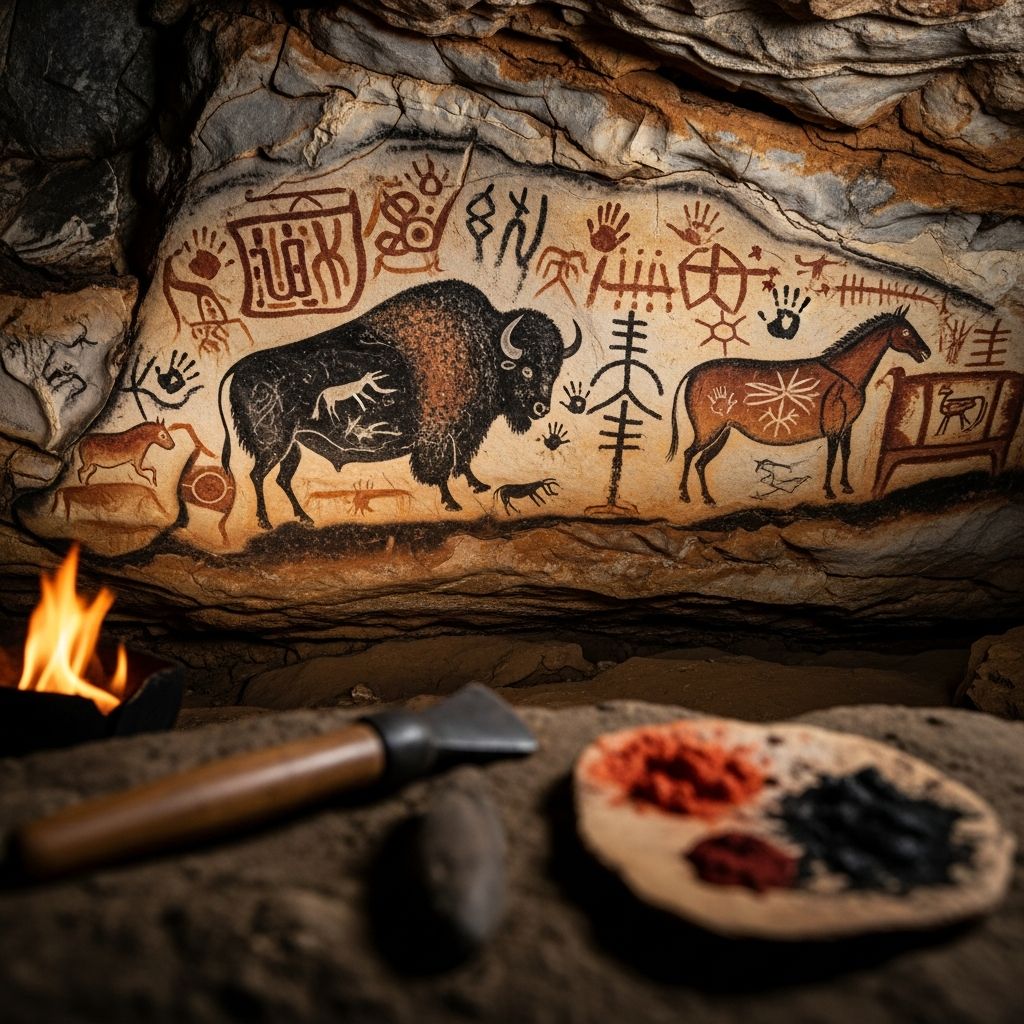
The Paleolithic period, spanning from roughly 30,000 BCE to 10,000 BCE, marks the dawn of human artistic expression. During this Old Stone Age era, early modern humans created some of the world’s oldest known artworks, including vivid cave paintings, intricate sculptures, and engraved artifacts. These creations, found primarily in caves across Europe, offer profound insights into the cognitive and cultural lives of our ancestors.
Defining the Paleolithic Era and Its Artistic Legacy
The term ‘Paleolithic’ refers to the ‘Old Stone Age,’ a time when hunter-gatherer societies relied on rudimentary stone tools for survival. Artistic production emerged prominently in the Upper Paleolithic, starting around 40,000 years ago, coinciding with the arrival of Homo sapiens in Europe. While earlier Middle Paleolithic artifacts show hints of aesthetic sensibility, such as symmetrical tools, undisputed art begins here.
Two primary categories dominate: parietal art—fixed wall paintings and engravings in caves—and portable or pocket art, like small figurines and decorated objects carried by nomadic groups. These works blend realism with abstraction, depicting animals, humans, and geometric patterns with remarkable skill.
Major Discoveries: Caves That Rewrite History
Europe’s limestone caves preserve the bulk of Paleolithic masterpieces, especially in southern France and northern Spain. Over 200 sites have been identified, each a time capsule of prehistoric ingenuity.
- Chauvet-Pont-d’Arc Cave (France, ~30,000 BCE): Discovered in 1994, this vast cavern boasts hundreds of animal depictions, including rare predators like lions, rhinos, and hyenas alongside herbivores. The artwork’s preservation and dynamism make it one of the oldest and finest examples.
- Lascaux Cave (France, ~17,000 BCE): Famous for its ‘Hall of Bulls,’ featuring massive aurochs up to 17 feet long. Polychrome techniques create lifelike motion, suggesting advanced observational skills.
- Altamira Cave (Spain, ~36,000–12,000 BCE): Known as the ‘Sistine Chapel of Prehistory’ for its ceiling bison painted in vivid reds and blacks.
- Pech Merle (France, ~25,000 BCE): Showcases spotted horses and hand stencils, blending human and animal motifs.
Beyond Europe, evidence extends to Indonesia (Borneo pig painting, ~40,000 years old) and South Africa’s Blombos Cave (~75,000 years ago), with ochre engravings hinting at even earlier symbolism.
Techniques and Materials: Tools of the Stone Age Artist
Paleolithic artists improvised with natural pigments: charcoal for black, iron oxides for reds and yellows, mixed with binders like saliva or fat. Application methods included finger painting, blowing pigment through reeds for stencils, and engraving with flint tools.
Scales varied dramatically—from tiny Venus figurines (4–10 cm) to sprawling mural scenes. Lighting came from flickering oil lamps made of stone bowls filled with animal fat and moss wicks, casting dramatic shadows that may have enhanced the art’s mystical effect.
| Technique | Description | Examples |
|---|---|---|
| Engraving | Scratching lines into rock or bone | Chauvet horse outlines |
| Painting | Brushing or blowing pigments | Lascaux bulls |
| Stencil | Hand outlines with sprayed color | Pech Merle negatives |
| Sculpture | Carving ivory, stone, or clay | Venus of Willendorf |
Iconography: Animals, Humans, and Symbols
Animals dominate, portrayed with anatomical precision—muscles rippling, horns curving realistically. Herbivores like bison, deer, and horses prevail, but predators appear too, possibly symbolizing power or danger.
Human figures are rare and often hybrid: therianthropes (half-human, half-animal) like the ‘Sorcerer’ in Les Trois Frères or wounded man in Lascaux, suggesting shamanic themes.
Abstract signs—dots, lines, claviforms (club shapes)—comprise up to 50% of motifs, their meanings debated as maps, tallies, or spiritual notations.
Debating the Purpose: Rituals, Magic, or Storytelling?
Why create art in deep, dark caves? Theories abound:
- Hunting Magic: Images as sympathetic magic to ensure prey abundance, supported by arrow-pierced animals.
- Fertility Rites: Venus figurines with exaggerated features linked to reproduction.
- Shamanism: Caves as spirit realms; art induced trance via isolation and acoustics.
- Information Exchange: Scenes narrating hunts or migrations, aiding social communication.
- Aesthetic Drive: Pure expression of human creativity, recording the world.
Recent studies propose cave art marked cognitive shifts toward symbolic language, with patterns evolving into complex narratives.
Portable Art: Sculptures in Hand
Mobile pieces include voluptuous ‘Venus’ statuettes from across Eurasia, like the Venus of Willendorf (Austria, ~25,000 BCE), carved from limestone with braided hair and massive breasts/hips symbolizing fertility.
Animal carvings in mammoth ivory, such as the Swabian Germany’s ‘Lion Man’ (~40,000 BCE), blend human-animal forms, evidencing advanced abstract thought.
Blombos Cave’s shell beads and crosshatched ochre (~75,000 BCE) push symbolic art’s timeline back, possibly to early Homo sapiens in Africa.
Global Reach: Beyond Europe’s Caves
While Franco-Cantabrian caves shine brightest, art spans continents:
- Africa: Blombos engravings, oldest abstract designs.
- Asia: Borneo’s 40,000-year-old pig; Sulawesi’s 51,200-year-old figures.
- Near East: Hayonim Cave’s Levantine horse (~28,000 BCE).
Neanderthal contributions, like 51,000-year-old bone carvings, blur species lines in creativity.
Preservation Challenges and Modern Insights
Fragile pigments demand climate control; replicas like Lascaux II protect originals from tourism. Uranium-thorium dating refines chronologies, revealing multi-phase use over millennia.
These works affirm early humans’ rich inner worlds, challenging views of ‘primitive’ minds.
Frequently Asked Questions (FAQs)
What is the oldest known Paleolithic art?
Chauvet Cave paintings (~30,000 BCE) and Blombos engravings (~75,000 BCE) vie for the title, with Indonesian finds at ~51,000 years.
Why were animals the main subject?
As central to survival, they likely held ritual, magical, or narrative significance.
Did Neanderthals create art?
Evidence like 51,000-year-old carvings suggests yes, overlapping with early modern humans.
How was pigment applied?
Via fingers, brushes, sprays, or engravings using natural earth tones.
What do Venus figurines represent?
Probably fertility symbols, emphasizing reproductive traits.
References
- Paleolithic Art – Art and Visual Culture: Prehistory to Renaissance — BC Campus Pressbooks. 2023. https://pressbooks.bccampus.ca/cavestocathedrals/chapter/paleolithic/
- Why Did Our Paleolithic Ancestors Paint Cave Art? — Discover Magazine. 2009-11-01. https://www.discovermagazine.com/why-did-our-paleolithic-ancestors-paint-cave-art-44437
- Paleolithic art, an introduction — Smarthistory. 2023. https://smarthistory.org/paleolithic-art-an-introduction/
- Paleolithic Period – Art, Tools, Hunter-Gatherers — Encyclopaedia Britannica. 2024. https://www.britannica.com/event/Paleolithic-Period/Paleolithic-art
- Art of the Upper Paleolithic — Wikipedia (informed by primary sources). 2024-07-03. https://en.wikipedia.org/wiki/Art_of_the_Upper_Paleolithic
- Paleolithic art, an introduction — Khan Academy. 2023. https://www.khanacademy.org/humanities/ap-art-history/global-prehistory-ap/paleolithic-mesolithic-neolithic-apah/a/paleolithic-art-an-introduction

- Integrated M.A. in Applied Linguistics, University of Hyderabad
- 5+ years in editorial, instructional, SEO, and research-based writing
Sneha is a relationships and lifestyle writer with a strong foundation in applied linguistics and certified training in relationship coaching. She brings over five years of writing experience to theskillvault, crafting thoughtful, research-driven content that empowers readers to build healthier relationships, boost emotional well-being, and embrace holistic living. Her writing and insights reflect the belief that beauty, happiness, and wellness…