
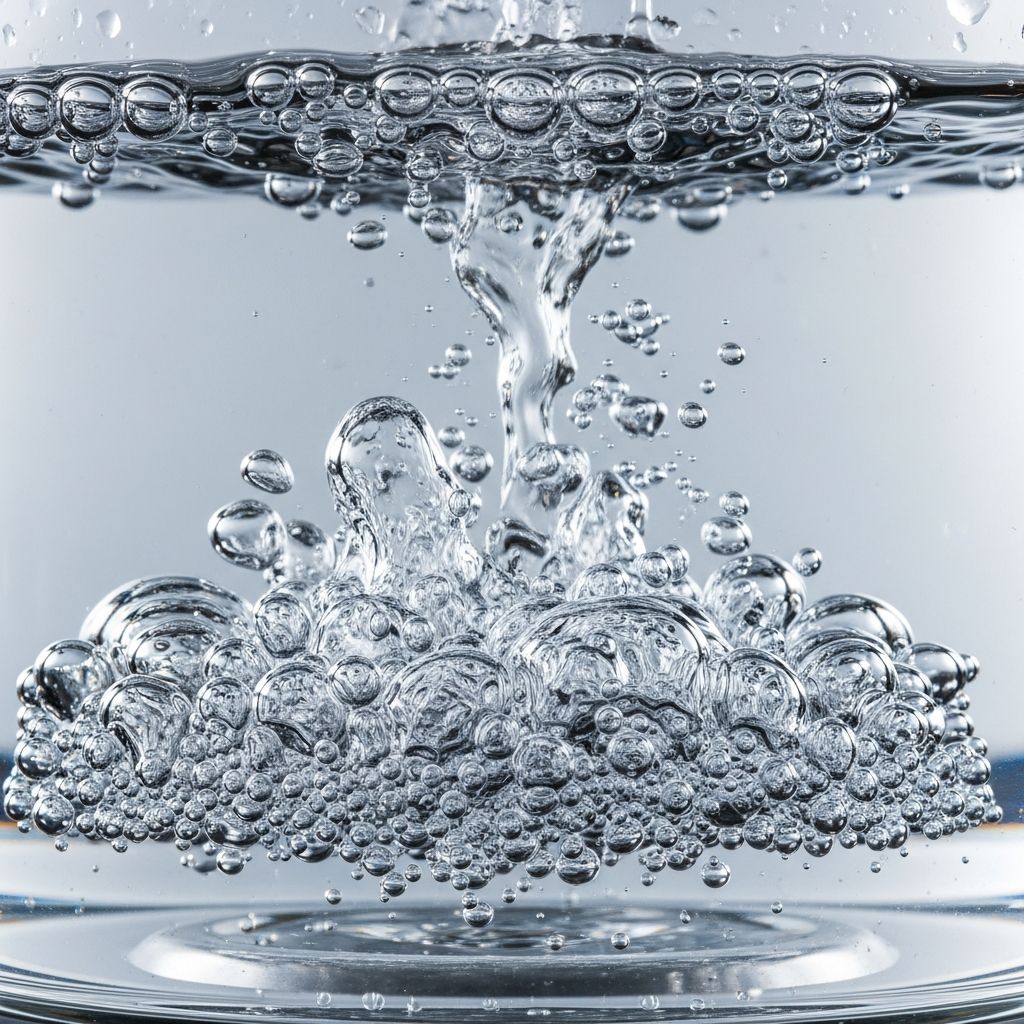
When you place a pot of water on the stove, one of the first signs of heating is the appearance of small bubbles rising from the bottom. These bubbles grow larger and more frequent as the temperature climbs, culminating in a vigorous rolling boil. But what exactly are these bubbles made of, and why do they form? This article delves into the physics and chemistry of boiling water, distinguishing between initial air bubbles and true water vapor bubbles, exploring the mechanics of bubble formation, and explaining unique phenomena like superheating in microwaves.
The Initial Stage: Air Bubbles Emerge First
As water heats up from room temperature, the very first bubbles you notice are not water vapor at all. Instead, they consist primarily of dissolved gases from the atmosphere, such as nitrogen, oxygen, and carbon dioxide. Water naturally holds these gases in solution under normal pressure, much like a carbonated beverage.
Heating reduces the solubility of these gases in water. As temperature rises, the gases come out of solution and form tiny bubbles that rise to the surface. These early bubbles are small and sparse, often clinging to the sides or bottom of the pot before detaching. Their composition mirrors the surrounding air: roughly 78% nitrogen, 21% oxygen, and trace amounts of other gases.
- Nitrogen (N₂): Most abundant dissolved gas, bubbles out due to weak van der Waals forces at relatively low temperatures.
- Oxygen (O₂): Follows similar behavior, contributing to the initial fizzing effect.
- Carbon Dioxide (CO₂): Releases at slightly higher temperatures due to dipole-dipole interactions.
This degassing phase continues until most dissolved air is expelled, typically around 70-90°C. If you cool the water and reboil it immediately, far fewer of these initial bubbles appear, confirming their gaseous origin.
Transition to True Boiling: Water Vapor Takes Over
Once the bulk of dissolved air is gone, the dynamics shift. At approximately 100°C (212°F) at sea level, water reaches its boiling point—the temperature where its vapor pressure equals atmospheric pressure. Here, liquid water molecules gain sufficient kinetic energy to break free from hydrogen bonds and transition to the gaseous phase, forming bubbles of pure water vapor.
These vapor bubbles nucleate around imperfections: scratches on the pot’s surface, tiny particles, or residual air pockets. Without such sites, forming a bubble requires overcoming significant surface tension, which acts to minimize the gas-liquid interface.
| Stage | Temperature Range | Bubble Composition | Key Process |
|---|---|---|---|
| Heating | 20-90°C | Dissolved air (N₂, O₂, CO₂) | Degassing |
| Pre-boil | 90-100°C | Mix of air and vapor | Nucleation begins |
| Full Boil | 100°C+ | Water vapor only | Vapor pressure = atmospheric pressure |
At full boil, bubbles form rapidly at the bottom, rise, expand due to decreasing pressure, and burst at the surface, releasing steam. Importantly, boiling water does not decompose into hydrogen and oxygen gas; the bubbles are H₂O in gaseous form, not elemental gases.
The Physics of Bubble Formation: Nucleation and Surface Tension
Bubble creation is governed by a delicate balance of energies. Water’s boiling point marks when vapor is thermodynamically favored, but forming a bubble incurs an energy cost due to surface tension—the cohesive force shrinking the bubble’s surface area.
Small bubbles have a high surface-area-to-volume ratio, making surface tension dominant and prone to collapse. Larger bubbles, with more volume relative to surface, are stable once formed. This is why water often superheats slightly above 100°C before boiling vigorously—extra heat provides the activation energy for bubble initiation.
Nucleation sites lower this barrier. Rough pot surfaces or impurities allow bubbles to form as partial spheres (hemispheres), halving the surface area needed and thus the energy cost. That’s why bubbles first appear at the pot’s edges or bottom hotspots.
Superheating: When Water Boils Without Bubbles
In ideal conditions—clean container, pure water, even heating—water can exceed 100°C without boiling, a state called superheating. Lacking nucleation sites, no bubbles form despite the liquid being primed for vaporization.
Microwaves exemplify this. They heat water volumetrically from microwave agitation of molecules, creating uniform temperature without hotspots. In a smooth glass or ceramic mug, superheating up to 120°C (248°F) is possible. Disturbing the vessel (e.g., adding tea) triggers explosive boiling as a massive vapor bubble erupts, potentially causing burns.
Safety Tip: Avoid Microwave Superheating
Use a microwave-safe container with a rough interior or add a wooden stir stick to promote nucleation. Never heat water alone in a microwave beyond 2 minutes.
Superheating occurs in any liquid but is pronounced in water due to its high surface tension. Other liquids with lower tension boil more readily.
Types of Boiling: Beyond Nucleate Boiling
Boiling isn’t uniform. Key regimes include:
- Nucleate Boiling: Bubbles form, detach, and rise—efficient heat transfer, typical in pots.
- Transition Boiling: Partial vapor film forms, reducing efficiency.
- Film Boiling: Vapor blanket insulates liquid from heat source (Leidenfrost effect), seen with water droplets on hot pans. Droplets ‘dance’ on vapor cushions.
Understanding these aids engineering, like nuclear reactor cooling or cooking efficiency.
Factors Affecting Bubble Behavior
Several variables influence boiling:
- Altitude: Lower pressure raises boiling point (e.g., 93°C at 2000m), producing smaller, faster-rising bubbles.
- Impurities: Salt or minerals enhance nucleation, speeding boiling onset.
- Container Material: Copper conducts heat better than glass, promoting even bubbling.
- Pressure: Pressure cookers raise boiling point to 121°C, killing bacteria faster.
Boiling point also varies with purity: pure water boils at exactly 100°C; tap water slightly lower due to solutes.
Common Misconceptions About Boiling Water
Myth 1: Bubbles are always hydrogen and oxygen. False—boiling doesn’t electrolyze water; it’s phase change to vapor.
Myth 2: More heat means hotter boiling water. No, temperature stabilizes at boiling point; excess heat increases bubble rate, not temperature.
Myth 3: All bubbles mean boiling. Early air bubbles precede true boiling.
Practical Applications and Experiments
Try this at home: Boil tap water, note small bubbles early. Cool, reboil—fewer initial bubbles. Microwave distilled water carefully to observe superheating (with safety precautions).
In labs, boiling studies inform heat exchangers, climate models (ocean boiling dynamics), and food science (pasta cooking optima).
Frequently Asked Questions (FAQs)
What are the tiny bubbles when first heating water?
They are dissolved air gases (nitrogen, oxygen) escaping as solubility decreases.
Are boiling bubbles water vapor or steam?
Yes, at full boil, bubbles are water vapor; steam is the visible mist post-burst.
Why no bubbles in microwave-boiled water?
Uniform heating and lack of nucleation sites cause superheating until disturbed.
Can water boil above 100°C?
Yes, in superheated states or under pressure (e.g., pressure cookers).
Is boiled water safe to drink immediately?
Yes, but let it cool; reboiling degassed water boils smoother.
References
- Why does boiling water have bubbles, except in a microwave? — Live Science. 2023-06-12. https://www.livescience.com/chemistry/why-does-boiling-water-have-bubbles-except-in-a-microwave
- What Are The Bubbles Made Of When Water Boils? — ScienceABC. 2024-01-15. https://www.scienceabc.com/pure-sciences/what-are-the-bubbles-made-of-when-water-boils
- What Are the Bubbles in Boiling Water? — Science Notes. 2023-11-08. https://sciencenotes.org/what-are-the-bubbles-in-boiling-water/
- What are the bubbles in boiling water? How can you boil without bubbles? — YouTube (Steve Mould). 2022-05-20. https://www.youtube.com/watch?v=A5D-ICLmbfA

Medha Deb is an editor with a master's degree in Applied Linguistics from the University of Hyderabad. She believes that her qualification has helped her develop a deep understanding of language and its application in various contexts. Medha specializes in the areas of beauty, health, sports, and wellness and is committed to ensuring that the content on the website is…