
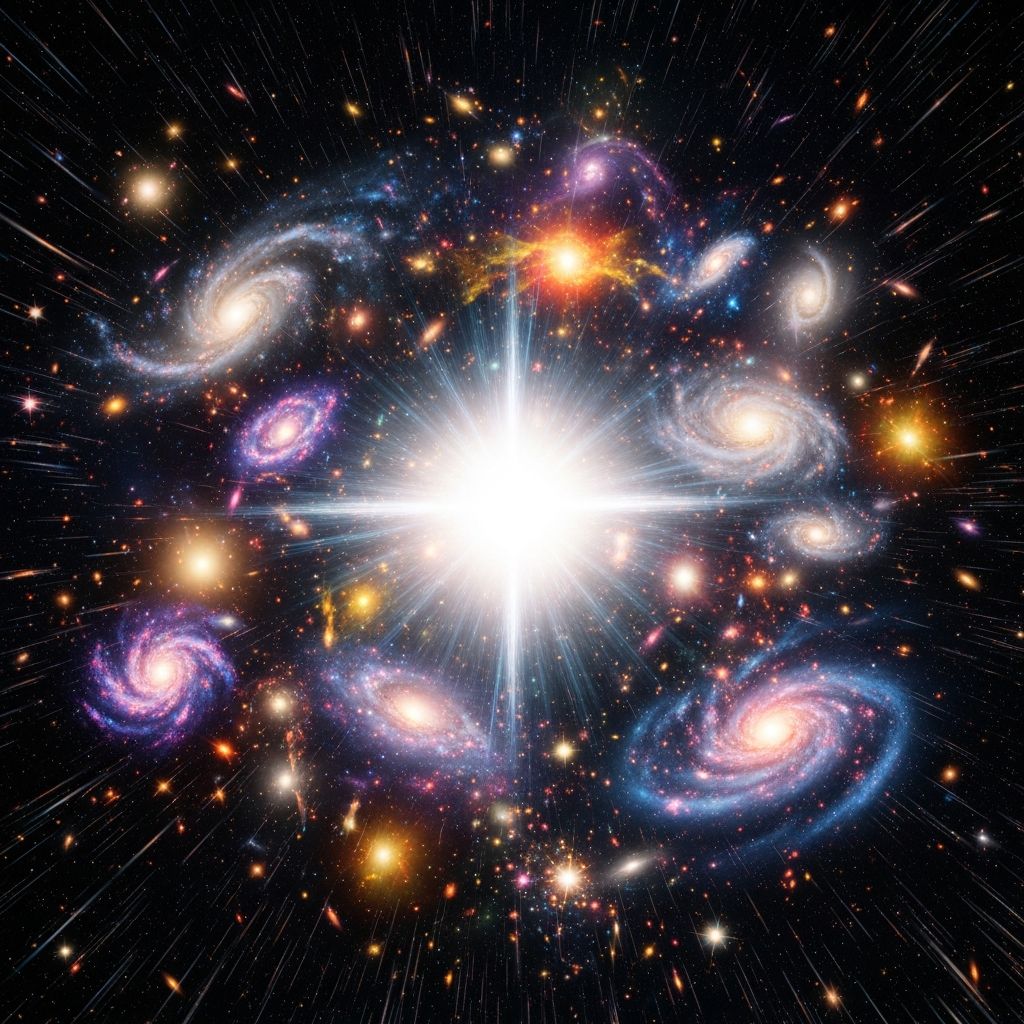
The Big Bang theory posits that the universe originated from an extraordinarily hot and dense state approximately 13.8 billion years ago, expanding rapidly to form the vast cosmos we observe today.
Core Principles of Cosmic Genesis
At its heart, the Big Bang describes not an explosion in space but the expansion of space itself from a singularity—a point of infinite density and temperature where the laws of physics as we know them break down. This model, part of the standard cosmological framework, accounts for the universe’s evolution from this initial condition through phases of cooling and structure formation.
Unlike classical explosions, the Big Bang involves every point in space stretching uniformly. Galaxies recede from each other at speeds proportional to their distance, a phenomenon captured by Hubble’s law. This implies that in the distant past, all matter was concentrated in a much smaller volume, rewinding the clock to the universe’s birth.
Timeline of the Early Universe
The universe’s first moments unfolded in fractions of a second. Immediately after the singularity, during a phase known as cosmic inflation, space expanded faster than light, smoothing out irregularities and setting the stage for uniformity. This ultra-rapid growth, proposed by physicist Alan Guth in 1980, lasted about 10^-32 seconds and resolved issues like the horizon problem, where distant regions appear surprisingly similar.
Post-inflation, the universe cooled from trillions of degrees. Within the first second, fundamental particles like quarks, electrons, protons, and neutrons formed as energy converted to matter. By three minutes, Big Bang nucleosynthesis (BBN) occurred: protons and neutrons fused into light atomic nuclei, primarily hydrogen (75%) and helium (25%), with traces of lithium and beryllium. These abundances match observations precisely, providing strong model validation.
For the next 380,000 years, the universe was a hot plasma of electrons and nuclei, opaque to light. As it expanded and cooled to about 3,000 K, electrons combined with nuclei to form neutral atoms in recombination, allowing photons to travel freely. This released the cosmic microwave background (CMB), a faint glow permeating space today at 2.7 K.
| Time After Big Bang | Temperature | Key Event |
|---|---|---|
| 10^-32 seconds | Extremely high | Cosmic inflation |
| 1 second | Billions of K | Quarks form protons/neutrons |
| 3 minutes | 10^9 K | Nucleosynthesis (H, He formation) |
| 380,000 years | 3,000 K | Recombination, CMB release |
| 100-400 million years | Cooler | First stars and galaxies |
Observational Pillars Supporting the Theory
Several lines of evidence converge to affirm the Big Bang. First, Hubble’s law: distant galaxies exhibit redshift, indicating recession speeds increasing with distance, consistent with uniform expansion. Measurements from telescopes like Hubble and James Webb refine the expansion rate, pinning the universe’s age at 13.787 ± 0.02 billion years.
Second, the CMB, discovered accidentally in 1964 by Arno Penzias and Robert Wilson (1978 Nobel laureates), is the afterglow of the early universe. Its blackbody spectrum and tiny temperature fluctuations (1 part in 100,000) match Big Bang predictions exactly, mapped precisely by satellites like COBE, WMAP, and Planck.
Third, BBN predictions for light element ratios align with stellar and interstellar measurements, impossible to explain without a hot, dense early phase. Additionally, the large-scale structure—galaxies clustered in filaments and voids—evolved from CMB fluctuations amplified by gravity over billions of years.
- Redshift of Galaxies: Demonstrates ongoing expansion.
- CMB Uniformity: Snapshot of the universe at 380,000 years old.
- Element Abundances: Legacy of primordial fusion.
- Structure Formation: From quantum seeds to cosmic web.
Addressing Cosmological Puzzles with Inflation
The basic Big Bang model faced challenges: why is the universe so flat and uniform across vast distances that never interacted (horizon problem)? Why isn’t it curved as expected from linear expansion (flatness problem)? Inflation solves these by proposing an exponential expansion phase, diluting irregularities and inflating a tiny flat patch to cosmic scales.
During inflation, quantum fluctuations were stretched to macroscopic sizes, seeding density variations that gravity later amplified into galaxies. CMB anisotropies confirm this, with patterns matching inflationary models. Though unproven directly, inflation is widely accepted as it unifies diverse observations.
From Plasma to Stars: Building the Cosmos
After recombination, the universe entered the dark ages, a foggy era without light sources. Gravity clumped neutral hydrogen into the first stars around 100-400 million years post Big Bang, igniting via fusion and ionizing surrounding gas. These Population III stars were massive, short-lived, forging heavier elements through stellar nucleosynthesis.
Supernovae from these stars enriched the interstellar medium, enabling smaller, long-lived Population II and I stars. Galaxies merged and grew, forming clusters and superclusters. Today, the universe continues expanding, accelerated by dark energy since about 5 billion years ago.
Particle accelerators like the LHC recreate Big Bang conditions, confirming electroweak symmetry breaking around 10^-12 seconds, when the Higgs field endowed particles with mass. This bridges cosmology and particle physics.
Challenges and Frontiers in Big Bang Cosmology
Despite triumphs, mysteries persist. The singularity evades general relativity, demanding quantum gravity theories like string theory or loop quantum gravity. What triggered inflation or preceded the Big Bang? Baryon asymmetry—why more matter than antimatter—remains unsolved, probed by LHC experiments.
Tensions in Hubble constant measurements (Hubble vs. CMB-derived) hint at new physics. Dark matter (27% of energy budget) and dark energy (68%) dominate, yet evade direct detection. Upcoming missions like Euclid and Rubin Observatory will map structures to test models.
Frequently Asked Questions
What exactly was the Big Bang?
It was the rapid expansion of space from a hot, dense singularity, not an explosion of matter into empty space.
How old is the universe according to the Big Bang?
Precisely 13.8 billion years, based on expansion rate and CMB data.
Does the Big Bang explain what caused the universe?
No, it describes evolution from 10^-43 seconds onward; the ultimate cause remains unknown.
What is the cosmic microwave background?
Relic radiation from when the universe became transparent at 380,000 years old.
Is the Big Bang theory proven?
It’s the best-supported model, backed by multiple independent observations, though refinements continue.
Future Probes into Cosmic Dawn
Next-generation telescopes like the James Webb Space Telescope peer back to the first galaxies, testing reionization timelines. Gravitational wave detectors may glimpse inflation-era ripples. These efforts refine the Lambda-CDM model, incorporating dark components.
In summary, the Big Bang weaves a coherent narrative from primordial plasma to starry realms, grounded in empirical rigor. As observations advance, it evolves, illuminating our place in the cosmos.
References
- Big Bang – Wikipedia — Wikipedia Contributors. 2026-04-01. https://en.wikipedia.org/wiki/Big_Bang
- Big Bang Theory: Overview — EBSCO Research Starters. 2023-01-15. https://www.ebsco.com/research-starters/physics/big-bang-theory-overview
- The big bang — Institute of Physics. 2024-05-20. https://www.iop.org/explore-physics/big-ideas-physics/big-bang
- What is the Big Bang Theory? — Space.com. 2024-11-10. https://www.space.com/25126-big-bang-theory.html
- It all started with a Big Bang — MIT Physics. 2014-03-20. https://physics.mit.edu/news/it-all-started-with-a-big-bang-the-quest-to-unravel-the-mystery-behind-the-birth-of-the-universe/
- What Is the Big Bang? — NASA Space Place. 2025-02-14. https://spaceplace.nasa.gov/big-bang/

- Integrated M.A. in Applied Linguistics, University of Hyderabad
- 5+ years in editorial, instructional, SEO, and research-based writing
Sneha is a relationships and lifestyle writer with a strong foundation in applied linguistics and certified training in relationship coaching. She brings over five years of writing experience to theskillvault, crafting thoughtful, research-driven content that empowers readers to build healthier relationships, boost emotional well-being, and embrace holistic living. Her writing and insights reflect the belief that beauty, happiness, and wellness…