
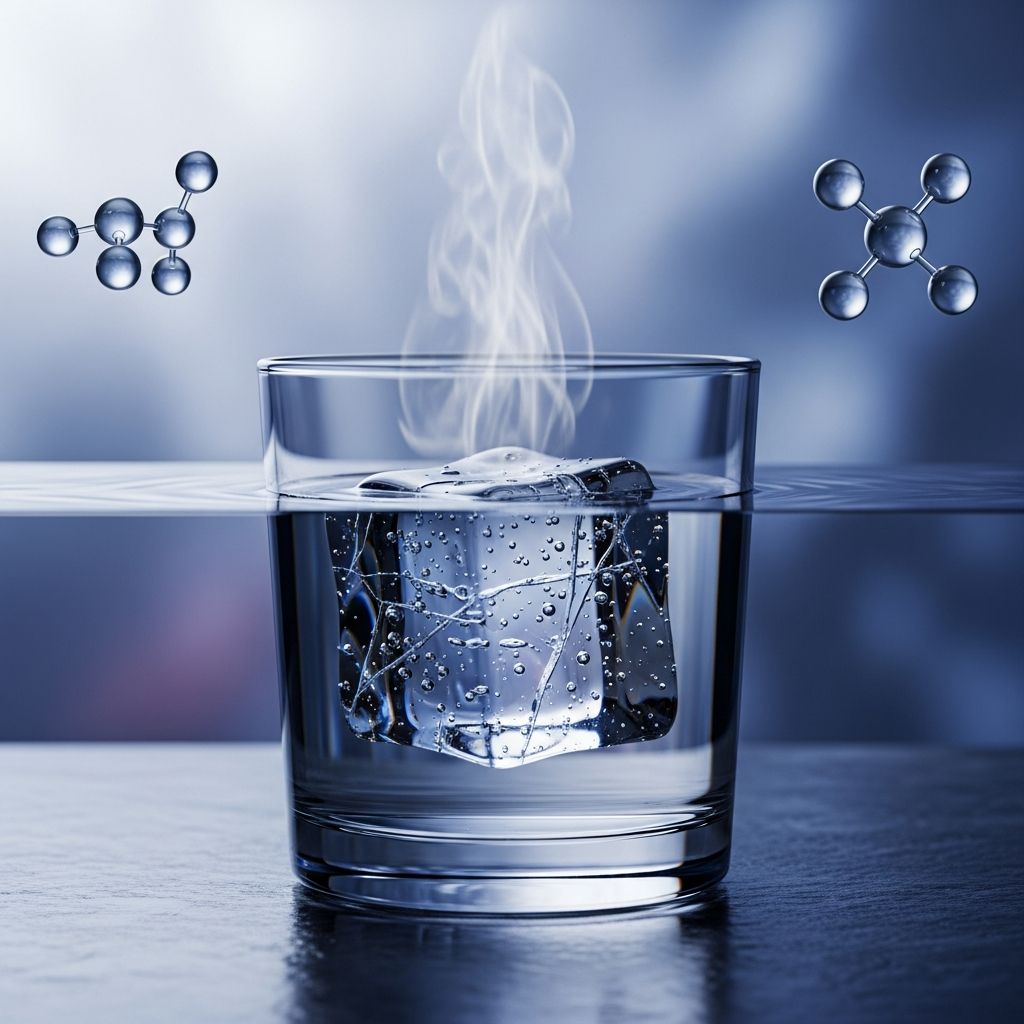
Water exists in three distinct states of matter—solid, liquid, and gas—each occurring at specific temperature ranges. Understanding the temperatures at which water transitions between these states is fundamental to chemistry, physics, and countless real-world applications. These transformation points are not arbitrary; they represent the precise temperatures where the energy supplied to water molecules overcomes the forces holding them in their current physical structure. This exploration examines the mechanisms behind these transitions and the factors that influence them.
Defining the Three States and Their Transitions
Matter exists in distinct physical forms, each characterized by different molecular arrangements and behaviors. When water molecules are tightly bonded in a rigid crystalline structure, water exists as ice—a solid. As thermal energy increases, molecules vibrate more intensely until they break free from this rigid arrangement, transitioning into the liquid state where molecules move more freely but remain closely packed. Further heating provides sufficient energy for molecules to escape the liquid phase entirely, transforming into water vapor—a gas where molecules are widely dispersed and move independently through space.
The boundaries between these states are precisely defined temperatures where phase changes occur. These temperatures are not random but are determined by the molecular structure of water and the strength of the forces holding its molecules together. For pure water under standard atmospheric conditions at sea level, these transition points have been carefully measured and documented through scientific observation.
The Melting Point: Solid to Liquid Transformation
The melting point represents the threshold temperature where solid water transforms into its liquid form. For pure water at standard atmospheric pressure (sea level), this transition occurs at 0°C, equivalent to 32°F or 273 Kelvin. At this critical temperature, the thermal energy supplied to ice molecules becomes sufficient to disrupt the organized crystalline lattice structure that defines the solid state.
During melting, something remarkable occurs at the molecular level. The rigid, orderly arrangement of water molecules in ice begins to destabilize as heat energy causes increased molecular motion. Once the temperature reaches exactly 0°C, the forces maintaining the crystalline structure can no longer contain the energized molecules. They break free from their fixed positions and begin moving more freely, though they remain in close proximity to one another—the defining characteristic of the liquid state.
For pure crystalline solids, melting occurs at a precisely defined temperature with remarkable consistency. This characteristic allows scientists to identify unknown substances or verify the purity of known substances through melting point determination, as the sharpness of the transition can be measured to within 0.1°C for small, pure samples. Impurities in water cause subtle deviations from the standard melting point, providing a quality control method in various industries.
The Freezing Point: Liquid to Solid Transformation
The freezing point represents the inverse process, where liquid water transitions back into solid ice as thermal energy is removed. Theoretically, the freezing point and melting point should occur at identical temperatures—0°C for pure water—since both represent equilibrium states between solid and liquid phases. In practice, tiny variations can be observed under laboratory conditions, but for most practical purposes, these temperatures are considered equivalent.
When liquid water cools to its freezing point, the thermal energy of its molecules decreases substantially. The molecules slow their movement and eventually begin organizing themselves into the orderly, rigid crystalline structure characteristic of ice. At the critical freezing temperature, solid and liquid states exist in equilibrium, with either phase potentially dominant depending on minuscule energy fluctuations.
This equilibrium state at 0°C represents what might be considered a “tipping point” for water. Any additional heat applied will melt solid ice into liquid water, while any heat removal will freeze liquid water into solid ice. Both phases can coexist at this temperature, existing in a delicate balance determined by molecular forces and thermal conditions.
The Boiling Point: Liquid to Gas Transformation
The boiling point marks a far more energetic phase transition than melting. For pure water at sea level atmospheric pressure, this occurs at 100°C (212°F). At this temperature, water molecules gain sufficient thermal energy to completely escape the liquid phase and transform into a gas, where individual molecules move independently with vast distances separating them.
The boiling process requires substantially more energy than melting. While melting involves disrupting the rigid crystalline structure, boiling requires completely overcoming the attractive forces between molecules so they can exist as separate gaseous entities. Water’s boiling point is notably high compared to chemically similar compounds due to strong hydrogen bonding between water molecules—these intermolecular attractions require more energy to overcome than similar-sized molecules that lack such bonding.
The boiling point specifically corresponds to the temperature where the vapor pressure of water equals atmospheric pressure. Under standard conditions with an atmospheric pressure of 760 millimeters of mercury, water reaches this equilibrium at exactly 100°C. Any temperature increase beyond this point continues converting liquid water to vapor without further temperature rise until all liquid water has transformed.
Impact of Atmospheric Pressure on Phase Transitions
One of the most significant variables affecting water’s transition temperatures is atmospheric pressure. While the 0°C melting point and 100°C boiling point represent conditions at sea level with standard atmospheric pressure, these temperatures shift dramatically at different elevations where pressure varies.
Elevation Effects on Boiling Point
At higher elevations where atmospheric pressure is lower, water boils at temperatures substantially below 100°C. At 10,000 feet elevation, where atmospheric pressure is approximately 526 millimeters of mercury (compared to 760 mmHg at sea level), water boils at roughly 90°C. This dramatic effect has practical implications for cooking and food preparation in mountainous regions. At even more extreme elevations, the effect becomes pronounced: on Mount Everest at approximately 27,000 feet, water boils at only 68°C (154°F).
This phenomenon occurs because boiling depends on vapor pressure equilibrium. Lower atmospheric pressure means water molecules need less kinetic energy to escape the liquid phase—the external pressure isn’t pushing down as forcefully against evaporating molecules. Conversely, at high-pressure environments (such as in pressurized industrial equipment or at great ocean depths), water’s boiling point increases substantially.
Pressure Effects on Melting Point
While boiling point changes with pressure are dramatic and familiar to most people, melting point changes are far more subtle but equally real. At extremely high pressures, water’s melting point can actually decrease rather than increase. Under 800 bars of pressure (approximately 11,603 pounds per square inch), the melting point of water drops to -6.9°C. This unusual behavior occurs because of water’s unique molecular structure and the way increased pressure affects ice crystal formation.
This counterintuitive relationship between pressure and melting point distinguishes water from most other substances and reflects the anomalous properties of water related to hydrogen bonding. The effect is particularly significant in glaciology and planetary science, where extreme pressures at the base of massive ice sheets can create localized melting conditions despite below-freezing temperatures.
Hydrogen Bonding: The Foundation of Water’s Properties
Water’s distinctive transition temperatures compared to chemically similar compounds stem directly from hydrogen bonding—the strong intermolecular attractions between water molecules. Hydrogen sulfide (H₂S), hydrogen selenide (H₂Se), and hydrogen telluride (H₂Te) are chemically analogous to water but have dramatically different phase transition temperatures.
Water’s boiling point of 100°C stands in stark contrast to these similar compounds: hydrogen sulfide boils at -62°C, hydrogen selenide at -42°C, and hydrogen telluride at -4°C. Despite water’s smaller molecular weight relative to these compounds, its boiling point is extraordinarily elevated. This anomaly reflects the exceptional strength of hydrogen bonding in water molecules—the oxygen atom’s high electronegativity creates strong partial charges that lead to powerful intermolecular attractions requiring substantial energy to overcome during phase transitions.
Freezing points follow similar patterns. Water freezes at 0°C while hydrogen sulfide freezes at -84°C, hydrogen selenide at -64°C, and hydrogen telluride at -49°C. The pattern is consistent: water’s freezing point is anomalously high due to hydrogen bonding strength, making water’s solid-liquid transition occur at a much higher temperature than chemically similar hydrides.
Effects of Dissolved Substances on Water’s Phase Transitions
Pure water serves as the reference point for phase transition temperatures, but natural and prepared water samples typically contain dissolved substances that modify these critical temperatures. Salt water, for example, has a boiling point approximately 2°C higher than pure water—around 102°C compared to 100°C. This elevation occurs because dissolved salts alter intermolecular interactions between water molecules, affecting the energy required to complete the phase transition.
The presence of any dissolved solute modifies water’s phase transition temperatures in predictable ways. The addition of non-volatile solutes raises the boiling point through a phenomenon called boiling point elevation. These impurities remain in the liquid phase during boiling, requiring water molecules to overcome not only their mutual attractions but also interactions with dissolved particles. Conversely, dissolved substances typically lower the freezing point through a process called freezing point depression, making solutions freeze at temperatures below 0°C.
These colligative properties—properties that depend on the number of dissolved particles rather than their chemical identity—have practical applications in antifreeze formulations, food preservation, and de-icing operations. By understanding how dissolved substances modify water’s phase transitions, scientists and engineers can design solutions for specific applications.
Comparative Phase Transition Analysis
| Substance | Freezing Point (°C) | Boiling Point (°C) | State at Room Temperature |
|---|---|---|---|
| Water (pure) | 0 | 100 | Liquid |
| Hydrogen Sulfide | -84 | -62 | Gas |
| Hydrogen Selenide | -64 | -42 | Gas |
| Hydrogen Telluride | -49 | -4 | Gas |
| Salt Water (standard) | Slightly below 0 | ~102 | Liquid |
Practical Applications and Real-World Implications
Understanding water’s phase transitions has profound implications across numerous fields. In meteorology, knowledge of boiling and freezing points explains cloud formation, precipitation, and atmospheric phenomena. In the culinary arts, understanding how water’s boiling point changes with elevation explains why cooking times differ significantly in mountainous regions. In physics and engineering, these concepts underpin refrigeration systems, steam power generation, and countless industrial processes.
Environmental scientists rely on these principles to predict ice sheet behavior, glacier dynamics, and climate-related changes in water distribution. Medical professionals understand that maintaining proper body temperature depends on sweating—evaporative cooling that depends on water’s boiling point. These seemingly abstract physical properties are intimately connected to the practical world surrounding us.
Frequently Asked Questions
Q: Why does water boil at different temperatures at different elevations?
A: At higher elevations, atmospheric pressure decreases, requiring less energy for water molecules to escape the liquid phase. Lower external pressure means boiling occurs at lower temperatures. At sea level with full atmospheric pressure, water needs 100°C to overcome that pressure; at lower pressures, the threshold temperature drops accordingly.
Q: Are the freezing point and melting point of water always identical?
A: Theoretically yes, both occur at 0°C for pure water under standard conditions. In practice, tiny variations can be observed in laboratory conditions, but for practical purposes they are considered the same temperature. However, at extremely high pressures, the melting point can shift to different values.
Q: Does salt water freeze at the same temperature as pure water?
A: No, dissolved salt lowers water’s freezing point through freezing point depression. Salt water freezes at temperatures below 0°C, which is why salt is used for de-icing roads in winter—it prevents ice formation at temperatures that would freeze pure water.
Q: Why is water’s boiling point so much higher than similar chemical compounds?
A: Hydrogen bonding between water molecules creates exceptionally strong intermolecular attractions. These bonds require substantial energy to overcome during boiling, making water’s boiling point much higher than chemically similar compounds like hydrogen sulfide that lack such strong intermolecular forces.
Q: Can water boil and freeze simultaneously?
A: Yes, under specific pressure and temperature conditions called the triple point, water can exist simultaneously as solid, liquid, and gas in equilibrium. Additionally, water can exist as both ice and liquid water at 0°C when conditions are perfectly balanced between melting and freezing.
References
- The Melting Point, Boiling Point, and Freezing Point of Water — Chemistry Talk. Accessed April 2026. https://chemistrytalk.org/melting-boiling-point-water/
- Melting Point of Water in Celsius, Fahrenheit, and Kelvin — Science Notes. Accessed April 2026. https://sciencenotes.org/melting-point-of-water-in-celsius-fahrenheit-and-kelvin/
- Melting Point, Freezing Point, Boiling Point — Purdue University General Chemistry Topic Review. Accessed April 2026. https://chemed.chem.purdue.edu/genchem/topicreview/bp/ch14/melting.php
- The Melting and Boiling Point of Water — LabXchange, MIT. Accessed April 2026. https://www.labxchange.org/library/items/lb:LabXchange:9792ef1b:html:1
- What is Freezing Point, Melting Point and Boiling Point? — Educational Video Resource. Accessed April 2026. https://www.youtube.com/watch?v=Yv_vDQerOBk
- Unusual Properties of Water — Chemistry LibreTexts, University of California Davis. Accessed April 2026. https://chem.libretexts.org/Bookshelves/Physical_and_Theoretical_Chemistry_Textbook_Maps/Supplemental_Modules_(Physical_and_Theoretical_Chemistry)/Physical_Properties_of_Matter/States_of_Matter/Properties_of_Liquids/Unusual_Properties_of_Water
- Water | H2O | CID 962 — PubChem Database, National Center for Biotechnology Information (NCBI). Accessed April 2026. https://pubchem.ncbi.nlm.nih.gov/compound/Water

- Integrated M.A. in Applied Linguistics, University of Hyderabad
- 5+ years in editorial, instructional, SEO, and research-based writing
Sneha is a relationships and lifestyle writer with a strong foundation in applied linguistics and certified training in relationship coaching. She brings over five years of writing experience to theskillvault, crafting thoughtful, research-driven content that empowers readers to build healthier relationships, boost emotional well-being, and embrace holistic living. Her writing and insights reflect the belief that beauty, happiness, and wellness…