
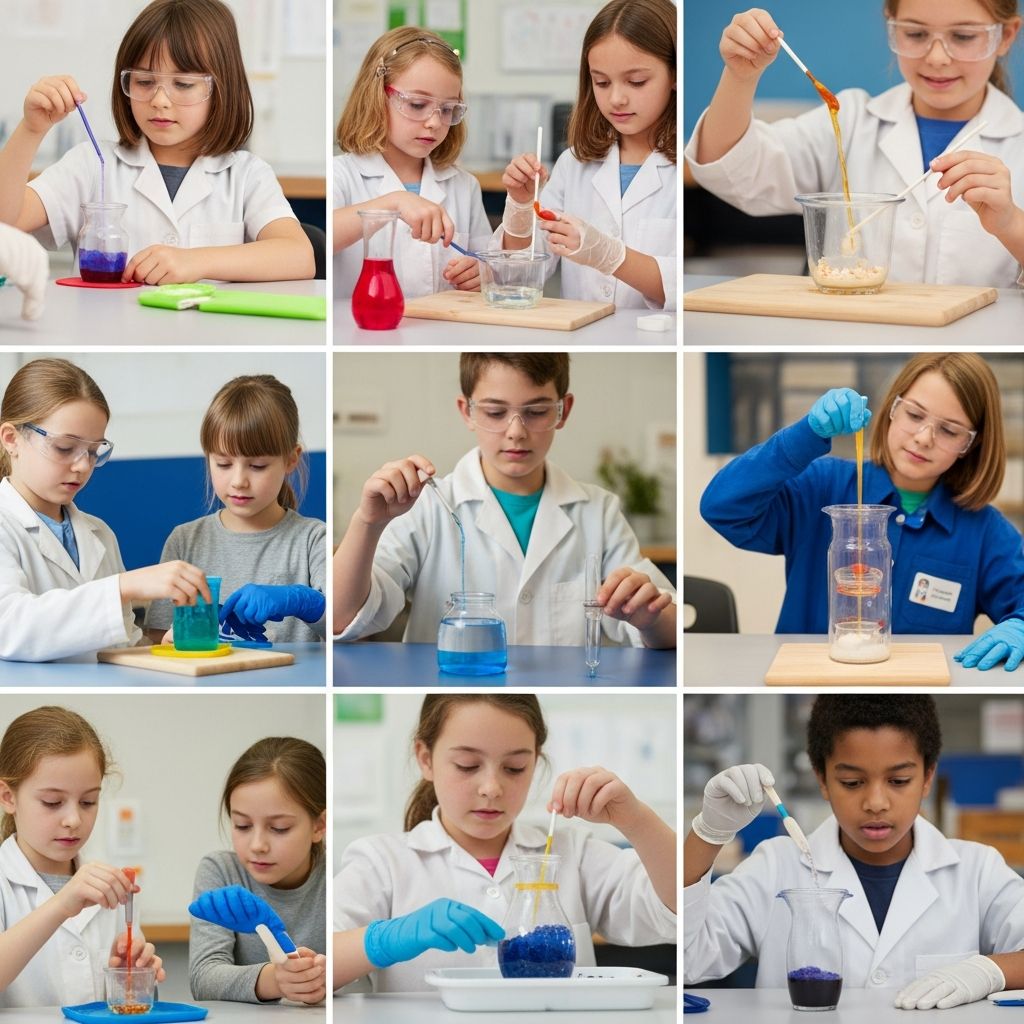
Hands-on science activities captivate children’s imaginations while building foundational knowledge in physics, chemistry, and biology. These 10 experiments use common household items, require minimal setup, and deliver wow-factor results that encourage questioning and discovery. Ideal for ages 4-10, they align with early childhood education standards from sources like the National Science Teaching Association.
Why Hands-On Science Matters for Kids
Interactive experiments help children develop critical thinking, observation skills, and hypothesis-testing abilities. Research from the American Association for the Advancement of Science shows that early STEM exposure predicts later success in science fields. These activities also promote fine motor skills and family bonding.
Experiment 1: Buoyancy Challenge – Sink or Float Discovery
Test predictions with everyday objects to explore density and buoyancy. Fill a large basin with water and gather items like coins, sponges, apples, and plastic toys.
- Have kids predict if each item will sink or float.
- Drop items in and observe results.
- Discuss why heavy metal sinks while airy plastic floats (density differences).
This builds scientific vocabulary and encourages trial-and-error learning.
Experiment 2: Dancing Milk – Surface Tension Magic
Witness colors swirl in milk due to soap breaking surface tension. Pour whole milk into a shallow dish, add food coloring drops, then touch with soapy cotton swabs.
- Colors explode outward in hypnotic patterns.
- Explain: Soap molecules disrupt milk’s fat-protein bonds, reducing tension.
- Variations: Try skim milk for less dramatic effects.
A mesmerizing intro to chemistry for preschoolers.
Experiment 3: Bouncy Egg – Shell Dissolving Wonder
Transform a raw egg into a rubbery bouncer via chemical reaction. Submerge an egg in vinegar for 24-48 hours.
- Shell dissolves (calcium carbonate reacts with acetic acid).
- Gently bounce the flexible egg on a soft surface.
- Extend: Test bounce height after more time.
Demonstrates acids and osmosis safely.
Experiment 4: Baking Soda Volcano – Fizzy Eruption
Create a mini mountain that erupts with gas. Mold playdough into a volcano over a bottle, add baking soda, then pour in vinegar with dish soap and food coloring.
- Foam overflows from carbon dioxide production.
- Chemical reaction: Acid + base → gas + water + salt.
- Scale up outdoors for bigger blasts.
Classic acid-base demo with geological tie-in.
Experiment 5: Invisible Ink Messages – Heat Reveal
Write secret notes that appear with heat. Use lemon juice or baking soda solution as ink on paper, let dry, then heat gently over a bulb or iron.
- Juice oxidizes and browns; soda chars.
- Historical context: Used in espionage.
- Safety: Adult supervision for heating.
Teaches oxidation and simple cryptography.
Experiment 6: Cloud in a Jar – Water Cycle Miniature
Simulate rain formation. Fill jar halfway with hot water, add shaving cream ‘cloud’ on top, then drip food-colored water via dropper.
- ‘Rain’ falls as cloud saturates.
- Links to evaporation, condensation, precipitation.
- Real-world: Explains why skies darken before storms.
Perfect weather lesson for early learners.
Experiment 7: Homemade Lava Lamp – Density Dance
Oil and water bubbles rise mesmerizingly. Fill jar with water, add food coloring, top with vegetable oil, then drop in Alka-Seltzer tablet.
- Bubbles carry colored water up through oil.
- Demonstrates immiscible liquids and CO2 gas.
- Reuse: Add more tablets for continuous show.
Explores states of matter dynamically.
Experiment 8: Magnetic Slime – Oobleck with a Twist
Make slime that dances to magnets. Mix white glue, liquid starch, iron oxide powder (or filings), then add magnets underneath.
- Slime spikes and moves magnetically.
- Combines non-Newtonian fluids and magnetism.
- Cleanup: Non-toxic, washes off.
STEM fusion of physics and chemistry.
Experiment 9: Rainbow in a Glass – Density Tower
Layer liquids by density. Use honey, dish soap, water, oil, and alcohol in a tall glass, adding one at a time slowly.
| Liquid | Density (g/mL) | Color Suggestion |
|---|---|---|
| Honey | 1.42 | Yellow |
| Dish Soap | 1.02 | Green |
| Water | 1.00 | Blue |
| Oil | 0.92 | Purple |
| Alcohol | 0.79 | Red |
Insert objects to see where they settle. Teaches liquid properties.
Experiment 10: DIY Compass – Earth’s Magnetic Field
Detect north with a magnetized needle. Stroke sewing needle with magnet 50 times, float on cork in water bowl.
- Needle aligns north-south.
- Earth acts as giant magnet.
- Outdoor test: Compare to real compass.
Introduces geomagnetism accessibly.
Safety Guidelines for All Experiments
Supervise children closely, especially with heat, chemicals, or small parts. Use food-grade items, avoid ingestion, and work in ventilated areas. Clean up spills promptly.
Tips for Educators and Parents
- Prompt Questions: What do you think will happen? Why?
- Record Data: Use charts for predictions vs. results.
- Extensions: Repeat with variations; connect to school curriculum.
- Inclusivity: Adapt for different abilities, e.g., verbal descriptions.
Frequently Asked Questions
What ages are these experiments suitable for?
Primarily 4-10 years, with adult help. Simplify for younger kids by focusing on observation.
Do I need special supplies?
No, mostly kitchen staples like vinegar, baking soda, food coloring. Optional: Magnets, iron filings.
How can I tie these to school learning?
Align with NGSS standards for matter, forces, weather. Use as homework extensions.
Are they messy?
Some (volcano, slime), so use trays and old clothes. Cleanup is straightforward.
What if an experiment fails?
Discuss variables; science involves iteration. Check measurements and freshness of ingredients.
References
- 20 science activities for preschoolers — Bright Horizons. 2023-05-15. https://www.brighthorizons.com/article/education/science-for-preschoolers
- 10 Easy Science Experiments For Kids — KiwiCo. 2024-02-10. https://www.kiwico.com/diy/lists/10-easy-science-experiments-for-kids
- Easy Science Experiments for Kids at Home or in the Classroom — Science Sparks. 2025-01-20. https://www.science-sparks.com
- 10 EYFS science experiments and activities — Famly. 2023-11-08. https://www.famly.co/blog/10-eyfs-science-experiments
- Top Science Experiments For Kids — Science Fun. 2024-03-12. https://www.sciencefun.org/kidszone/experiments/top-science-experiments-for-kids/

- Integrated M.A. in Applied Linguistics, University of Hyderabad
- 5+ years in editorial, instructional, SEO, and research-based writing
Sneha is a relationships and lifestyle writer with a strong foundation in applied linguistics and certified training in relationship coaching. She brings over five years of writing experience to theskillvault, crafting thoughtful, research-driven content that empowers readers to build healthier relationships, boost emotional well-being, and embrace holistic living. Her writing and insights reflect the belief that beauty, happiness, and wellness…