
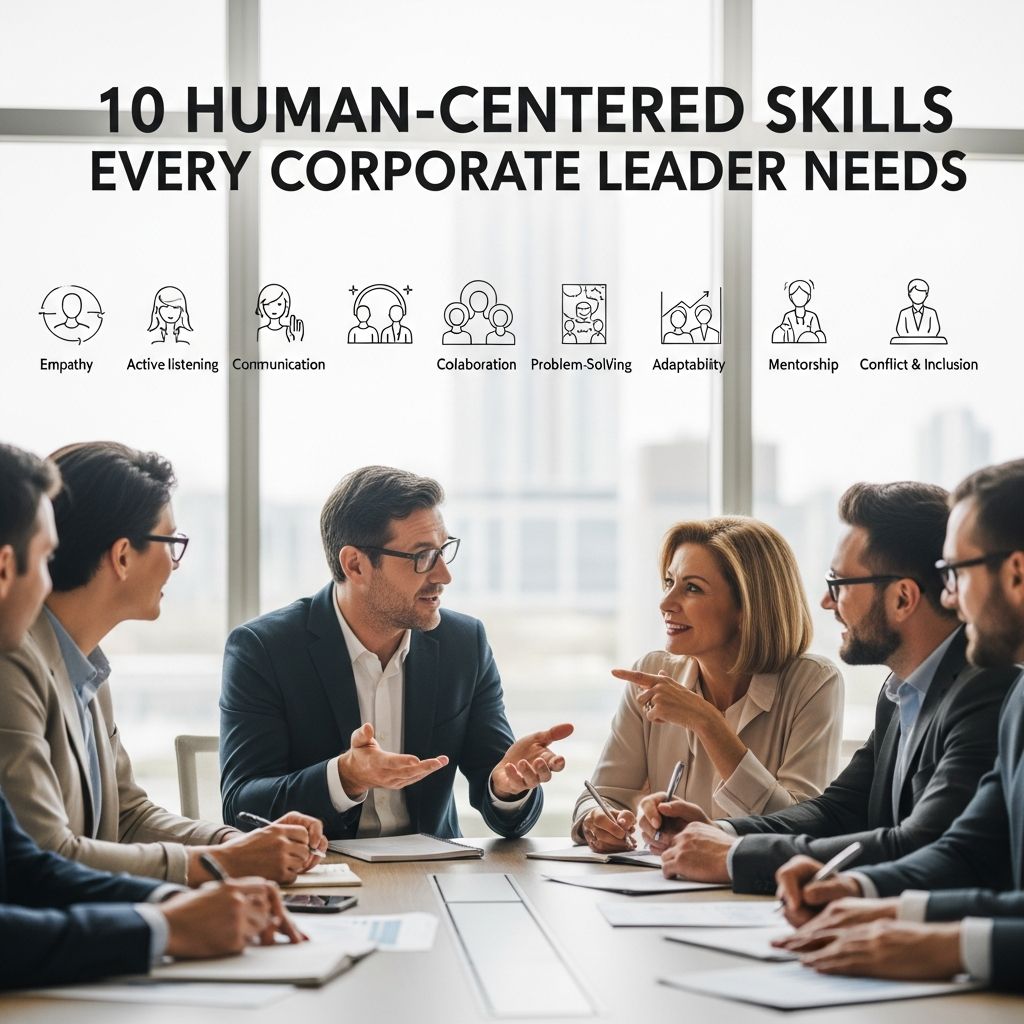
Technical expertise might get you into a leadership role, but it is your soft skills that determine whether people genuinely want to work with you over the long term. In modern organizations, leaders are expected not only to deliver results, but to cultivate trust, psychological safety, and sustainable performance.
This article explores 10 essential soft skills for corporate leaders and offers practical ways to strengthen each one so you can lead with clarity, empathy, and impact.
Why Soft Skills Define Modern Corporate Leadership
Soft skills are the interpersonal, emotional, and cognitive abilities that shape how you work with others: how you listen, decide, adapt, and respond under pressure. Research on leadership effectiveness consistently links these capabilities to better outcomes.
- Organizations increasingly prioritize communication, teamwork, and problem solving over purely technical skills when hiring or promoting leaders.
- Emotional intelligence and relationship skills are strongly associated with employee engagement, which is tied to productivity and profitability.
In other words, soft skills are not “nice-to-have” leadership add-ons; they are core performance drivers.
1. Emotional Intelligence: The Foundation of People Leadership
Emotional intelligence (EI) is the capacity to notice, understand, and manage your own emotions and the emotions of others. It is often broken down into four components:
- Self-awareness: recognizing your feelings, triggers, and impact on others
- Self-management: regulating your reactions and staying composed under stress
- Social awareness: reading group dynamics, tone, and nonverbal cues
- Relationship management: building trust, influencing, and navigating tension
Leaders with strong EI are less likely to react impulsively, more likely to create psychological safety, and better equipped to guide teams through uncertainty.
Ways to strengthen emotional intelligence:
- Keep a brief daily reflection log on emotionally charged moments and your responses.
- Ask trusted colleagues for feedback on how you show up in high-stakes situations.
- Practice naming your emotions (“I feel frustrated”) before acting on them.
2. Clear, Two-Way Communication
Corporate leaders communicate constantly: in town halls, one-on-ones, emails, and board meetings. But communication is not just about transmitting information; it is about creating shared understanding.
High-impact communication skills include:
- Clarity: stripping away jargon and ambiguity
- Consistency: aligning words, tone, and behavior with the same message
- Active listening: giving full attention, reflecting back, and checking understanding
- Audience awareness: tailoring the message to stakeholder needs and context
Leaders who communicate clearly reduce confusion, speed up decision cycles, and help teams focus on what truly matters.
Practical communication habits:
- Begin key messages with the outcome or decision, then add supporting detail.
- Ask open questions (“What concerns do you see?”) and pause long enough for a thoughtful answer.
- Summarize action items and owners at the end of every important meeting.
3. Empathy and Psychological Safety
Empathy is the ability to understand another person’s perspective and emotional experience. It does not mean agreeing with every view, but it does require genuine curiosity about how others think and feel.
Empathetic leadership is closely linked to psychological safety—the shared belief that it is safe to speak up, ask questions, or admit mistakes without fear of humiliation or retaliation. Research led by Harvard Business School professor Amy Edmondson shows that psychologically safe teams learn faster and make fewer critical errors.
In fast-moving corporate environments, empathy allows leaders to spot burnout, disengagement, or silent disagreement before they turn into performance problems.
Empathy in action:
- Use phrases like “Help me understand how you’re seeing this” instead of jumping to conclusions.
- Pay attention to nonverbal cues: energy levels, facial expressions, and silence in meetings.
- Normalize conversations about workload, boundaries, and well-being.
4. Adaptability and Resilience in a Changing Landscape
Corporate strategies, technologies, and markets shift constantly. Leaders must be able to adjust plans without losing direction. Adaptability is the willingness and capability to change course; resilience is the capacity to recover from setbacks and persist toward long-term goals.
These skills matter because:
- Business disruptions—from economic shocks to technology shifts—are now routine rather than exceptional.
- Teams take emotional cues from leaders: calm, constructive behavior during uncertainty can stabilize morale.
Practices that build adaptability and resilience:
- Scenario-plan: regularly explore “What if?” situations and possible responses.
- Debrief major projects: focus on what was learned, not just what went wrong.
- Model flexible thinking by publicly revising your views when new evidence appears.
5. Sound, Timely Decision-Making
Leaders are judged not only on what they decide but also on how and when they decide. Effective decision-making combines analysis, judgment, and courage.
| Aspect | Weak Decision-Making | Strong Decision-Making |
|---|---|---|
| Use of data | Ignores evidence or over-relies on intuition | Uses data and experience together, aware of limits |
| Speed | Delays choices or rushes without reflection | Decides quickly when needed, slows down for high risk |
| Involvement | Excludes key voices or crowdsources endlessly | Consults the right people, then owns the call |
| Follow-through | Reverses course unpredictably | Communicates rationale and sticks to the plan unless new facts emerge |
Techniques to improve decisions:
- Clarify the decision type: reversible vs. irreversible, high vs. low impact.
- Separate data gathering from deciding: set a deadline for each phase.
- Use pre-mortems: ask, “If this failed in 12 months, what likely went wrong?”
6. Managing Stress and Protecting Energy
Corporate leadership comes with pressure: financial targets, stakeholder demands, and complex risks. Without deliberate stress management, leaders may become reactive, impatient, or emotionally distant—all of which undermine their effectiveness.
Research from the American Psychological Association highlights that chronic work-related stress can impair decision-making, creativity, and health. Leaders who build sustainable habits not only protect their own performance but also set a healthy standard for their teams.
Healthy stress-management behaviors:
- Establish predictable non-negotiables (sleep, exercise, or quiet focus time).
- Use brief recovery pauses between intense meetings instead of scheduling back-to-back days.
- Communicate realistic priorities so teams are not pulled in every direction at once.
7. Coaching and Development Mindset
Modern corporate leaders are expected to be talent developers, not just task assigners. A coaching mindset emphasizes helping people grow their own problem-solving capacity rather than providing every answer.
This mindset benefits organizations by:
- Building a stronger leadership pipeline and succession options
- Increasing engagement, because people see a future for themselves
- Reducing dependency on a single “hero” leader for all tough calls
Simple coaching practices:
- Ask, “What options have you considered?” before offering your view.
- Give specific, behavior-focused feedback instead of vague praise or criticism.
- Agree on one development focus per direct report and revisit it regularly.
8. Inspiring and Purpose-Driven Leadership
Great corporate leaders do more than allocate resources; they create meaning. They help people connect day-to-day tasks with a compelling purpose and longer-term direction.
Gallup’s research on engagement has shown that employees who strongly agree their work has purpose are more resilient and perform better, especially in times of change. When leaders communicate a clear “why” and live it consistently, they unlock discretionary effort instead of bare-minimum compliance.
How to lead with purpose:
- Translate corporate strategy into plain language for each team’s context.
- Highlight real stories that show your values in action, not just on posters.
- Recognize contributions that advance long-term goals, not only short-term wins.
9. Constructive Problem-Solving and Conflict Management
Wherever people work together, differences of opinion will arise. Leaders who avoid conflict often allow small issues to grow; leaders who confront aggressively damage trust. Constructive conflict management means surfacing issues early, listening to all sides, and guiding the group toward workable solutions.
According to the U.S. Department of Labor, core workplace skills such as problem solving and conflict management significantly influence employability and long-term success. For leaders, these skills are essential to maintaining both performance and cohesion.
Core elements of effective conflict management:
- Address patterns quickly rather than waiting for a “perfect moment.”
- Focus on behaviors and processes, not personal character judgments.
- Encourage joint ownership of solutions rather than imposing a verdict.
10. Time, Focus, and Priority Management
Leadership roles bring competing demands: strategic thinking, stakeholder management, performance reviews, and unexpected crises. Without strong time and priority management, leaders can become chronic bottlenecks.
Effective leaders:
- Differentiate clearly between urgent and important work
- Protect time for deep thinking and relationship-building
- Delegate responsibilities that others can handle to free capacity for uniquely leadership tasks
Practical steps to manage time and focus:
- Block regular “no meeting” time for strategic work and stick to it.
- Use simple criteria (impact, alignment, risk) to rank initiatives.
- Regularly review your calendar against your stated leadership priorities to identify gaps.
Integrating Soft Skills into Your Leadership Practice
Soft skills are not innate traits reserved for a few charismatic leaders—they can be learned, practiced, and refined throughout your career. A systematic approach helps:
- Choose 1–2 focus skills at a time (for example, emotional intelligence and conflict management).
- Define observable behaviors you want to change (for example, asking more questions before giving your opinion).
- Seek regular feedback from peers, direct reports, and mentors.
- Reflect on specific situations weekly: what went well, what you would do differently next time.
Over time, these practices compound into a leadership style that is more grounded, trustworthy, and impactful—exactly what complex corporate environments demand.
Frequently Asked Questions (FAQs)
Q1. What are the most important soft skills for new corporate leaders?
For new leaders, the most critical soft skills are usually emotional intelligence, communication, and time management. These three form the basis for understanding your team, setting expectations clearly, and managing the increased scope of responsibilities that come with a leadership role.
Q2. Can soft skills really be learned, or are they personality traits?
Soft skills are highly learnable. While personality influences your natural style, research in adult development shows that self-awareness, emotional regulation, communication, and conflict skills can all be improved through feedback, deliberate practice, and coaching over time.
Q3. How can I measure progress in my soft skills?
Progress is best tracked through behavioral evidence and feedback. You might notice fewer misunderstandings, smoother meetings, or more proactive input from your team. Formal tools such as 360-degree feedback surveys or leadership assessments can also help you quantify change across specific competencies.
Q4. Do soft skills matter as much in highly technical or data-driven roles?
Yes. In technical environments, soft skills often provide a competitive edge because they enable knowledge sharing, cross-functional collaboration, and stakeholder influence. Many organizations report that technical leaders are most successful when they can communicate complex ideas clearly and build strong relationships across functions.
Q5. Where should organizations start if they want to build soft skills at scale?
Organizations can start by defining a clear leadership competency framework, assessing current capabilities, and investing in targeted development programs such as coaching, workshops, and peer learning. Embedding soft skills expectations in hiring, promotion, and performance systems helps ensure these capabilities become part of the culture.
References
- Soft Skills: The Competitive Edge — U.S. Department of Labor, Office of Disability Employment Policy. 2012-01-01. https://www.dol.gov/agencies/odep/publications/fact-sheets/soft-skills-the-competitive-edge
- Stress in America: The State of Our Nation — American Psychological Association. 2017-11-01. https://www.apa.org/news/press/releases/stress/2017/state-nation
- Psychological Safety and Learning Behavior in Work Teams — Amy C. Edmondson, Administrative Science Quarterly. 1999-06-01. https://doi.org/10.2307/2666999
- State of the Global Workplace — Gallup. 2023-06-27. https://www.gallup.com/workplace/349484/state-of-the-global-workplace.aspx
- 18 Essential Soft Skills You Need to Succeed in Business Leadership Roles — University of San Diego, Division of Professional and Continuing Education. 2022-08-10. https://pce.sandiego.edu/18-essential-soft-skills-you-need-to-succeed-in-business-leadership-roles/
- 10 Emerging Skills for Professionals — Harvard Division of Continuing Education Professional Development. 2022-02-15. https://professional.dce.harvard.edu/blog/10-emerging-skills-for-professionals/

- Integrated M.A. in Applied Linguistics, University of Hyderabad
- 5+ years in editorial, instructional, SEO, and research-based writing
Sneha is a relationships and lifestyle writer with a strong foundation in applied linguistics and certified training in relationship coaching. She brings over five years of writing experience to theskillvault, crafting thoughtful, research-driven content that empowers readers to build healthier relationships, boost emotional well-being, and embrace holistic living. Her writing and insights reflect the belief that beauty, happiness, and wellness…