
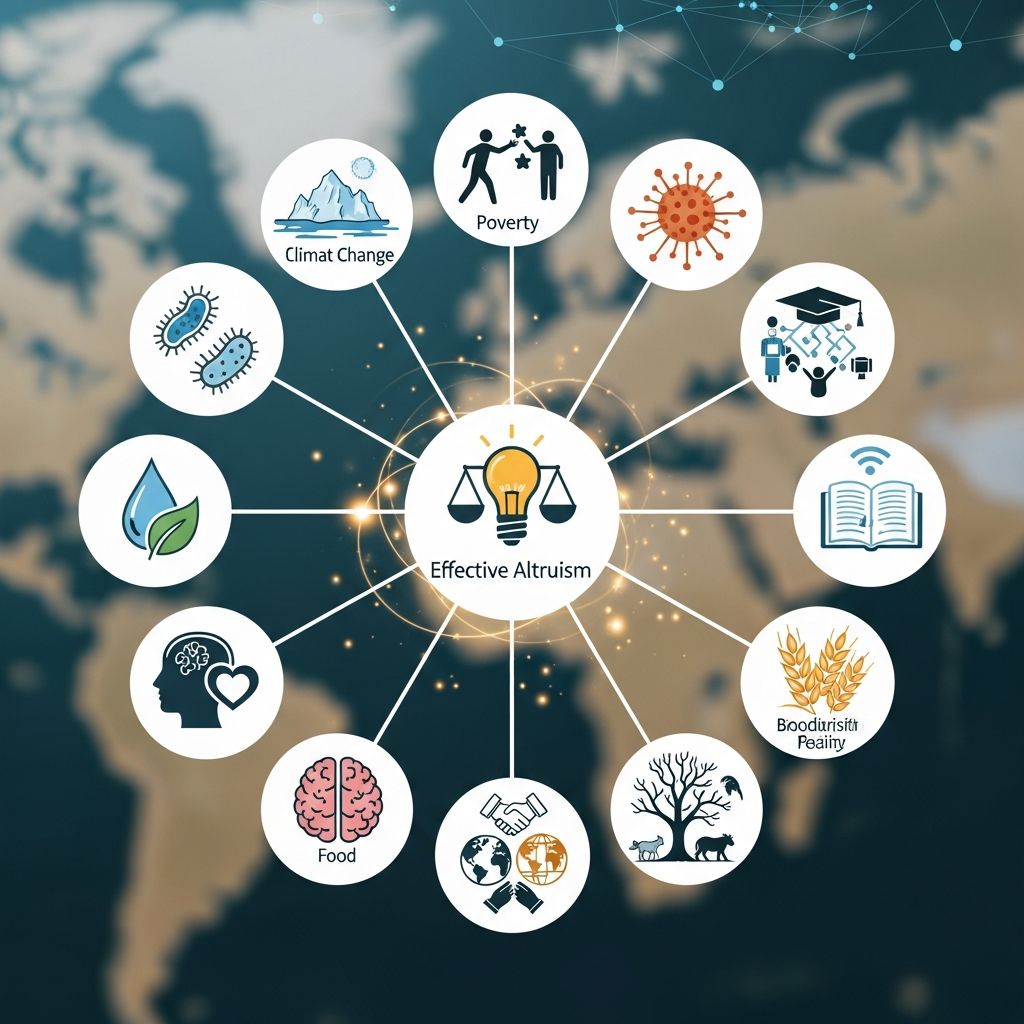
Across the world, people care deeply about problems like poverty, climate change, and injustice. Yet resources are limited, and not every effort has the same impact. Effective altruism is a community and set of ideas focused on using evidence and careful reasoning to do as much good as possible with our time, money, and careers. Rather than asking only “What is important?”, it also asks “Where can additional work make the biggest difference?”
This article introduces ten broad global challenges commonly discussed in effective altruism, and explores how individuals can contribute to solving them. These challenges range from immediate issues like global health to long-term threats such as advanced artificial intelligence and nuclear war.
Why Prioritising Global Problems Matters
Many causes are worthy, but their scale, neglect, and tractability differ dramatically. Effective altruists often consider three guiding questions when comparing global problems:
- Scale: How many beings are affected, how deeply, and for how long?
- Neglect: How many resources and how much attention is the problem already receiving?
- Tractability: Are there realistic strategies that additional people and funding can pursue now?
Holding other factors equal, additional work on the most pressing global problems can be many times more valuable than work on issues that are smaller, better funded, or less solvable with today’s tools.
Ten Global Challenges Through the Lens of Effective Altruism
The following ten challenges are inspired by topics frequently highlighted in the effective altruism community and in 80,000 Hours resources. They are not an exhaustive list, but they illustrate the range of areas where focused effort may have outsized impact.
1. Global Health and Extreme Poverty
Hundreds of millions of people still live on less than the equivalent of a few dollars per day, facing preventable disease, malnutrition, and limited access to basic services. The World Bank estimates that around 700 million people live in extreme poverty by international standards, though the exact number varies by methodology.
Evidence-based global health interventions can be remarkably cost-effective. Randomised controlled trials and large-scale studies have identified programs such as:
- Malaria prevention through insecticide-treated bed nets and indoor spraying.
- Childhood immunisation campaigns against diseases like measles and polio.
- Direct cash transfers to very poor households, which allow families to allocate funds where they are most needed.
For people interested in this area, high-impact paths include research in public health, work at global development organisations, and rigorous charity evaluation.
2. Improving Education in Low-Income Countries
Education is often seen as a route out of poverty, yet in many low-income countries, years spent in school do not always translate into strong learning outcomes. The World Bank has highlighted a “learning crisis,” where a large share of children cannot read and understand a simple text by age 10.
From an effective altruism perspective, promising approaches tend to:
- Target basic skills like literacy and numeracy.
- Use low-cost, scalable interventions, such as tailored instruction or tutoring.
- Rely on rigorous evidence of impact, including large studies and replication.
Careers that help here include educational research, policy analysis, and on-the-ground program design focused on measurable learning gains rather than just years of schooling.
3. Climate Change and Environmental Stability
Climate change is already affecting weather extremes, sea levels, and ecosystems worldwide. The Intergovernmental Panel on Climate Change (IPCC) concludes that human activities, particularly greenhouse gas emissions, have unequivocally warmed the atmosphere, ocean, and land, leading to widespread and rapid changes in the climate system.
From a long-term perspective, climate change raises concerns about large-scale human suffering, damage to biodiversity, and potential destabilisation of societies. Effective altruists often focus on:
- Mitigation: Cutting emissions through clean technology, policy, and behavioural change.
- Adaptation: Helping vulnerable communities adjust to changing conditions.
- Innovation: Supporting research into low-carbon energy, carbon removal, and resilient infrastructure.
While climate change receives significant public attention, some sub-areas, such as advanced clean energy R&D or governance of geoengineering, may be comparatively neglected.
4. Future Pandemics and Biosecurity
The COVID-19 pandemic has shown how infectious diseases can reshape societies and economies. The World Health Organization (WHO) has warned that the world remains vulnerable to new outbreaks, including from pathogens with pandemic potential.
Effective altruism highlights both natural and human-made biological risks. In addition to improving routine surveillance and healthcare systems, there is interest in:
- Early detection of novel pathogens through genomic surveillance.
- Rapid-response platforms for vaccines and therapeutics.
- Biosafety and biosecurity norms to reduce laboratory accidents and misuse of biotechnology.
Those with skills in biology, data science, public health, or policy can contribute to making future pandemics less likely and less severe.
5. Reducing Violence and Improving Criminal Justice
Crime and violence impose heavy human and economic costs. The United Nations Office on Drugs and Crime (UNODC) reports that hundreds of thousands of people die each year from intentional homicide, with additional harms from non-lethal violence and criminal activity.
Effective altruists are interested in policies that can simultaneously reduce harm and protect civil liberties. Promising work includes:
- Evaluating policing and sentencing reforms for both fairness and public safety.
- Exploring community-based violence reduction strategies.
- Using data and experimentation to identify interventions that reliably lower crime and misconduct.
Researchers, lawyers, policymakers, and data scientists can all play a role in making criminal justice systems more humane and effective.
6. Ending Factory Farming and Improving Animal Welfare
Each year, tens of billions of animals are raised and killed for food, often in intensive systems where they experience severe confinement, painful procedures, and limited ability to engage in natural behaviours. Scientific bodies such as the European Food Safety Authority (EFSA) have documented welfare concerns in common practices like battery cages for hens and gestation crates for pigs.
Because so many animals are affected, and because their interests have historically received less attention than human-focused causes, effective altruists often consider farmed animal welfare highly impactful. Work in this area can involve:
- Campaigning for stronger welfare standards.
- Supporting alternative proteins that reduce reliance on animal products.
- Researching the most effective ways to change consumer and corporate behaviour.
7. Nuclear Weapons and Other Catastrophic Conflict Risks
Nuclear weapons remain a major global catastrophic risk. The UN Office for Disarmament Affairs notes that roughly 12,000 nuclear warheads are still in existence worldwide, and accidental or intentional use would have devastating consequences.
Effective altruists study how to reduce the chance of large-scale war and mitigate its impact if it occurs. Possible strategies include:
- Strengthening arms control agreements and transparency.
- Improving early warning systems and decision-making protocols to prevent accidental launches.
- Supporting diplomacy and conflict prevention in regions where escalation risks are high.
Careers in international relations, security studies, and policy advising can contribute directly to lowering these existential risks.
8. Advanced Artificial Intelligence: Opportunity and Risk
Rapid progress in artificial intelligence (AI) could transform many aspects of society, from scientific research to the economy. At the same time, leading research organisations and experts have emphasised that advanced AI systems may pose significant safety and security challenges.
Core concerns include:
- Alignment: Ensuring highly capable AI systems reliably pursue goals that match human values.
- Control: Maintaining meaningful human oversight over AI systems deployed at scale.
- Misuse: Preventing powerful AI tools from being used for cyberattacks, surveillance, or autonomous weapons.
Effective altruism encourages technically skilled people and policymakers to work on AI safety research, governance frameworks, and standards to maximise the benefits of AI while limiting extreme downside risks.
9. Safeguarding the Long-Term Future
Some risks do not attract daily headlines but could shape the entire trajectory of civilisation. These include global catastrophes from emerging technologies, environmental tipping points, or other threats that could permanently curtail humanity’s potential.
Intergovernmental organisations like the UN have increasingly recognised the importance of future generations and long-term resilience, for example in discussions of sustainable development and disaster risk reduction.
From a longtermist perspective—a view common in parts of the effective altruism community—actions that reduce existential risk or improve global coordination may have enormous expected value because of the vast number of future lives at stake.
10. Meta Work: Growing Capacity to Solve Problems
Beyond any single cause, there is also “meta” work: efforts that support many problems at once. Examples include:
- Research into global priorities—which problems matter most, and why.
- Building communities and networks of people committed to high-impact work.
- Creating better tools for forecasting, decision-making, and philanthropy.
Such work may multiply impact by helping others direct their efforts more effectively. 80,000 Hours itself, for instance, focuses on career advice for people who want to work on pressing problems, rather than working on a single cause directly.
Comparing Global Problems: A Simple Overview
The table below summarises, at a high level, how these ten challenges compare on the common effective altruism criteria of scale, neglect, and tractability. These ratings are illustrative rather than definitive; detailed problem profiles would be needed for precise comparisons.
| Problem Area | Scale | Neglect | Tractability (Short-Term) |
|---|---|---|---|
| Global health & poverty | Very high | Moderate | High (many proven interventions) |
| Education in poor countries | High | Moderate | Medium–high |
| Climate change | Very high | Low–moderate | Medium |
| Pandemics & biosecurity | Very high | Moderate | Medium |
| Crime & justice reform | Medium | Moderate | Medium–high |
| Factory farming | Very high (many animals) | High | Medium |
| Nuclear & great-power conflict | Very high | Moderate | Low–medium |
| Advanced AI safety | Potentially enormous | High (relative to stakes) | Uncertain |
| Long-term future & existential risk | Extremely high | High | Uncertain |
| Meta & global priorities research | Indirect but broad | High | Medium |
How Individuals Can Contribute
You do not need to be a policymaker or billionaire to make a difference. Effective altruism emphasises that many people can have substantial impact by aligning their choices with high-value opportunities.
High-Impact Career Choices
- Specialise in areas with large, neglected, and solvable problems.
- Build transferable skills (e.g., quantitative analysis, management, communication) that can be applied to different causes over time.
- Consider roles in research, policy, entrepreneurship, or movement-building, not just direct service.
Effective Giving
- Donate a portion of your income to independent, evidence-based evaluators’ top charities.
- Focus on cost-effectiveness—the impact per dollar, not just the cause area.
- Take a long-run view: small, consistent donations can add up to major impact over a lifetime.
Community and Advocacy
- Share ideas about effective altruism and global priorities with others who are curious.
- Join or start local discussion groups, reading circles, or professional networks interested in doing good better.
- Support policy changes that are grounded in strong evidence and that reduce major risks.
Frequently Asked Questions (FAQs)
Q1: Is effective altruism only about donating money?
No. While effective giving is important, effective altruism also focuses on career choices, research, policy, and community-building. Many people have their largest impact through how they spend their working lives, not just their donations.
Q2: Does focusing on a few top problems mean ignoring everything else?
Prioritisation does not say that other causes are unimportant. It recognises that we have limited resources and asks where additional effort will do the most good. People can still care about many issues while choosing to focus their marginal time or money on especially high-impact areas.
Q3: How can I decide which global problem to work on?
A useful starting point is to consider (1) which problems appear large, neglected, and solvable; (2) your skills, values, and comparative advantages; and (3) where you expect to have the most influence. Resources from organisations like 80,000 Hours can help you compare different paths in a systematic way.
Q4: Are long-term risks like AI and nuclear war too speculative?
Some long-term risks are uncertain, but uncertainty cuts both ways: outcomes could be better than expected or much worse. When the potential stakes involve billions of current and future lives, many researchers argue that it is reasonable to devote substantial resources to understanding and reducing these risks, especially when there are concrete actions we can take today.
Q5: Can one person really make a meaningful difference on such huge problems?
Yes. For example, working with a highly effective health charity can help protect thousands of people from disease; contributing to pandemic preparedness or AI safety may reduce the chance of extreme catastrophes, even if only slightly. Because the stakes are so large, even modest improvements can have significant expected impact.
References
- What are the most pressing world problems? — 80,000 Hours. 2023-06-01. https://80000hours.org/problem-profiles/
- Effective Altruism: Ten Global Problems — 80,000 Hours Podcast. 2020-01-01. https://80000hours.org/podcast/effective-altruism-ten-global-problems/
- Poverty Overview — World Bank. 2023-03-30. https://www.worldbank.org/en/topic/poverty/overview
- World Malaria Report 2023 — World Health Organization. 2023-11-30. https://www.who.int/publications/i/item/9789240078020
- Global Education Policy Dashboard: Measuring the Education Status — World Bank. 2021-03-01. https://www.worldbank.org/en/topic/education/brief/global-education-policy-dashboard
- Climate Change 2023: Synthesis Report — Intergovernmental Panel on Climate Change. 2023-03-20. https://www.ipcc.ch/report/ar6/syr/
- Nuclear Weapons — United Nations Office for Disarmament Affairs. 2022-12-31. https://www.un.org/disarmament/wmd/nuclear/
- Managing AI Risks — OECD. 2024-01-15. https://oecd.ai/en/ai-principles

Medha Deb is an editor with a master's degree in Applied Linguistics from the University of Hyderabad. She believes that her qualification has helped her develop a deep understanding of language and its application in various contexts. Medha specializes in the areas of beauty, health, sports, and wellness and is committed to ensuring that the content on the website is…