
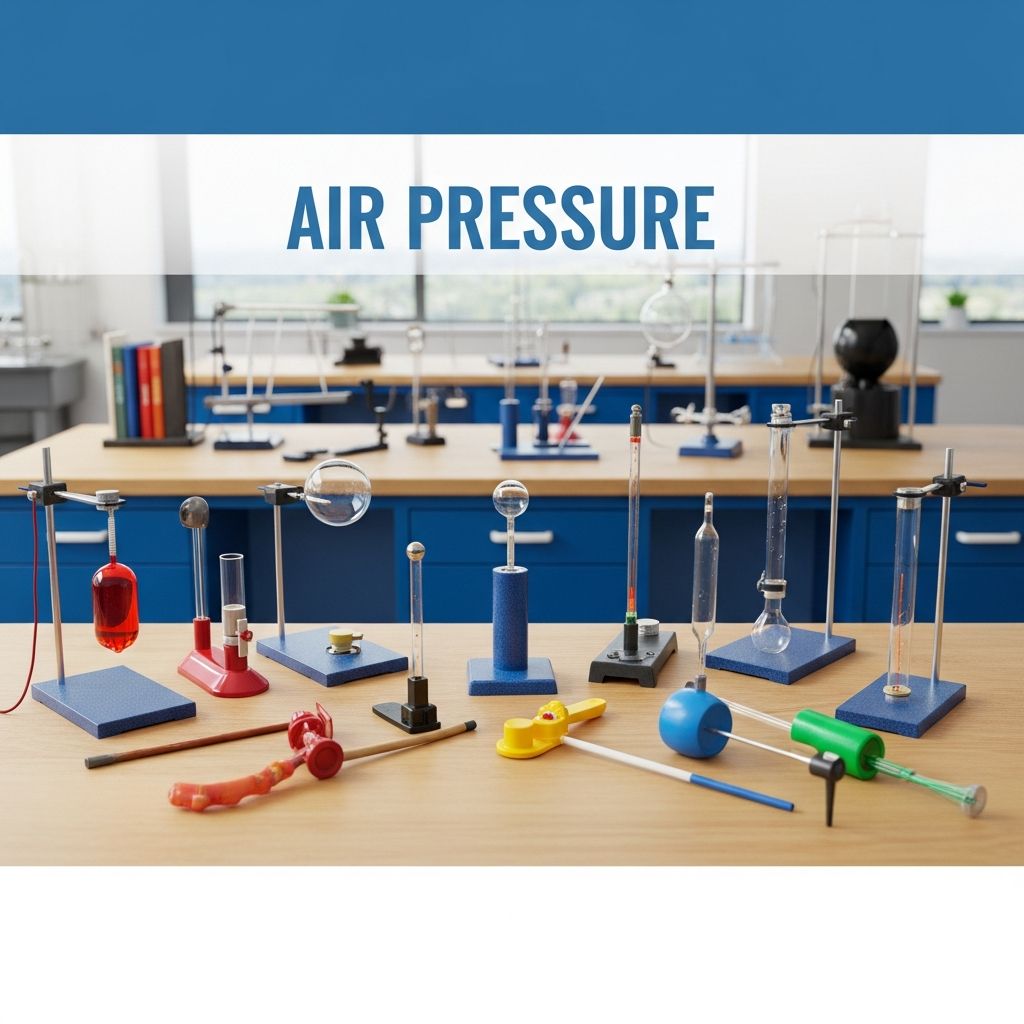
Air pressure, the force exerted by the weight of air molecules, surrounds us constantly yet remains invisible. These 12 original experiments reveal its power using simple household items, making abstract physics tangible for kids and adults alike. Each activity includes materials, steps, scientific explanation, and educational takeaways to enhance learning.
Understanding the Basics of Air Pressure
Air pressure arises from countless air molecules colliding with surfaces, creating about 14.7 pounds per square inch at sea level. It decreases with altitude because fewer molecules exist higher up.Key principle: Differences in pressure cause motion, from wind to airplane lift. These demos build intuition for concepts like Bernoulli’s principle, where faster air lowers pressure.
Experiment 1: Inverted Water Challenge
Demonstrate how atmospheric pressure holds water in place against gravity.
- Materials: Glass half-filled with water, sturdy card, sink.
- Steps:1. Fill glass one-third with water. 2. Cover rim tightly with card. 3. Hold card, flip glass upside down over sink. 4. Release hand slowly.
The card stays, water doesn’t spill. Air pressure pushes up with ~15 psi, outweighing water’s downward force (~1 psi). Takeaway: Explains barometer function and vacuum seals.
Experiment 2: Levitating Ball in Funnel
Show Bernoulli’s principle with a floating ping-pong ball.
- Materials: Funnel, ping-pong ball, hairdryer or straws.
- Steps:1. Place ball in funnel’s wide end. 2. Blow into narrow end steadily.
Ball hovers despite airflow. Fast-moving air inside reduces pressure below the ball; higher outside pressure keeps it in. Extend by tilting funnel.
Experiment 3: Collapsing Can Crusher
Illustrate pressure differences inside vs. outside a container.
- Materials: Empty aluminum soda can, tongs, hot water, cold water bowl.
- Steps:1. Add tablespoon hot water to can. 2. Heat over stove until steam forms. 3. Tongs-grip can, invert into cold water quickly.
Can implodes dramatically. Steam condenses, creating low-pressure vacuum; atmosphere crushes it. Safety: Adult supervision for heat.
Experiment 4: Balloon Squeeze Surprise
Watch balloons “kiss” due to pressure changes.
- Materials: Two inflated balloons, string, straws.
- Steps:1. Tie balloons together, hang via string through straw on rod. 2. Blow between them.
Balloons move together. Blowing lowers air pressure between; surrounding higher pressure pushes them. Relates to airplane wing lift.
Experiment 5: DIY Air Rocket Launcher
Launch a bottle rocket powered by compressed air.
- Materials: Plastic bottle, cork, bike pump, water.
- Steps:1. Fill bottle 1/3 with water. 2. Insert pump needle through cork, seal in bottle. 3. Pump rapidly (10-20 times).
Rocket blasts off. Pumped air pressure expels water jet, propelling by Newton’s third law. Measure flight distance variations.
Experiment 6: Paper Lift Illusion
Lift paper against intuition with airflow.
- Materials: Sheet of paper, straw or mouth.
- Steps:1. Hold paper under lower lip. 2. Blow hard over top edge.
Paper rises. Fast air atop lowers pressure, lifting paper like airplane wings. Try with heavier paper.
Experiment 7: Balloon Weight Balance
Prove air has mass and weight.
- Materials: Two identical balloons, ruler/stick, string.
- Steps:1. Inflate one balloon, leave other deflated. 2. Balance on ruler ends. 3. Deflate slowly, observe tip.
Inflated side dips heavier due to air mass. Extend: Balance multiple balloons, deflate sequentially.
Experiment 8: Stack Pressure Tower
Model altitude’s effect on pressure visually.
- Materials: 14 wafers/cookies per student, ruler.
- Steps:1. Stack 14 wafers (each ~1000 ft altitude). 2. Note: Bottom wafers bear more “weight” (pressure).
Simulates decreasing pressure with height; fewer air molecules above. Calculate: Sea level ~14.7 psi, drops ~1 in/1000 ft.
Experiment 9: Fluid Pressure Dispenser
Create a balloon-powered drink pourer.
- Materials: Plastic bottle, balloon, straw, tape, water/food coloring.
- Steps:1. Poke holes in bottle cap for straw/balloon. 2. Fill bottle halfway. 3. Inflate balloon over cap holes.
Squeeze releases liquid via pressure. Balloon air forces fluid out. Customize colors for parties.
Experiment 10: Egg Vacuum Drop
Suck an egg into a bottle using fire and pressure.
- Materials: Hard-boiled egg (peeled), wide-mouth jar, paper, matches.
- Steps:1. Light paper in jar, insert quickly. 2. Place egg on mouth.
Egg gets pulled in. Combustion consumes oxygen, lowering pressure; atmosphere pushes egg. Use safety precautions.
Experiment 11: Floating Paper Plate
Demonstrate atmospheric pressure lifting objects.
- Materials: Paper plate, spool, pin, hairdryer.
- Steps:1. Pin spool to plate center. 2. Blow upward through spool with dryer.
Plate floats. Directed airflow reduces pressure below. Adjust speed for stability.
Experiment 12: Pressure vs. Altitude Model
| Altitude (ft) | Pressure (psi) | Analogy (Weight on 1 sq in) |
|---|---|---|
| Sea Level (0) | 14.7 | 15 elephants approx. |
| 5,000 | 12.2 | 12 elephants |
| 18,000 | 7.4 | 7-8 elephants |
Build model comparing objects’ pressure to air. E.g., elephant foot ~3 psi vs. air’s 14.7 psi. Discuss aviation impacts.
Advanced Insights and Applications
These experiments tie to real-world engineering: Aircraft design counters low-pressure high altitudes; pollution dispersion follows pressure gradients. Weather patterns form from pressure differences driving winds. Encourage extensions like graphing pressure-altitude data.
Frequently Asked Questions
What age group suits these air pressure experiments?
Best for ages 6-14, with adult supervision for heat/fire. Younger kids (4-6) can observe simplified versions like balloon squeeze.
Why does air pressure decrease at higher altitudes?
Fewer air molecules above exert less force downward.
Can these be done without special equipment?
Yes, 90% use household items; alternatives like straws for pumps.
How do these teach Bernoulli’s principle?
Experiments 2, 6 show faster air lowers pressure, enabling lift/flight.
Are there safety tips for all demos?
Supervise heat sources (3,10); eye protection for launches (5); no ingestion of small parts.
References
- Air Pressure Experiments: I Can’t Take the Pressure! — TeachEngineering (University of Colorado Boulder). 2023. https://www.teachengineering.org/activities/view/cub_air_lesson04_activity1
- Top 10 Air Pressure Experiments — Education Corner. 2024. https://www.educationcorner.com/air-pressure-experiments/
- 5 Ways to Demonstrate Air Pressure to Children — ASME. 2023-05-15. https://www.asme.org/topics-resources/content/5-ways-to-demonstrate-air-pressure-to-children
- 20 Best Air Pressure Science Experiments — Go Science Girls. 2024. https://gosciencegirls.com/science-experiments-on-air-pressure/
- Top Ten Air Pressure Experiments to Mystify Your Kids — Super Charged Science (PDF). 2022. https://www.superchargedscience.com/documents/Top%20Ten%20Air%20Pressure%20Experiments%20to%20Mystify%20Your%20Kids.pdf

Medha Deb is an editor with a master's degree in Applied Linguistics from the University of Hyderabad. She believes that her qualification has helped her develop a deep understanding of language and its application in various contexts. Medha specializes in the areas of beauty, health, sports, and wellness and is committed to ensuring that the content on the website is…