
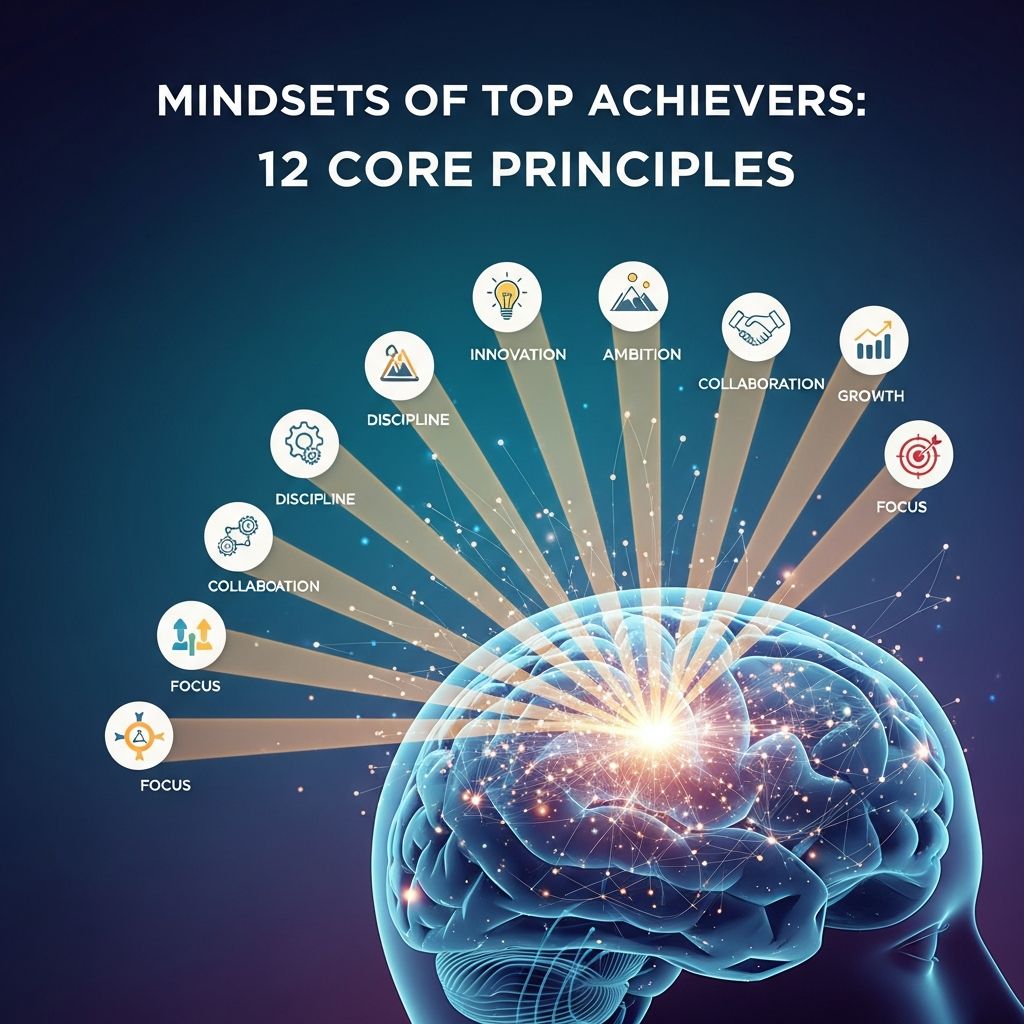
High achievers consistently outperform others not due to luck or innate talent alone, but through cultivated mindsets that shape their actions and responses to challenges. Research from institutions like MIT Sloan and psychological studies reveals common traits such as resilience, resourcefulness, and a solutions-focused approach that propel individuals toward success. This article delves into 12 key principles, drawing from empirical evidence on entrepreneurial mindsets, personality traits, and emotional intelligence to provide actionable insights for anyone aiming to elevate their performance.
Building an Unshakable Foundation
Success begins with internal frameworks that withstand external pressures. Top performers develop mental models emphasizing adaptability and growth, enabling them to thrive in uncertainty. According to MIT Sloan, an entrepreneurial mindset—resilient, resourceful, and solutions-oriented—serves as a catalyst for innovation and value creation, even in complex conditions. These principles form the bedrock, influencing how individuals perceive opportunities and obstacles.
1. Embrace Emotional Composure Under Pressure
One hallmark of elite performers is their ability to maintain calm amid chaos. They monitor emotions closely, using self-awareness to respond thoughtfully rather than react impulsively. TalentSmartEQ’s research on over a million people shows that 90% of ultra-successful individuals excel at emotional management, staying focused and productive in high-stakes scenarios. This composure allows them to adapt to change, recognizing that circumstances are temporary, which fosters sustained control and happiness.
2. Commit to Lifelong Knowledge Pursuit
Exceptional people prioritize continuous self-education, filling every spare moment with learning. This passion for growth stems from high self-awareness and curiosity, driving them to ask questions without fear of appearing uninformed. By constantly expanding their knowledge, they position themselves ahead, turning potential ignorance into strategic advantages in personal and professional arenas.
3. Master Deliberate Decision-Making
Rather than relying on gut instincts, top achievers deliberate carefully, seeking counsel and allowing time for reflection—often sleeping on major choices. Studies confirm that impulsive decisions mislead, while measured approaches yield better outcomes. This trait ensures choices align with long-term goals, minimizing regrets and maximizing effectiveness.
4. Cultivate an Optimistic Worldview
Optimism is not naive positivity but a learned outlook that enhances health, perseverance, and growth. Martin Seligman’s work in Learned Optimism demonstrates that optimists exhibit stronger immune function, lower depression rates, and greater resilience post-trauma. They interpret setbacks as temporary, fueling persistence toward objectives.
5. Define a Clear Purpose and Vision
High achievers anchor their efforts in a definite aim, providing direction amid distractions. This clarity acts as a North Star, guiding decisions and motivating sustained action. Without it, even talented individuals falter; with it, ordinary efforts compound into extraordinary results.
6. Harness the Power of Grit
Grit—passion combined with perseverance—outpredicts talent in achieving goals. Angela Duckworth’s research at West Point and beyond shows gritty individuals endure longer, applying relentless effort until success. This quality sustains commitment through obstacles, turning vision into reality.
7. Exercise Ironclad Discipline
Discipline bridges ambition and accomplishment, requiring consistent effort toward long-term aims. Duckworth’s studies link self-discipline to goal attainment, noting its role in overcoming adolescent struggles with delayed gratification. Top performers treat it as non-negotiable, building habits that automate progress.
8. Turn Fear into Calculated Risk-Taking
While danger triggers instinctual caution, fear is a mindset choice that achievers reframe. They seek the adrenaline of conquest, pursuing opportunities others avoid. This fearlessness, tempered by assessment, enables boundary-pushing innovations and breakthroughs.
9. Chase Incremental Wins for Momentum
Small victories are psychological rocket fuel, building androgen receptors in reward centers and boosting testosterone for confidence. Achievers stack these wins deliberately, creating momentum that propels them through larger challenges, with effects lasting months.
10. Leverage Personality Traits for Self-Efficacy
The Big Five personality traits—particularly conscientiousness, openness, extraversion, and low neuroticism—enhance self-efficacy, the belief in one’s capabilities. Peer-reviewed studies confirm conscientious individuals sustain higher engagement and achievement, while openness fosters creative problem-solving. Cultivating these amplifies entrepreneurial intent.
11. Adopt a Solutions-Oriented Entrepreneurial Mindset
Entrepreneurs view problems as opportunities, acting decisively with limited data. Rowena Barrett describes them as self-directed, action-oriented critical thinkers who remain adaptable in uncertainty, sparking innovation across sectors. This mindset drives societal and economic value.
12. Practice Daily Gratitude and Appreciation
Grounded in thankfulness, top performers sustain motivation by appreciating current blessings. This reduces envy, lowers stress, and reinforces positivity, grit, and focus. It’s the quiet force multiplying their capacity for further success.
How These Mindsets Interact: A Comparative Overview
| Mindset | Key Benefit | Supporting Research |
|---|---|---|
| Emotional Composure | Pressure handling | TalentSmartEQ (90% emotional mastery) |
| Grit & Discipline | Long-term persistence | Duckworth studies |
| Optimism | Health & resilience | Seligman, Carver et al. |
| Solutions-Oriented | Innovation catalyst | MIT Sloan |
| Self-Efficacy Traits | Entrepreneurial intent | Big Five SEM analysis |
This table illustrates synergies: emotional composure supports grit, while optimism amplifies self-efficacy, creating a reinforcing loop for sustained achievement.
Practical Steps to Adopt These Mindsets
- Daily Reflection: Journal emotions and decisions to build composure and deliberation.
- Learning Rituals: Dedicate 30 minutes daily to reading or podcasts on growth topics.
- Grit Building: Set micro-goals with perseverance trackers, celebrating small wins.
- Optimism Training: Practice reframing setbacks as learning opportunities, per Seligman techniques.
- Personality Audit: Assess Big Five traits via validated tools and target conscientiousness through routines.
Frequently Asked Questions (FAQs)
Can anyone develop these success mindsets?
Yes, research shows mindsets like optimism and grit are learnable through deliberate practice, as evidenced by Seligman’s optimism training and Duckworth’s grit interventions.
How long does it take to see results from adopting these principles?
Incremental changes appear in weeks via small wins, with profound shifts in months through consistent application, per neurochemical studies on confidence boosts.
Do personality traits limit success potential?
No, while Big Five traits influence self-efficacy, they can be nurtured; conscientiousness and openness strongly predict growth regardless of starting point.
What’s the role of failure in these mindsets?
Failure is reframed as feedback, building resilience and solutions-orientation, key to entrepreneurial success even in uncertain environments.
How do successful people balance ambition with well-being?
Through appreciation and composure, maintaining positivity and reducing stress, as ultra-achievers prioritize gratitude for sustained motivation.
References
- 3 traits of an entrepreneurial mindset — MIT Sloan School of Management. 2023-10-12. https://mitsloan.mit.edu/ideas-made-to-matter/3-traits-entrepreneurial-mindset
- 12 Qualities That Set Ultra Successful People Apart — TalentSmartEQ. 2023-05-15. https://www.talentsmarteq.com/12-qualities-that-set-ultra-successful-people-apart/
- 10 Traits of Highly Successful People — Damon Ashworth Psychology. 2024-03-14. https://damonashworthpsychology.com/2024/03/14/ten-traits-of-highly-successful-people/
- The role of five big personality traits and entrepreneurial mindset on entrepreneurial intention — National Center for Biotechnology Information (PMC). 2022-10-20. https://pmc.ncbi.nlm.nih.gov/articles/PMC9627345/

Medha Deb is an editor with a master's degree in Applied Linguistics from the University of Hyderabad. She believes that her qualification has helped her develop a deep understanding of language and its application in various contexts. Medha specializes in the areas of beauty, health, sports, and wellness and is committed to ensuring that the content on the website is…