
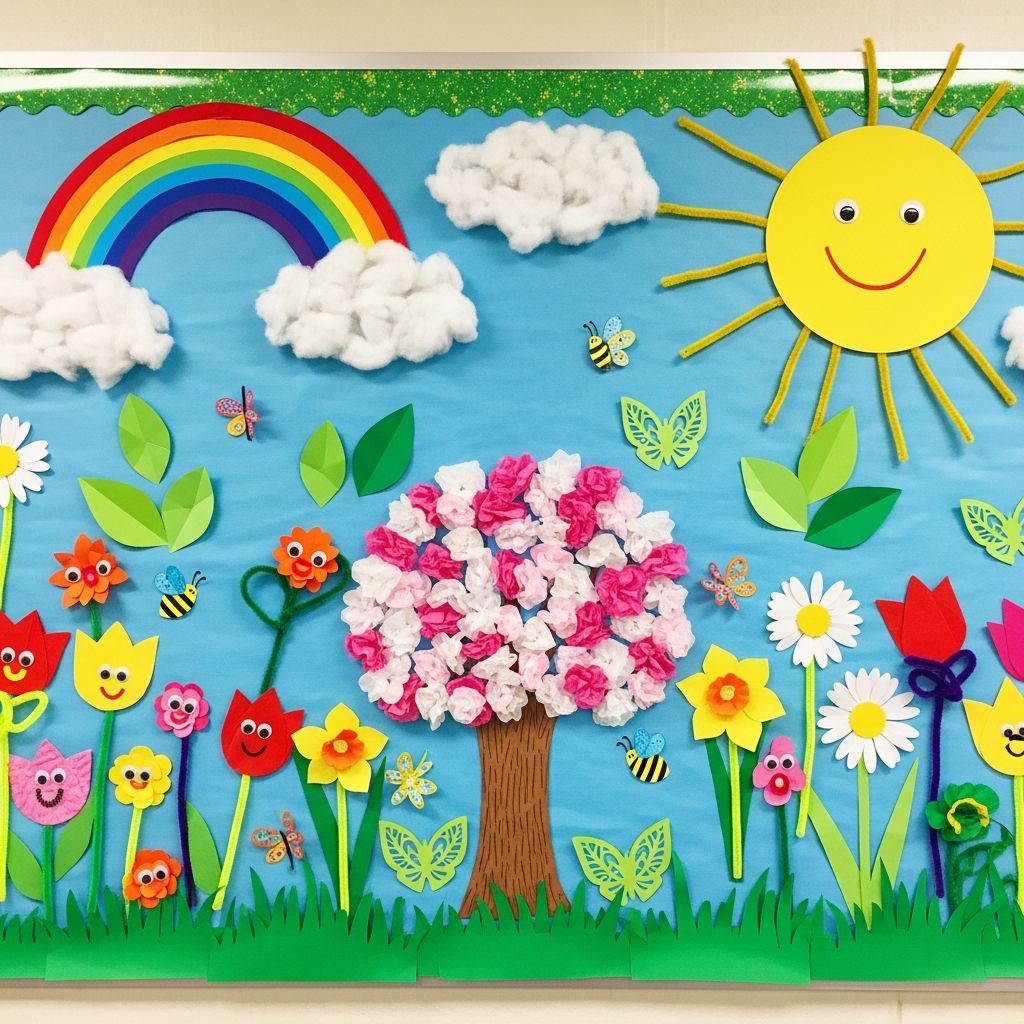
Spring brings renewal and energy into classrooms, making it the ideal time to refresh bulletin boards with colorful, interactive displays. These boards not only beautify walls but also engage students in learning, reflection, and community building. Drawing from seasonal motifs like blooming flowers, fresh growth, and environmental awareness, educators can create focal points that spark curiosity and participation. This article explores 12 unique concepts, each designed for easy setup, minimal prep, and maximum student involvement.
Why Update Bulletin Boards in Spring?
Bulletin boards serve as dynamic teaching tools. In spring, they transition from winter’s muted tones to vibrant pastels and greens, mirroring nature’s awakening. Research from educational psychology highlights how visual environments influence student mood and focus; colorful, thematic displays can improve engagement by up to 20% in elementary settings. Interactive elements encourage ownership, turning passive walls into active learning spaces.
- Boost morale with seasonal relevance.
- Promote skills like writing, reflection, and creativity.
- Facilitate discussions on themes like growth and sustainability.
Environmental Awareness Boards
Planet Guardians Pledge Wall
Create a commitment-focused board titled “Planet Guardians: Our Promises for Earth.” Use blue-green backgrounds with globe cutouts and leaf borders. Students fill pledge cards stating one eco-friendly action, such as “I will recycle paper daily.” Display them around a central Earth image, fostering school-wide sustainability discussions.
Green Thumb Heroes
This board celebrates everyday environmental heroes. Title it “Green Thumb Heroes in Action.” Feature student photos with captions describing their contributions, like planting seeds or reducing waste. Add vine borders and recycled material accents for texture, tying into Earth Day activities.
Reading and Literacy Inspirations
Blossoming Book Adventures
Encourage reading with “Blossoming Book Adventures,” where students craft flower-shaped reviews. Petals list title, character, and a favorite quote. Stem them from a book stack base, using floral borders to frame the growing garden. This visual tracker motivates ongoing reading challenges.
Story Seeds Garden
Design a “Story Seeds Garden” board. Students plant “seeds” (cards) with story ideas or summaries, watching them “sprout” into full blooms as stories develop. Include sunny skies and watering can props, perfect for creative writing units.
Personal Growth and Reflection Displays
Spring Growth Petals
Titled “Spring Growth Petals,” this interactive board has students create personalized flowers. Each petal reflects on a growth area: academics, friendships, or habits. Center with self-portraits, arranged in a meadow layout to symbolize collective progress.
New Beginnings Meadow
“New Beginnings Meadow” prompts goal-setting. Students add butterfly cutouts with resolutions, pinned to grass-like borders. Track progress monthly by adding wing colors, inspiring resilience and forward-thinking.
Kindness and Community Builders
Blooms of Kindness
Build empathy with “Blooms of Kindness.” Students write kind acts on petals, attaching to a kindness tree. Use heart-shaped leaves and rainbow borders. This board grows visibly, reinforcing positive behavior.
Friendship Flower Patch
“Friendship Flower Patch” features paired flowers where buddies share compliments. Stems intertwine, bordered by smiling suns. Ideal for social-emotional learning (SEL) mornings.
Seasonal Fun and Holiday Ties
Easter Egg Hunt of Learning
For early spring, “Easter Egg Hunt of Learning” hides egg cards with facts or questions. Students “hunt” by answering to claim them. Pastel borders and bunny accents add whimsy.
Rainy Day Rainbow Challenges
“Rainy Day Rainbow Challenges” displays weather-themed tasks across rainbow arcs, like math puzzles or art prompts. Clouds and raindrops frame it, turning gloomy days productive.
Math and Science Integration Boards
Math Garden Metrics
Integrate STEM with “Math Garden Metrics.” Students measure and graph plant growth data on veggie-shaped graphs. Use ruler borders and calculator props for a hands-on math tie-in.
| Plant Type | Avg. Growth (cm) | Student Predictions |
|---|---|---|
| Bean | 15 | Varied |
| Sunflower | 25 | Overestimated |
| Radish | 10 | Accurate |
Weather Watch Bloom
“Weather Watch Bloom” tracks spring patterns with flower thermometers and rain gauges drawn by students. Petals log daily data, teaching observation skills.
Practical Tips for Implementation
To maximize impact:
- Select durable borders like fabric-wrapped foam for reuse.
- Involve students in design for buy-in.
- Rotate elements bi-weekly to maintain interest.
- Photograph progress for portfolios.
Budget-friendly supplies include construction paper, markers, and free printables from educational sites. Prep time averages 1-2 hours per board.
Frequently Asked Questions (FAQs)
What materials are best for spring bulletin boards?
Use vibrant cardstock, tissue paper for 3D flowers, and washi tape for borders. These withstand humidity and frequent handling.
How can I make boards interactive for remote learners?
Share digital versions via class apps; students submit virtual pledges or photos for inclusion in scanned updates.
Are these suitable for all grade levels?
Yes, adapt complexity: simple pledges for K-2, data graphs for 4-6.
How often should I change spring boards?
Refresh monthly to align with holidays like Earth Day or end-of-year reflections.
Can these tie into curriculum standards?
Absolutely; link to Common Core for writing (ELA) or NGSS for environmental science.
Advanced Customization Ideas
For seasoned teachers, layer boards with QR codes linking to student videos or extension activities. Incorporate multicultural spring festivals, like Holi or Nowruz, for diversity. Use LED string lights (battery-powered) for evening events, enhancing ambiance safely.
Measure success by student feedback surveys or participation rates. One study notes interactive displays increase on-task behavior by 15%.
References
- Environmental Psychology in Education: Visual Displays and Student Engagement — American Psychological Association (APA). 2023-05-15. https://www.apa.org/pubs/journals/releases/edu-edu0000789.pdf
- Next Generation Science Standards (NGSS) for K-12 — National Research Council (via NGSS.gov). 2024-02-10. https://www.nextgenscience.org/
- Classroom Design and Academic Performance — U.S. Department of Education. 2022-11-01. https://ies.ed.gov/ncee/edlabs
- Social-Emotional Learning in Elementary Settings — Collaborative for Academic, Social, and Emotional Learning (CASEL). 2025-01-20. https://casel.org/

Medha Deb is an editor with a master's degree in Applied Linguistics from the University of Hyderabad. She believes that her qualification has helped her develop a deep understanding of language and its application in various contexts. Medha specializes in the areas of beauty, health, sports, and wellness and is committed to ensuring that the content on the website is…