
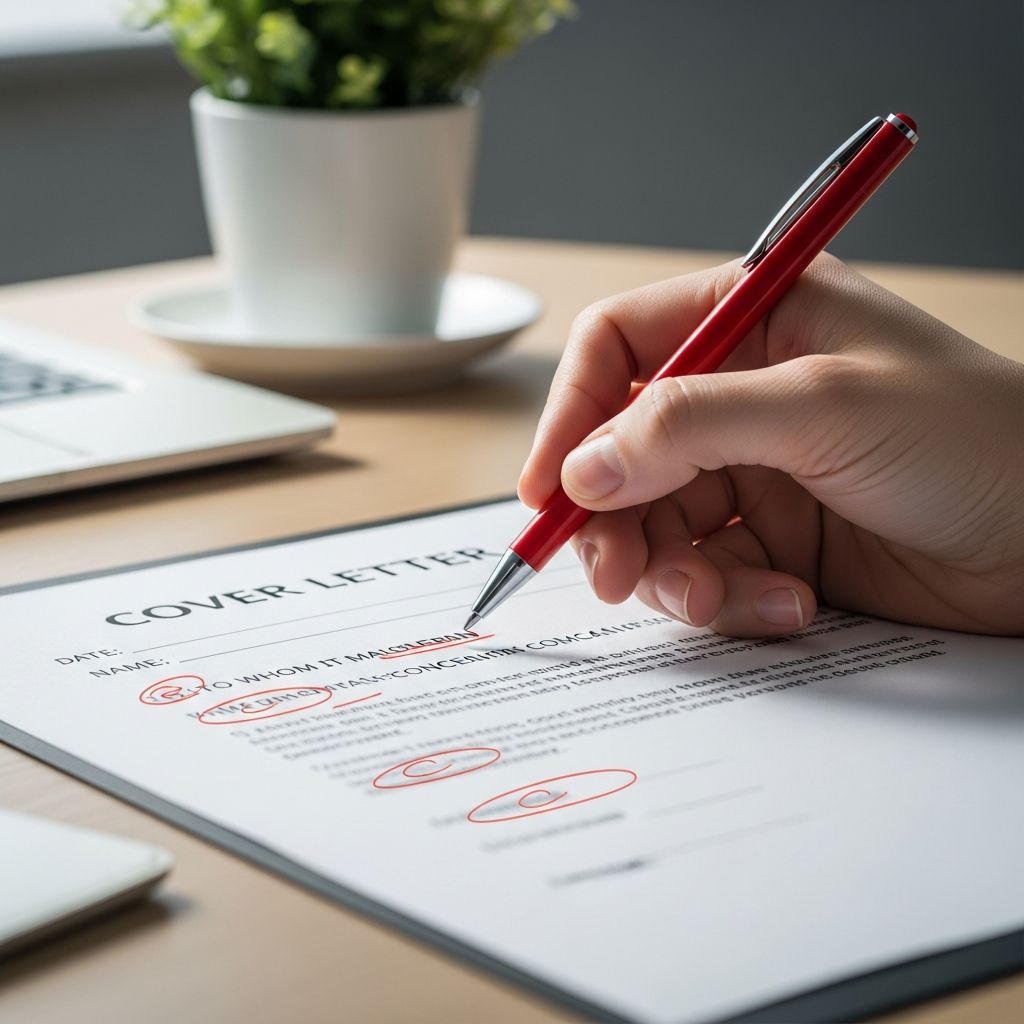
Understanding Why Cover Letters Matter in Your Job Search
Your cover letter serves as your introduction to hiring managers and recruiters, providing them with context about your qualifications and demonstrating your genuine interest in a specific position. While many applicants view the cover letter as a formality, it remains one of the most critical components of your job application package. The difference between a compelling cover letter and a flawed one can determine whether a recruiter takes time to review your resume or moves directly to the next candidate in their stack. Recognizing and correcting common errors in your cover letter writing significantly increases your chances of securing an interview invitation.
The Self-Centered Narrative Trap
One of the most pervasive mistakes applicants make is constructing their cover letter around personal desires and career aspirations rather than demonstrating value to the employer. When hiring managers read your letter, they don’t want to understand what you hope to gain from the position or how the company aligns with your personal goals. Instead, they seek clarity on what you can contribute to their organization and how your background addresses their specific needs.
Transform your narrative by reframing your experiences in relation to employer benefits. Rather than writing about the salary package you deserve or the career growth opportunities that attract you, illustrate how your skills will solve problems within their team. Use language that emphasizes mutual benefit and demonstrates that you’ve researched the company’s challenges and positioned yourself as someone capable of addressing them. This shift in perspective fundamentally changes how recruiters perceive your candidacy.
The Plagiarism Problem: Moving Beyond Generic Templates
Downloading a standardized cover letter template or using artificial intelligence to generate a generic letter defeats the fundamental purpose of the document. Hiring managers review numerous applications, and they can instantly recognize a templated letter that could apply to virtually any position and company. These generic letters signal that you haven’t invested time in understanding the organization or the specific role.
To differentiate yourself, spend time customizing every element of your cover letter. Reference specific projects the company has undertaken, mention particular team members if appropriate, and connect your background directly to their stated objectives. This personalization demonstrates genuine interest and shows that you’ve conducted thorough research before submitting your application. The effort you invest in customization is precisely what hiring managers notice and appreciate.
Claiming Attributes Without Substantiation
Stating that you are a \”team player\” or possess \”excellent communication skills\” without providing concrete examples weakens your credibility. Hiring managers hear these assertions repeatedly from every applicant, and without supporting evidence, your claims sound hollow and unconvincing. Instead of making general declarations about your character or abilities, demonstrate these qualities through specific examples and documented achievements.
When you mention a relevant skill, immediately follow it with a concrete illustration of how you applied that skill in a previous role. Describe the situation you faced, the action you took, and the measurable outcome that resulted. This approach transforms vague claims into powerful evidence of your capabilities. For example, rather than asserting that you excel at problem-solving, describe a specific challenge you encountered, your innovative solution, and how that solution benefited the organization.
Ignoring Application Instructions and Requirements
Job postings frequently include specific instructions about how to submit your materials or what information to include in your cover letter. Overlooking these guidelines signals to hiring managers that you lack attention to detail—a quality essential in virtually every professional role. Whether the instructions request a particular format, specific information, or submission method, following them precisely demonstrates your ability to execute instructions accurately.
Before you submit your application, create a checklist of all requirements mentioned in the job posting. Verify that your cover letter addresses each requirement explicitly. If the employer requests information about your salary expectations, availability date, or specific certifications, incorporate this information directly into your cover letter rather than assuming they’ll find it elsewhere. This compliance demonstrates professionalism and attention to detail.
The Mechanics Matter: Proofreading and Error Correction
Spelling mistakes, grammatical errors, and punctuation problems are among the most damaging errors you can make in a cover letter. Hiring managers frequently use these mechanical errors as an immediate reason to eliminate candidates from consideration, regardless of how qualified they may be. In highly competitive job markets, where hiring managers may review hundreds of applications for a single position, they use small errors as filtering criteria to reduce their workload.
Implement a multi-layered proofreading strategy to catch errors before submission. First, use your word processor’s built-in spell-check and grammar tools. Next, read your letter aloud slowly to identify errors that automated tools might miss. Then, request a colleague or mentor to review your letter with fresh eyes, as they may notice mistakes you’ve become blind to after multiple reviews. Consider using dedicated proofreading tools like Grammarly to catch subtle errors related to sentence structure and clarity.
Length and Depth: Finding the Right Balance
Cover letters that exceed a single page dilute your message and test the patience of busy hiring managers who review applications quickly. Conversely, letters that are too brief—fewer than two complete paragraphs—appear sparse and fail to convey sufficient information about your qualifications. The ideal length typically falls between three and four paragraphs, providing enough space to make your case without overwhelming the reader.
Within this length constraint, include only information directly relevant to the position you’re pursuing. Avoid tangential stories or unrelated accomplishments that don’t strengthen your candidacy. While personal details can humanize your application, focus primarily on demonstrating professional competency and alignment with the role’s requirements. Every sentence should serve a purpose in advancing your candidacy.
Visual Presentation and Formatting Standards
The visual appearance of your cover letter influences how hiring managers perceive your professionalism and attention to detail. Using appropriate fonts, consistent formatting, and clear paragraph breaks makes your letter easier to read and more visually appealing. Conversely, unusual font choices, inconsistent spacing, or cluttered formatting create a negative impression that may overshadow strong content.
Maintain consistency between your cover letter and resume formatting to present a cohesive application package. Use standard, professional fonts that are easily readable in various formats and on different devices. Break your content into logical paragraphs separated by white space, making the letter visually approachable. Avoid fancy cursive fonts or decorative elements that may render improperly when files are transferred between systems or printed.
Tone and Professionalism: Matching Culture Without Sacrificing Standards
The appropriate tone for your cover letter depends partly on the company’s industry and culture. A tech startup may appreciate a conversational tone, while a financial institution may expect formality. However, regardless of the industry, maintaining a baseline level of professionalism is non-negotiable. This means avoiding slang, colloquial language, casual references, and jokes that could be misinterpreted.
Research the company’s communication style by reviewing their website, social media presence, and any materials they’ve published. If the company uses a friendly, conversational tone in their communications, you can mirror this approach while remaining professional. However, never sacrifice appropriate language for perceived cultural fit. Phrases like \”hey girl\” or excessively casual language suggest you’re not taking the application seriously. When in doubt, err on the side of professionalism—a professional tone is always appropriate, while an overly casual tone may disqualify you.
Excessive Self-Promotion and Bragging
There’s a delicate balance between confidently presenting your qualifications and appearing arrogant or boastful. Using superlatives like \”master of\” or \”expert in\” without substantiating evidence of your expertise can backfire. Instead of claiming mastery, use measured language that presents your skills factually and let your accomplishments speak for themselves.
When describing your achievements, frame them in terms of impact and results rather than personal glory. Instead of writing \”I am an exceptional leader,\” describe a specific instance where your leadership produced measurable results. This approach demonstrates competence through evidence rather than assertion, which is far more convincing to discerning hiring managers. Present yourself with confidence, but allow your track record to justify your position.
Linguistic Clarity and Communication Quality
Poor grammar, awkward phrasing, and unclear sentence structure undermine your credibility, particularly in roles where written communication matters. These errors suggest carelessness or limited proficiency with the English language. Hiring managers expect clear, well-constructed communication that accurately conveys your thoughts without forcing them to interpret your meaning.
If English is not your first language, consider having a native speaker review your letter before submission. If writing is challenging for you, invest time in improving your clarity before applying to positions where communication is critical. Use active voice, construct clear topic sentences, and avoid unnecessarily complex vocabulary that obscures your meaning. Your goal is clear communication, not impressive vocabulary.
Redundancy with Your Resume Content
Your cover letter should complement your resume, not duplicate it. Hiring managers will review both documents, so restating information that already appears on your resume wastes valuable space where you could provide additional context or insights. Instead, use your cover letter to explain your career narrative, demonstrate cultural fit, and highlight how your specific experiences address the position’s requirements.
Think of your cover letter as the opportunity to tell the story behind your resume entries. Expand on why you left a previous position, provide context for career transitions, or explain how seemingly unrelated experiences have prepared you for this specific role. This narrative layer adds depth to your application and helps hiring managers understand your career trajectory and motivation.
Common Language Errors to Eliminate
Certain phrases appear frequently in cover letters but detract from your credibility and should be removed entirely. Phrases like \”I would be a good fit\” are obvious and unnecessary—you wouldn’t apply if you didn’t believe this. Similarly, using \”honestly\” or \”seriously\” implies that your other statements might be dishonest or joking, which undermines your credibility.
Filler words like \”basically,\” \”essentially,\” \”very,\” \”really,\” and \”quite\” weaken your writing without adding substance. Remove these words and your sentences become more direct and impactful. Additionally, using \”used to\” instead of the simpler past tense is unnecessarily verbose. \”I worked at the regional office\” is stronger than \”I used to work at the regional office\”. Edit your letter carefully to eliminate these weakening words and phrases.
Submission Format and Presentation
How you submit your cover letter affects how it’s received and read. If you paste your letter directly into an email body, verify that formatting transfers correctly and that the letter remains readable. Email systems may not preserve special formatting, unusual fonts, or intentional line breaks. Consider sending your letter as a PDF attachment to maintain consistent formatting across different systems and devices.
When naming your file, use a professional convention like \”FirstName_LastName_CoverLetter.pdf\” rather than \”Cover_Letter.pdf\” or \”My_Letter.pdf.\” This simple detail demonstrates professionalism and makes it easier for hiring managers to organize their files. Include a brief, professional salutation line that addresses the specific person responsible for hiring, if you can identify them from the job posting. If no individual is named, research the company’s website or LinkedIn to find the appropriate contact person.
Closing Strength and Call to Action
Your cover letter’s conclusion should reinforce your interest in the position and include a subtle call to action. Rather than simply ending your letter, indicate your enthusiasm about the opportunity and express your intention to follow up. A strong closing might state your intention to contact them on a specific date or express your availability for an interview at their convenience.
Avoid weak closings that leave the impression you’re waiting passively for a response. Instead, demonstrate initiative by indicating you’ll follow up with their office, while still respecting their process and timeline. This balance shows enthusiasm without appearing pushy or desperate. Pair this closing statement with a professional sign-off and your contact information to make it easy for hiring managers to reach you.
Frequently Asked Questions About Cover Letters
Q: How long should my cover letter be?
A: Your cover letter should typically be three to four paragraphs and fit on a single page. This length is sufficient to demonstrate your interest and qualifications without overwhelming busy hiring managers.
Q: Should I use the same cover letter for multiple positions?
A: No. Customize every cover letter to the specific position and company. Use the same template as a starting point, but personalize every section to reflect the job requirements and company details.
Q: What should I do if I don’t know the hiring manager’s name?
A: Research the company’s website and LinkedIn to identify the appropriate contact person. If you cannot find a name, use a professional greeting like \”Dear Hiring Manager\” or \”Dear [Company Name] Hiring Team\” rather than the outdated \”To Whom It May Concern.\”
Q: Can I use humor in my cover letter?
A: Use humor sparingly and only if it’s natural to your communication style and appropriate for the company culture. Most cover letters benefit from professionalism over humor, which can be misinterpreted in writing.
Q: How important is the cover letter compared to my resume?
A: Both documents matter. Your resume gets your foot in the door by demonstrating qualifications, but your cover letter provides context and personality that can move you from the candidate pile to the interview list.
References
- Top 10 Biggest Mistakes When Writing a Cover Letter — Monique Helstrom. Accessed January 18, 2026. https://www.moniquehelstrom.com/bloginventory/top10-mistakes-when-writing-a-cover-letter
- Common Mistakes Made When Writing a Cover Letter — Top Universities Blog. Accessed January 18, 2026. https://www.topuniversities.com/blog/common-mistakes-made-when-writing-cover-letter
- Cover Letter Mistakes and What to Say Instead — FlexJobs Career Guidance. Accessed January 18, 2026. https://www.flexjobs.com/blog/post/words-phrases-never-include-in-your-cover-letter-v2

- Integrated M.A. in Applied Linguistics, University of Hyderabad
- 5+ years in editorial, instructional, SEO, and research-based writing
Sneha is a relationships and lifestyle writer with a strong foundation in applied linguistics and certified training in relationship coaching. She brings over five years of writing experience to theskillvault, crafting thoughtful, research-driven content that empowers readers to build healthier relationships, boost emotional well-being, and embrace holistic living. Her writing and insights reflect the belief that beauty, happiness, and wellness…