
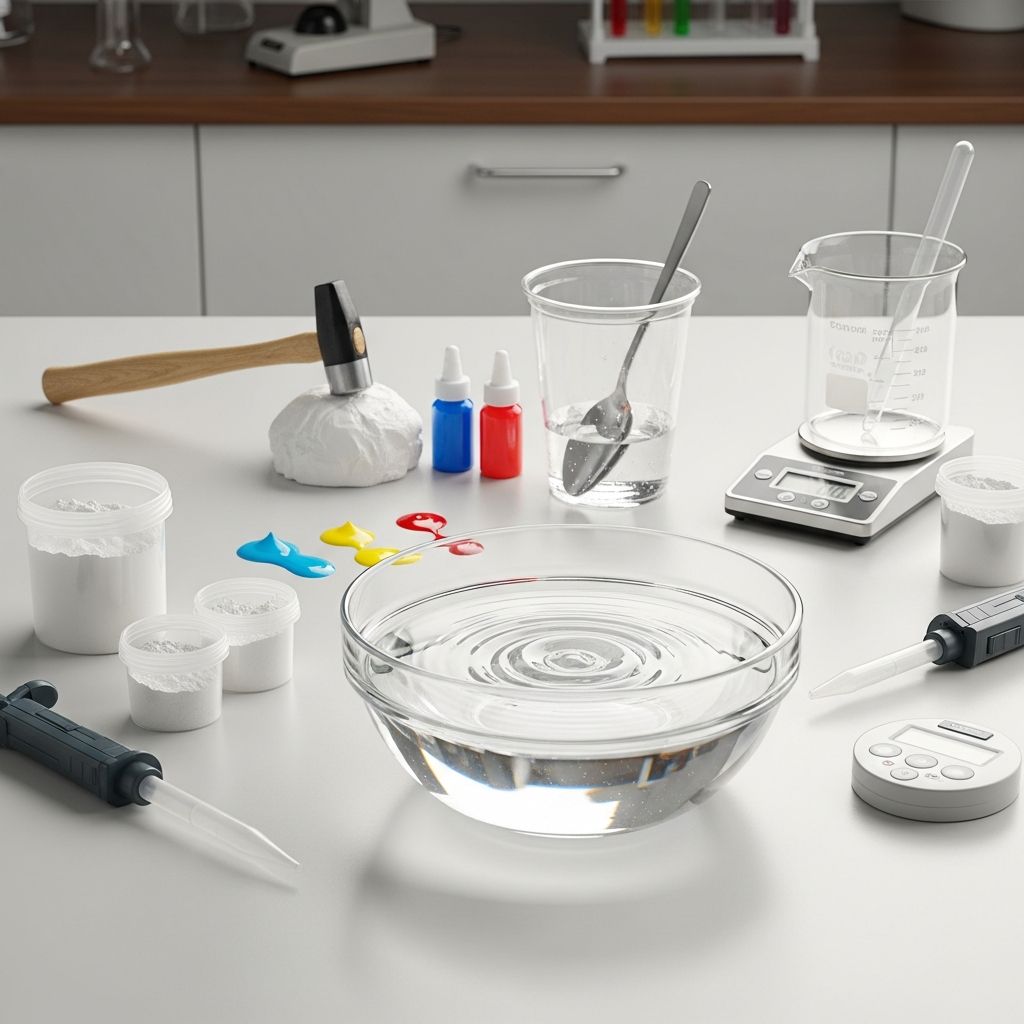
Cornstarch, a common kitchen ingredient derived from corn, transforms into a versatile tool for scientific discovery. When mixed with water or other substances, it creates **non-Newtonian fluids**—materials that act like liquids under gentle pressure but solidify under force. These experiments engage children in exploring physics concepts like viscosity, static electricity, and wave propagation, all while fostering creativity and problem-solving skills.
Understanding Cornstarch’s Unique Properties
At its core, cornstarch consists of tiny starch granules that absorb water, forming suspensions with remarkable behaviors. Unlike typical liquids, these mixtures resist rapid deformation, demonstrating **shear-thickening** properties. This makes cornstarch ideal for safe, mess-friendly science activities that teach states of matter and material science basics.
Essential Materials and Safety Tips
Most experiments require cornstarch, water, food coloring, bowls, spoons, and optional items like balloons or speakers. Always supervise young children, work in protected areas, and clean up promptly to avoid slips. Wear old clothes, as mixtures can stain.
- Cornstarch: 1-2 cups per experiment
- Water: Adjustable for consistency
- Food coloring: For visual appeal
- Tools: Mixing bowls, trays, balloons, speakers
Classic Non-Newtonian Fluid Creations
1. Magical Goo Creation
Start with the foundational cornstarch goo, often called oobleck. Combine 2 parts cornstarch with 1 part water, stirring until it flows like a thick liquid. Gently poke it to feel its fluidity; slap it to watch it harden. Add food coloring for vibrant versions. This reveals how pressure alters particle interactions, trapping water between granules under stress.
2. Quicksand Simulation
Scale up the goo for a quicksand experience: mix in a shallow tray until spoonable. Walk slowly to sink like in mud; quick steps make it solid. This demonstrates real-world non-Newtonian behaviors, mimicking natural quicksand.
3. Rainbow Sensory Dough
Mix cornstarch, water, and foam soap or conditioner with food colors to form squishy dough. Knead for a calming sensory experience that explores texture changes and color mixing.
Electricity and Motion Experiments
4. Jumping Electric Powder
Mix cornstarch with vegetable oil to a batter consistency. Charge a balloon by rubbing it on hair, then hover it over the mixture. Watch cornstarch particles leap toward the balloon due to static attraction. Neutral areas repel it, illustrating electrostatic forces on neutral particles.
5. Vibrating Speaker Patterns
Prepare thick cornstarch goo on a speaker covered in plastic. Play low-frequency tones (around 50-100 Hz) to create dancing spikes and patterns, known as Faraday waves. Higher frequencies yield minimal movement, showing how sound waves propagate through fluids.
Artistic and Frozen Explorations
6. Popsicle Chalk Magic
Blend cornstarch, water, and tempera paint; freeze in popsicle molds. Use the frozen chalk on sidewalks for colorful drawings that wash away easily. This combines chemistry (paint binding) with phase changes.
7. Edible Science Play
For safe tasting fun, mix cornstarch with corn syrup and flavors to make edible goo. Observe flow differences from water-based versions, introducing safe chemistry.
8. Bubble Foam Extravaganza
Add dish soap to cornstarch-water mix and blow bubbles. The gooey solution creates giant, resilient bubbles, teaching surface tension.
Advanced Physics Demonstrations
9. Pressure-Resistant Ball
Form goo into a ball and bounce it. It holds shape under impact, unlike water, highlighting shear-thickening.
10. Walking on Fluid Surface
In a kiddie pool, layer thick cornstarch mixture. Walk quickly across without sinking—slow steps cause sinking. Perfect for group demos on fluid dynamics.
11. Sound-Activated Monsters
Similar to speaker patterns, amplify bass music on cornstarch to sculpt eerie shapes, linking acoustics and material response.
Sensory and Themed Activities
12. Glow-in-the-Dark Slime
Incorporate glow powder or tonic water under blacklight with cornstarch base for nighttime play, adding optics to physics.
13. Cosmic Nebula Dough
Mix with glitter and blacklight-reactive paints for a space-themed sensory dough, blending art and science.
14. Finger Paint Physics
Use colored goo as finger paint on trays. Paint flows slowly, teaching viscosity in art.
15. Magnetic-Like Attractions
Enhance electric cornstarch with iron filings (supervised) to mimic magnetism via static, exploring forces.
Science Concepts Explained
These activities illustrate **non-Newtonian fluids**, specifically dilatant fluids where viscosity increases with shear rate. Static experiments demonstrate Coulomb’s law, while vibrations show wave interference.
| Experiment | Key Concept | Age Group |
|---|---|---|
| Magical Goo | Non-Newtonian | 4+ |
| Electric Powder | Static Electricity | 6+ |
| Speaker Patterns | Wave Propagation | 8+ |
| Walking Surface | Fluid Dynamics | 5+ |
Frequently Asked Questions
What is a non-Newtonian fluid?
A non-Newtonian fluid changes viscosity under stress, like cornstarch goo hardening when punched.
Is cornstarch goo safe to eat?
Plain mixtures are non-toxic but not tasty; avoid ingestion in large amounts.
How do I clean up cornstarch messes?
Let dry and sweep, or vacuum; water dissolves remnants.
Can these be done without food coloring?
Yes, natural versions work; coloring enhances visibility.
What if the mixture is too runny?
Add more cornstarch gradually for desired consistency.
Educational Benefits and Extensions
These experiments build hypothesis-testing skills, encourage observation, and connect to real science like body armor materials inspired by shear-thickening fluids. Extend by measuring flow rates or varying ratios for data tables.
References
- 15 Fun and Easy Science Experiments with Cornstarch — Education Corner. 2023. https://www.educationcorner.com/science-experiments-with-cornstarch/
- Electric Cornstarch Experiment — Little Bins for Little Hands. 2022-10-15. https://littlebinsforlittlehands.com/cornstarch-and-oil/
- Cornstarch Goo – Cool Science Experiment — Spangler Science (YouTube). 2012-07-23. https://www.youtube.com/watch?v=XbWBkwM1WAI
- Vibrating Cornstarch on a Speaker — Steve Spangler Science. 2021. https://stevespangler.com/experiments/cornstarch-monsters/
- Cornstarch and Water Experiment — Mocomi Kids (YouTube). 2014. https://www.youtube.com/watch?v=biAOOJgvRYI
- Walk On Water Cool Magic Science Experiment — Science Fun. 2020. https://www.sciencefun.org/kidszone/experiments/walk-on-water-cool-magic-science-experiment/

Medha Deb is an editor with a master's degree in Applied Linguistics from the University of Hyderabad. She believes that her qualification has helped her develop a deep understanding of language and its application in various contexts. Medha specializes in the areas of beauty, health, sports, and wellness and is committed to ensuring that the content on the website is…