
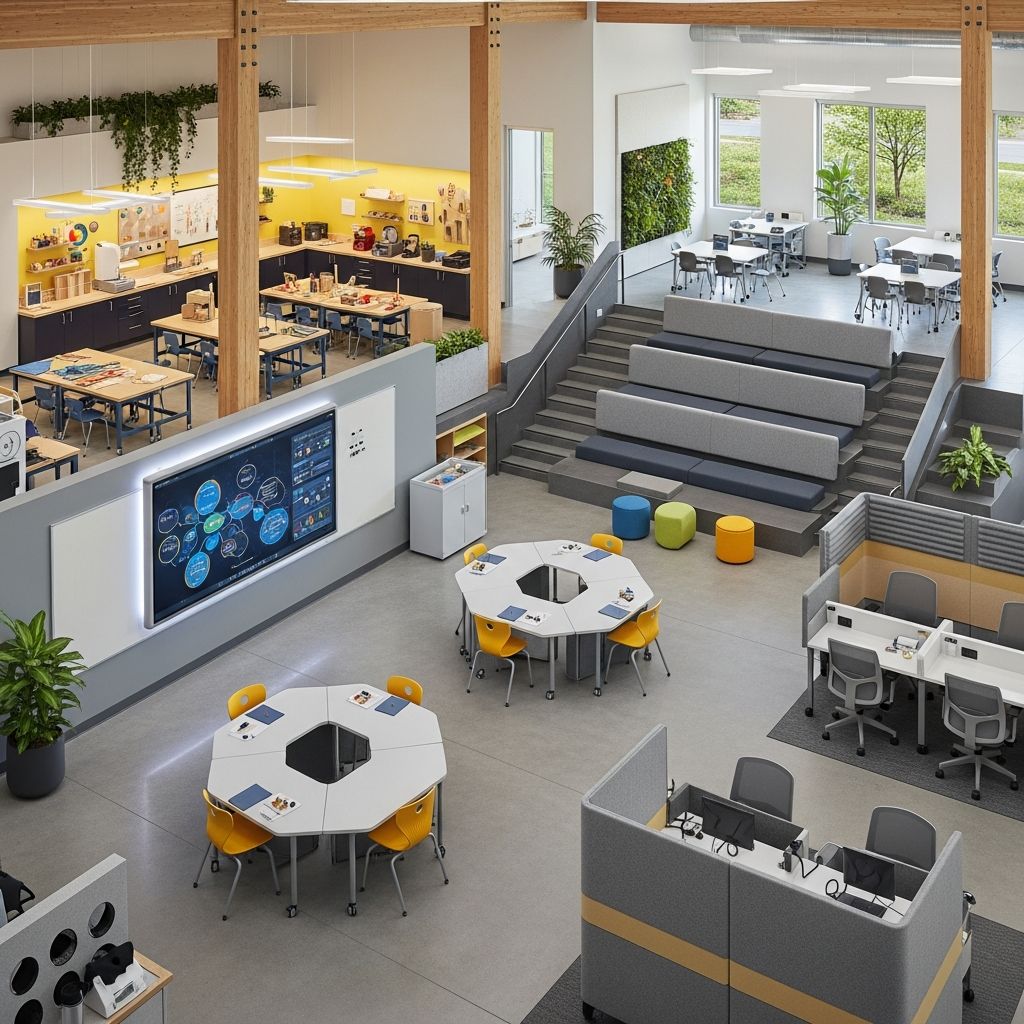
Understanding the Core Architecture of Contemporary Learning Environments
Modern educational spaces represent a significant departure from the traditional classroom model where students sit in uniform rows, passively receiving information from an instructor positioned at the front of the room. Today’s learning environments are intentionally designed to cultivate active engagement, foster collaborative problem-solving, and support diverse learning preferences among students. The transformation of classroom spaces reflects a fundamental shift in educational philosophy—one that recognizes students as active participants in their own learning journey rather than passive recipients of information. This evolution requires careful consideration of multiple factors that work together to create spaces where students thrive intellectually, socially, and emotionally.
The Four Essential Pillars of Instructional Excellence
Educational leaders and researchers have identified four critical dimensions that must be present in effective modern classrooms. These foundational pillars work in concert to create an ecosystem where meaningful learning flourishes.
Higher-Order Thinking Development
The ability to think critically, analyze complex problems, and synthesize information from multiple sources has become increasingly vital in contemporary society. Modern classrooms prioritize the development of these cognitive skills by moving beyond memorization-based approaches. Instead of simply storing facts, students engage in activities that require them to evaluate information, make connections between concepts, and apply knowledge to novel situations. This emphasis on intellectual rigor prepares learners to navigate an increasingly complex world where adaptability and analytical reasoning are paramount.
Student Agency and Empowerment
Contemporary educational design recognizes that students learn most effectively when they have autonomy over their learning process. Student agency refers to the capacity of learners to make meaningful choices about how, what, and when they learn. Modern classrooms incorporate this principle by offering multiple pathways to mastery, allowing students to select from various learning modalities, and providing opportunities for self-direction within structured frameworks. When students feel ownership over their educational experience, motivation increases, and deeper learning occurs.
Authentic Learning Experiences
Rather than completing abstract exercises disconnected from real-world contexts, students in modern classrooms engage with authentic work that has tangible relevance. Authentic learning involves tackling problems that professionals actually encounter, creating products for genuine audiences, and participating in meaningful projects that extend beyond the classroom walls. This approach transforms the learning process from an exercise in compliance into genuine problem-solving that mirrors professional practice.
Technology Integration as a Catalyst
Technology serves as a powerful tool for enhancing learning when thoughtfully integrated into the curriculum. Modern classrooms leverage digital tools not as replacements for quality instruction, but as enablers that expand possibilities for exploration, collaboration, and creation. Technology democratizes access to information, supports differentiation by allowing students to work at their own pace, and facilitates communication and collaboration that would be impossible in traditional settings.
Designing Spaces That Support Flexibility and Collaboration
The physical environment of a classroom exerts profound influence on how learning unfolds. Rather than fixed configurations designed for one teaching modality, modern educational spaces feature flexible arrangements that adapt to various instructional approaches.
Multi-Functional Layout Strategies
Effective contemporary classrooms typically incorporate several distinct zones, each serving different pedagogical purposes:
- Gathering areas: Central spaces where the entire class convenes for whole-group instruction, community building, and shared learning experiences
- Collaborative work zones: Smaller areas arranged with varied seating configurations that facilitate peer interaction, discussion, and group problem-solving
- Individual learning stations: Designated spaces where students can focus on independent work, reflect on their learning, or engage with personalized content
- Making and creation areas: Spaces equipped with materials, tools, and technology that enable students to design, build, prototype, and test ideas
- Quiet retreat spaces: Calm areas with soft furnishings where students can regroup when feeling overwhelmed or needing to focus without distraction
This zoning approach acknowledges that different learning activities require different environmental conditions. By providing multiple options, teachers can match classroom configurations to instructional objectives while offering students autonomy in selecting environments that suit their learning preferences.
Furniture That Adapts to Purpose
Traditional classroom furniture—fixed desks bolted to floors—prevents the flexibility necessary for modern instructional approaches. Contemporary learning spaces feature portable, multifunctional furnishings that can be quickly reconfigured. Common options include yoga mats for floor-based activities, exercise balls that encourage movement while working, kidney-shaped tables that facilitate group discussion, standing tables that promote active engagement, low sofas that create informal gathering spaces, and rolling storage units that provide easy access to materials.
Communication as the Foundation of Collaborative Learning
At the heart of effective modern classrooms lies sophisticated communication that extends far beyond students raising their hands to answer teacher questions. Contemporary educational spaces deliberately cultivate communication skills through intentional design and instructional practices.
Creating Community Through Dialogue
Modern classrooms use spatial design to encourage conversation and idea-sharing. Arrangements featuring multi-group pods, large collaborative tables, and intimate seating areas create natural meeting points where students gather, discuss, and develop ideas collectively. These configurations mirror professional environments where innovation emerges through dialogue and collective problem-solving.
Peer Learning and Knowledge Construction
Rather than positioning the teacher as the sole source of knowledge, contemporary classrooms embrace peer-to-peer learning as a legitimate and powerful educational mechanism. When students articulate their thinking to peers, listen to alternative perspectives, and work through conflicts collaboratively, they develop communication skills while simultaneously deepening their understanding of content. This shift transforms teachers from information-deliverers into facilitators who guide learning processes and create conditions for peer instruction.
Cultivating the Four Cs: Essential Competencies for Modern Learners
Educational research consistently identifies four competencies as essential for success in contemporary society. These are often referred to as the “Four Cs” of learning, and modern classroom design deliberately supports their development.
| Competency | Definition | Classroom Application |
|---|---|---|
| Communication | The ability to express ideas clearly and understand others’ perspectives through various modalities | Structured discussions, presentations, peer feedback, collaborative projects with communication components |
| Collaboration | Working effectively with others toward shared goals, valuing diverse contributions and perspectives | Group projects, cooperative learning structures, team-based problem-solving, shared responsibility for outcomes |
| Critical Thinking | Analyzing information, evaluating evidence, questioning assumptions, and making reasoned judgments | Inquiry-based learning, problem-based activities, Socratic questioning, analysis and evaluation tasks |
| Creativity | Generating novel ideas, making unexpected connections, and exploring alternative solutions | Open-ended design challenges, makerspaces, experimentation with materials, tolerance for productive failure |
Leadership’s Role in Facilitating Classroom Transformation
While classroom design and instructional practices are critical, educational leaders play an essential role in successfully implementing changes that move schools toward contemporary models. Leaders must approach this transformation strategically, recognizing that change management requires intentional effort and stakeholder buy-in.
Building Consensus Through Shared Vision
Successful transformation begins with establishing a compelling shared vision of what quality instruction looks like in the 21st century. This vision must be co-constructed by school leaders, teachers, students, and parents—all stakeholders who have a stake in educational outcomes. When all parties share a common understanding of teaching and learning goals and collectively recognize how modern approaches support those goals, resistance diminishes and collective effort mobilizes toward implementation.
Modeling the Competencies We Teach
Leaders cannot expect teachers and students to embody communication, collaboration, creativity, and critical thinking unless they demonstrate these competencies in their own work. When leaders model these skills—communicating transparently, collaborating across departments, thinking creatively about challenges, and engaging in critical reflection—they make the abstract concrete and inspire others to embrace similar practices.
The Physical Environment as a Teaching Tool
The design of learning spaces communicates powerful messages about what the school values. A classroom with movable furniture arranged in clusters conveys that collaboration matters. Displays of student work positioned at eye level throughout the room communicate that student thinking is valued. Accessible materials and tools suggest that students are trusted to direct their own learning. Lighting design that brings in natural light creates an environment that feels welcoming rather than institutional. These environmental messages shape student behavior and engagement in profound ways.
Practical Accessibility Considerations
Creating truly inclusive modern classrooms requires attention to how students with varying abilities access physical and informational resources. Bulletin boards, whiteboards, storage areas, and technology should be positioned at heights and locations accessible to all learners. Materials should be organized intuitively so students can independently locate what they need. When classrooms are designed with universal accessibility in mind from the beginning, students with diverse physical and cognitive abilities can participate fully in learning experiences.
Active Learning: From Passive Reception to Making and Creating
One of the most significant shifts in contemporary classrooms involves the transition from passive information reception to active creation. Rather than students taking notes while teachers talk, modern learning environments position students as makers who construct understanding through hands-on engagement.
The Maker Movement and Hands-On Learning
Makerspaces—areas equipped with a variety of materials, tools, and technologies—enable students to physically prototype their ideas. Using resources ranging from foam blocks and LEGOs to three-dimensional printers, students engage in constructive thinking as they work through problems. This kinesthetic approach to learning accesses multiple forms of intelligence, provides concrete experiences to ground abstract concepts, and offers low-risk environments where students can experiment and learn from mistakes.
Embracing Productive Struggle
Modern classrooms recognize that making mistakes and struggling productively are essential components of learning, not signs of failure. When students encounter challenges, persist through difficulties, and ultimately develop solutions, they build resilience and develop genuine problem-solving capabilities. Classroom environments that celebrate effort, value process over perfection, and treat errors as learning opportunities cultivate this productive struggle.
Technology Integration: Tools for Amplifying Learning
While technology is sometimes presented as the solution to educational challenges, its true power lies in how it amplifies human capabilities. Thoughtfully integrated technology expands possibilities for learning that would be impossible in its absence.
Differentiation and Personalized Pacing
Digital tools enable students to progress through content at individualized paces, providing enrichment opportunities for advanced learners while offering additional support for those needing extra practice. This personalization keeps students engaged at appropriate challenge levels, dramatically reducing behavioral issues stemming from boredom or frustration.
Global Connection and Authentic Collaboration
Technology connects classrooms to authentic audiences, expert resources, and collaborative partners beyond the classroom walls. Students might present their work to professionals in related fields, collaborate with peers in distant locations, or engage with real datasets collected by scientists. These connections transform academic work into authentic endeavors with genuine relevance.
Implementing Change: From Vision to Practice
Moving from traditional classroom models to contemporary learning environments requires deliberate implementation strategies. Educational leaders should focus on helping teachers envision manageable steps that move toward the larger vision. Rather than attempting wholesale transformation overnight, schools can implement changes incrementally—perhaps starting with flexible seating arrangements, then expanding to collaborative project structures, then gradually incorporating technology in new ways.
Frequently Asked Questions
Q: Do all subjects require the same classroom setup?
A: While the core principles of flexibility, collaboration, and technology integration apply across subjects, specific configurations may vary. Mathematics classrooms might emphasize makerspaces for geometric exploration, while writing workshops might feature peer review stations. The key is ensuring the physical environment supports the instructional approaches most effective for that particular subject.
Q: How can teachers implement modern classroom design with limited budgets?
A: Many changes don’t require significant expenditure. Moving from fixed desks to flexible arrangements, creating gathering areas with existing furniture, organizing accessible material centers, and leveraging technology schools already own can substantially improve learning environments. Community donations, grant funding, and student-created furnishings can supplement limited budgets.
Q: What role do students play in designing their learning environment?
A: Students should actively contribute ideas about classroom arrangement, material organization, and resource accessibility. Soliciting student feedback on how they use and would like to use classroom resources ensures designs serve actual learner needs rather than relying solely on teacher assumptions.
Q: How does classroom design support students with different learning preferences?
A: Modern classrooms intentionally create multiple learning style zones—quiet spaces for focused individuals, collaborative areas for social learners, kinesthetic stations for hands-on learners, and visual-rich environments for those who process information through images and displays. This diversity of options ensures various learners can find environments where they thrive.
Q: Can traditional subjects like history and literature benefit from 21st-century classroom design?
A: Absolutely. History students might engage in authentic research projects analyzed in collaborative spaces, while literature students could participate in peer-led discussion circles and creative adaptation projects. These subjects benefit from the same emphasis on critical thinking, collaboration, and authentic work as any other discipline.
References
- 6 Ways to Transform Your District for the 21st Century — ThinkCERCA. Accessed April 2026. https://info.thinkcerca.com/21st-century
- Effective 21st Century Classroom Design — studioTECHNE Architects. Accessed April 2026. https://www.technearchitects.com/blog/21st-century-classroom-design
- 4 Key Elements of 21st Century Classroom Design — Getting Smart. 2016. https://www.gettingsmart.com/2016/12/03/21st-century-classroom-design/
- The Evolution of a Twenty-First-Century Digital Classroom — Boston Consulting Group. 2014. https://www.bcg.com/publications/2014/public-sector-innovation-education-twenty-first-century-digital-classroom
- How a 21st Century Classroom Design Can Promote the 4 Cs of Learning — Today’s Classroom. Accessed April 2026. https://www.todaysclassroom.com/blog/how-a-21st-century-classroom-design-can-promote-the-4-cs-of-learning/
- Visualizing 21st-Century Classroom Design — Edutopia. Accessed April 2026. https://www.edutopia.org/blog/visualizing-21st-century-classroom-design-mary-wade

Medha Deb is an editor with a master's degree in Applied Linguistics from the University of Hyderabad. She believes that her qualification has helped her develop a deep understanding of language and its application in various contexts. Medha specializes in the areas of beauty, health, sports, and wellness and is committed to ensuring that the content on the website is…