
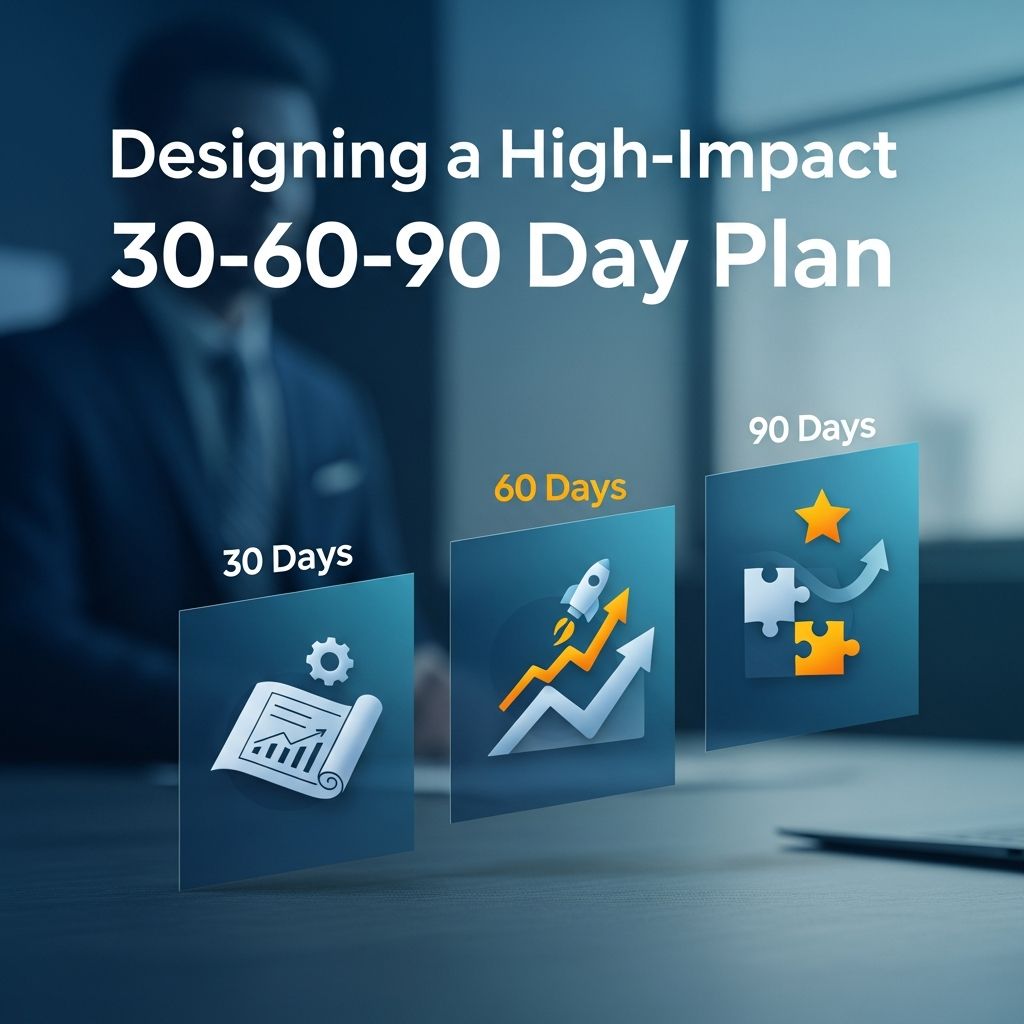
Starting a new role can feel like stepping into a moving train: the organization is already in motion and you are expected to contribute quickly. A well-crafted 30-60-90 day plan helps turn that initial uncertainty into a structured path with clear priorities, realistic goals, and measurable outcomes.
This guide explains what a 30-60-90 day plan is, why it matters, and how to design one that works for both employees and leaders, from the first day through the third month.
What Is a 30-60-90 Day Plan?
A 30-60-90 day plan is a simple framework that breaks the first three months in a role into three progressive phases, each with its own focus, goals, and success metrics.
- Days 1–30: Learn, observe, and build relationships.
- Days 31–60: Start contributing and improving processes.
- Days 61–90: Lead initiatives, drive impact, and plan ahead.
Originally popularized in sales and leadership roles, the model is now widely used across functions because it creates a shared understanding between employee and manager about what success looks like in the first 90 days.
Why the First 90 Days Matter
Research on onboarding and employee retention shows that structured early experiences strongly influence long-term performance and engagement. Organizations that invest in deliberate onboarding and early goal-setting typically see:
- Faster time-to-productivity for new hires.
- Better alignment with company culture and strategy.
- Clearer performance expectations and fewer misunderstandings.
- Higher retention and stronger employee commitment.
A 30-60-90 day plan turns these benefits into a practical tool: instead of vague hopes that someone will “figure it out,” there is a documented roadmap that both sides can use to check progress and adjust.
Core Principles of an Effective 30-60-90 Day Plan
Regardless of role or level, strong plans share a few common design principles.
- Role-specific: Goals are tied directly to the responsibilities, not generic “be a team player.”
- Outcome-based: Each phase includes concrete outcomes, not just activities (for example, “document X process” rather than merely “attend training”).
- Measurable: Success is defined with metrics where possible (completion rates, quality indicators, customer feedback, or delivery milestones).
- Progressive: The plan moves from learning to contributing to leading, with the level of autonomy increasing over time.
- Flexible: It is a living document that can be revisited and revised as new information emerges or priorities shift.
The Three Phases: From Learning to Leading
Although the exact content of your plan will differ by role and organization, the phases usually follow a common progression.
Phase 1 (Days 1–30): Learn and Build Context
The first month is primarily about understanding the environment you have joined and the expectations placed on your role.
- Objectives: Absorb information, learn how decisions are made, and map stakeholders.
- Typical activities:
- Complete mandatory onboarding and compliance training.
- Meet with your manager to clarify responsibilities and success criteria.
- Hold introductory 1:1 meetings with key colleagues and partners.
- Review existing documents, dashboards, and tools relevant to your work.
- Shadow or observe current processes in action.
- Expected outcomes:
- Clear understanding of how your work connects to organizational goals.
- A stakeholder map and communication preferences.
- A list of early improvement or “quick win” opportunities.
Phase 2 (Days 31–60): Contribute and Improve
By the second month, you should be transitioning from mainly observing to actively delivering work that has visible impact.
- Objectives: Take ownership of defined tasks or projects and improve at least one existing process.
- Typical activities:
- Deliver your first independent outputs (reports, customer interactions, project milestones).
- Propose small, low-risk process changes or efficiency improvements.
- Seek feedback from stakeholders on your work style and deliverables.
- Clarify medium-term priorities with your manager.
- Expected outcomes:
- Evidence of tangible contributions tied to team goals.
- One or two simple improvements implemented or piloted.
- Refined understanding of where you can create the most value.
Phase 3 (Days 61–90): Lead and Align for the Future
The final month is about consolidating what you have learned, demonstrating independent judgment, and aligning on what comes next.
- Objectives: Operate with greater autonomy, influence others, and contribute to forward-looking plans.
- Typical activities:
- Own a project, workstream, or client relationship end-to-end.
- Document or codify a practice (for example, a playbook, guide, or checklist).
- Review the outcomes of your first 60 days with your manager and adjust your role scope if needed.
- Co-create objectives for the next quarter or performance cycle.
- Expected outcomes:
- A clear track record of impact in at least one priority area.
- Agreement on personal development goals and skill gaps to address.
- A shared roadmap for your next 6–12 months in the role.
Comparing Focus Across the Three Phases
| Phase | Primary Focus | Level of Autonomy | Typical Metrics |
|---|---|---|---|
| Days 1–30 | Learning, context, and relationships | High guidance and support | Training completion, stakeholder meetings held |
| Days 31–60 | Execution and incremental improvement | Moderate autonomy on scoped work | Initial deliverables, small process wins |
| Days 61–90 | Leadership and medium-term planning | Higher autonomy and ownership | Impact on key goals, roadmap for next quarter |
Step-by-Step: How to Design Your 30-60-90 Day Plan
You can build a strong plan in a few deliberate steps.
1. Clarify Expectations with Your Manager
- Ask what success looks like after 30, 60, and 90 days.
- Identify must-win priorities versus nice-to-have tasks.
- Agree on how you will communicate progress (weekly check-ins, written updates, or dashboards).
2. Map Stakeholders and Resources
- List the people you depend on to succeed (manager, peers, cross-functional partners, customers).
- Note key systems, tools, and documents that influence your role.
- Record how each stakeholder prefers to communicate and make decisions.
3. Translate Responsibilities into Phase-Specific Goals
- Start from your job description or role profile.
- For each responsibility, decide what you can realistically learn, deliver, or improve in each phase.
- Limit yourself to a handful of high-value goals per phase to avoid overload.
4. Make Goals Specific and Measurable
Where possible, define your goals as observable outcomes.
- Replace “Understand product” with “Be able to present product overview to a colleague without notes.”
- Replace “Improve process” with “Reduce handoff time between A and B by 10%.”
- Connect your goals to existing metrics (customer satisfaction, delivery times, quality scores, revenue, or error rates) if they are relevant to your role.
5. Build in Feedback Loops
- Schedule recurring touchpoints with your manager to review the plan.
- Ask a few trusted colleagues for informal feedback during the second month.
- Use what you learn to adjust goals, timelines, or focus areas in real time.
Customizing the Plan for Different Roles
The core structure stays the same, but emphasis changes with each type of role.
- Individual contributors: Focus on mastering tools, workflows, and delivering reliable, high-quality outputs.
- People managers: Emphasize understanding team strengths, clarifying expectations, and establishing communication rhythms.
- Executives or senior leaders: Prioritize strategic alignment, organizational diagnosis, and building trust with critical stakeholders.
- Customer-facing roles: Split goals across product knowledge, customer interaction skills, and performance metrics like satisfaction or response times.
Common Pitfalls and How to Avoid Them
Even well-intentioned plans can fail if they fall into predictable traps.
- Too many goals: An overloaded plan leads to fatigue. Focus on a short list of outcomes that truly matter.
- Vague language: Terms like “support the team” are hard to evaluate. Translate them into specific behaviors or deliverables.
- No stakeholder input: Plans created in isolation often misalign with reality. Involve your manager and key partners from the start.
- Ignoring culture and norms: Technical success can be undermined by cultural misalignment. Include goals about how decisions are made, how conflict is handled, and what “good” looks like in this environment.
- Not updating the plan: Treat the document as a guide, not a contract. Adjust it as priorities evolve.
How Leaders Can Use 30-60-90 Day Plans
For managers and HR teams, 30-60-90 day plans are not only developmental tools but also alignment mechanisms.
- During hiring: Discuss a draft plan in final interviews to test role clarity and candidate expectations.
- During onboarding: Provide a template that can be tailored with the new hire in their first week.
- In performance conversations: Use the plan as a neutral reference point for early feedback, recognizing progress and addressing gaps.
- For succession and internal moves: Help employees use 30-60-90 day plans when transitioning to new teams or responsibilities.
Frequently Asked Questions (FAQs)
Q: Who should own the 30-60-90 day plan?
The new hire should own the plan, but it must be created and refined in partnership with their manager. This shared ownership keeps the plan realistic and aligned with organizational priorities.
Q: How detailed should the plan be?
It should be specific enough that you can clearly evaluate progress, but not so granular that it becomes a daily to-do list. Aim for a handful of goals and key activities per phase rather than documenting every task.
Q: Can a 30-60-90 day plan change after it is agreed?
Yes. It is normal and healthy to revise the plan as you learn more about the role, identify new priorities, or encounter unexpected constraints. Updates should be discussed openly with your manager.
Q: Is this approach only for new jobs?
No. The same structure works for internal promotions, lateral moves, or taking on a major new project. Any time your responsibilities change significantly, a 90-day roadmap can speed up your adjustment.
Q: How does this relate to long-term performance goals?
The 30-60-90 day plan is a ramp-up tool. It should feed into, but not replace, longer-term objectives such as annual goals or development plans. Think of it as the launch pad for sustained performance.
References
- 30-60-90 day sales plan: A complete guide — Zendesk. 2023-08-10. https://www.zendesk.com/blog/30-60-90-day-sales-plan/
- 30-60-90 Day Plan: Templates and Examples — Homebase. 2024-01-15. https://www.joinhomebase.com/blog/30-60-90-day-plan
- 30-60-90 Day Management Plan: A Guide To Success — Acorn PLMS. 2023-06-05. https://acorn.works/resource/30-60-90-day-management-plan
- The Complete Guide to Creating Effective 30-60-90 Day Plans for New Employees — TMI. 2023-09-22. https://www.tmi.org/blogs/the-complete-guide-to-creating-effective-30-60-90-day-plans-for-new-employees
- 30-60-90 Day Plan (With Template and Example) — Indeed Career Guide. 2024-02-01. https://www.indeed.com/career-advice/starting-new-job/30-60-90-day-plan
- 30-60-90 Day Plan Template & Guide — Academy to Innovate HR (AIHR). 2023-11-03. https://www.aihr.com/blog/30-60-90-day-plan-template/
- 30-60-90 Day Plan + Functional Role-Based Examples — Enboarder. 2023-07-12. https://enboarder.com/blog/30-60-90-day-plan/

Medha Deb is an editor with a master's degree in Applied Linguistics from the University of Hyderabad. She believes that her qualification has helped her develop a deep understanding of language and its application in various contexts. Medha specializes in the areas of beauty, health, sports, and wellness and is committed to ensuring that the content on the website is…