
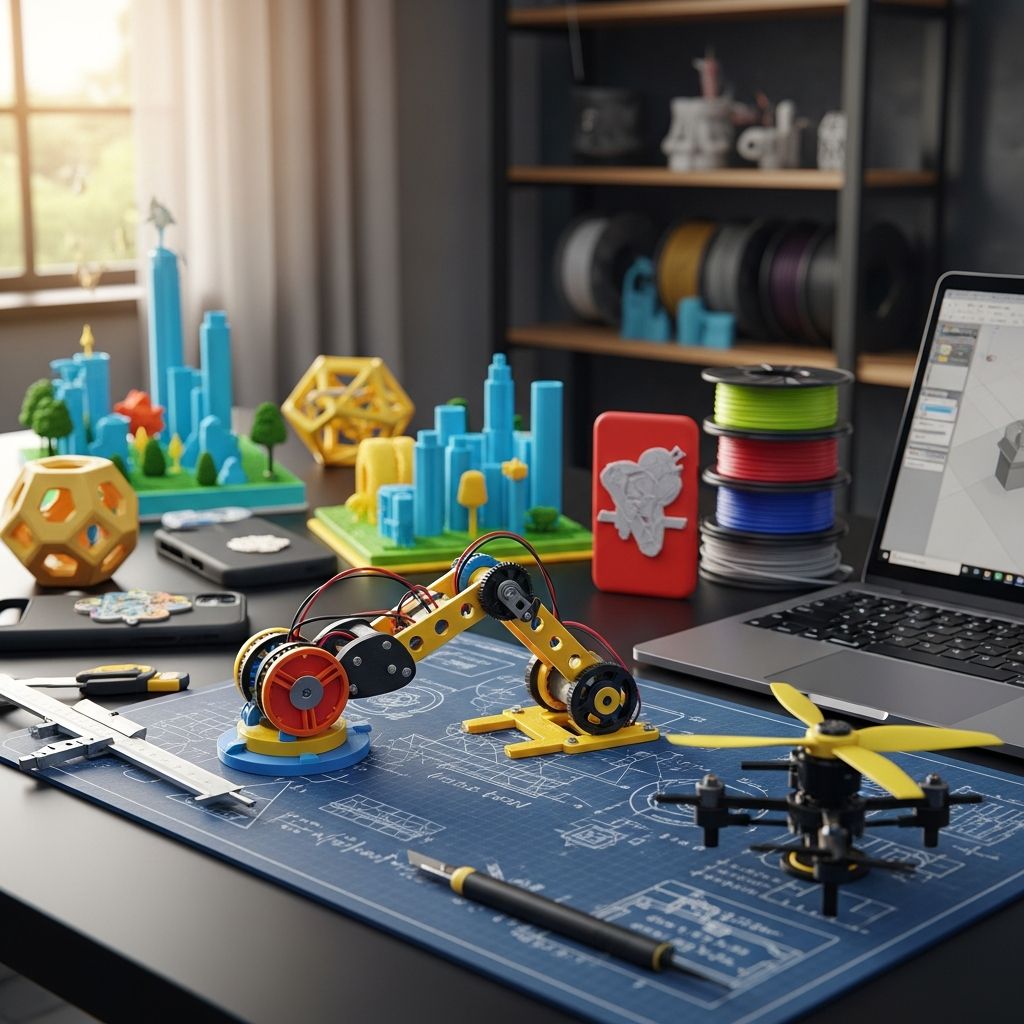
3D printing has emerged as a powerful tool in modern education, enabling students to bridge the gap between theoretical knowledge and physical reality. By fabricating custom models, interactive tools, and prototypes, learners engage deeply with subjects like mathematics, biology, geography, and engineering. This technology fosters problem-solving skills, sparks innovation, and accommodates diverse learning styles, from visual to tactile. Educators worldwide are integrating 3D printers into curricula to create personalized resources that captivate young minds and reinforce key concepts.
Transforming Classrooms with Hands-On Fabrication
The integration of 3D printing in schools goes beyond novelty; it revolutionizes teaching methods by allowing students to design and produce items that directly relate to their lessons. For instance, instead of relying on flat diagrams or expensive kits, teachers can generate precise, scalable models on demand. This approach not only saves costs but also empowers students to iterate on designs, learning from failures in a low-stakes environment. Research highlights that such maker activities improve retention rates, with students demonstrating up to 20% better comprehension of spatial relationships and geometric principles when using physical prototypes.
In elementary settings, simple prints introduce basic shapes and assembly, building confidence. As students advance, projects grow in complexity, incorporating electronics, mechanics, and even coding for printer control. The result is a classroom alive with creativity, where every print cycle yields new discoveries.
Mathematical Mastery Through Printable Manipulatives
Mathematics often challenges students due to its abstract nature, but 3D printing offers concrete solutions. Custom manipulatives help visualize operations that are otherwise intangible.
- Customizable Counting Devices: Print sliding bead frames resembling traditional abacuses, but with adjustable rods for different base systems. Students physically move beads to perform addition and subtraction, receiving tactile feedback that strengthens neural pathways for number sense.
- Fraction Visualization Sets: Create stackable blocks representing fractions like 1/2, 1/3, or 1/4. Transparent filaments reveal internal divisions, allowing learners to combine pieces and see equivalences, such as four 1/4 blocks forming one whole.
- Multiplication Grids: Design interlocking tiles that form multiplication tables. Each tile snaps into place only when factors match, turning rote memorization into a puzzle-solving adventure.
These tools are particularly effective for diverse learners, including those with visual impairments, as raised surfaces provide haptic cues. Teachers report heightened engagement, with students eagerly competing to build the tallest stable fraction tower or the most efficient counting machine.
Biological Structures Brought to Life
Biology lessons gain depth when microscopic or internal structures become graspable. 3D printing excels at replicating organic forms with accuracy.
- Cellular Organelle Models: Fabricate dissectible cells where nucleus, mitochondria, and chloroplasts snap apart for inspection. Color-coding differentiates components, aiding memorization of functions like energy production in mitochondria.
- DNA Helix Replicas: Produce twistable double helices with removable base pairs. Students manipulate rungs to simulate replication, grasping pairing rules (A-T, C-G) through hands-on trial and error.
- Anatomy Exploration Kits: Print life-sized organ sets or full animal dissections, like frog models with removable organs. This ethical alternative to live dissections teaches anatomy without mess or ethical concerns.
Studies show that interacting with these models significantly boosts understanding of scale and structure; for example, holding a printed neuron cluster clarifies signal transmission better than 2D images.
Geographical Wonders in Three Dimensions
Geography transforms from memorizing maps to exploring terrain when printed in relief.
| Project | Learning Focus | Key Features |
|---|---|---|
| Topographic Globes | Physical Features & Scale | Raised mountains, trenches; rotatable assembly |
| Continental Drift Puzzles | Plate Tectonics | Interlocking continents forming Pangaea |
| National Map Jigsaws | Political Boundaries | 50 labeled state pieces for USA; expandable to world |
These prints allow fingers to trace the Andes or fit Australia into the Pacific, embodying concepts like elevation and continental movement. Visually impaired students particularly benefit from textured surfaces that convey data haptically.
Engineering and Physics Experiments
3D printing democratizes engineering by providing rapid prototyping for physics principles.
- Bridge Building Challenges: Students design truss bridges to span gaps, testing load-bearing under weights. Iterative printing refines designs based on failure points.
- Aerodynamic Racers: Print dragsters or gliders, tweaking fins and fuselages to optimize speed. Wind tunnel tests (using fans) quantify improvements.
- Gear Mechanisms: Assemble planetary gears or linkages to explore motion transfer, integrating simple motors for automation.
Such projects align with NGSS standards, emphasizing design thinking and empirical testing.
Practical Classroom Organizers and Tools
Beyond academics, 3D printing streamlines daily school life with custom utilities.
- Desk Organizers: Modular trays for pencils, erasers, and notes, customizable to student needs.
- Bookmarks and Rulers: Thematic designs with measurement scales or literary quotes.
- Adaptive Aids: Pencil grips, page turners for special needs students.
These foster ownership, as students design for peers, promoting empathy and collaboration.
Age-Appropriate Project Progressions
Tailor projects to developmental stages for maximum impact.
Early Learners (Ages 5-8)
Focus on large, colorful shapes: alphabet sorters, basic polyhedra, animal habitats. Emphasize fun and fine motor skills.
Middle Grades (Ages 9-12)
Introduce assembly: solar system models, simple machines like levers. Encourage basic CAD design.
Upper Grades (Ages 13+)
Advanced: Robotic arms, prosthetic prototypes, data visualization sculptures. Integrate programming via slicer software.
This scaffolding ensures steady skill growth.
Frequently Asked Questions
What materials are safest for school 3D printing?
Water-washable resins and PLA filaments are ideal; non-toxic, low-odor, and easy to handle in classrooms.
How much does a classroom 3D printer cost?
Entry-level models start at $200, with educational bundles under $500 including software.
Can students design their own models?
Yes, free tools like Tinkercad offer intuitive interfaces for beginners, scaling to Fusion 360 for experts.
Where to find free 3D model files?
Platforms like Thingiverse and Printables host vast educational repositories, vetted for quality.
Does 3D printing save schools money?
Absolutely; custom models replace costly kits, with one printer serving hundreds of prints yearly.
Overcoming Common Challenges
Start small: One printer per lab, with teacher-led demos. Address filament costs by bulk buying and recycling scraps. Safety protocols include ventilation and supervised operation. Professional development via online communities accelerates adoption.
In summary, 3D printing equips educators with boundless resources to ignite curiosity and mastery across disciplines.
References
- 12 Must-Have 3D Printing Ideas for Students [Back to School] — Creality. 2023-08-15. https://www.creality.com/blog/3d-printing-ideas-for-back-to-school
- 15+ 3D Printing Ideas for Students: Best STEM Projects 2026 — Siraya Tech. 2026-01-10. https://siraya.tech/blogs/news/3d-printing-ideas-for-students
- Use of 3D Printing in Education and 20 Free Project Examples — CoPrint3D. 2024-05-20. https://coprint3d.com/blogs/tips-tricks/use-of-3d-printing-in-education-and-20-free-project-examples
- 3D Printing in Education: Classroom Ideas by School Level — MakerBot. 2025-03-12. https://www.makerbot.com/stories/3d-printing-in-education-by-school-level/
- Jaw-Dropping Classroom 3D Printer Creations — Edutopia. 2023-11-08. https://www.edutopia.org/blog/jaw-dropping-classroom-3d-printer-todd-finley

- Integrated M.A. in Applied Linguistics, University of Hyderabad
- 5+ years in editorial, instructional, SEO, and research-based writing
Sneha is a relationships and lifestyle writer with a strong foundation in applied linguistics and certified training in relationship coaching. She brings over five years of writing experience to theskillvault, crafting thoughtful, research-driven content that empowers readers to build healthier relationships, boost emotional well-being, and embrace holistic living. Her writing and insights reflect the belief that beauty, happiness, and wellness…