
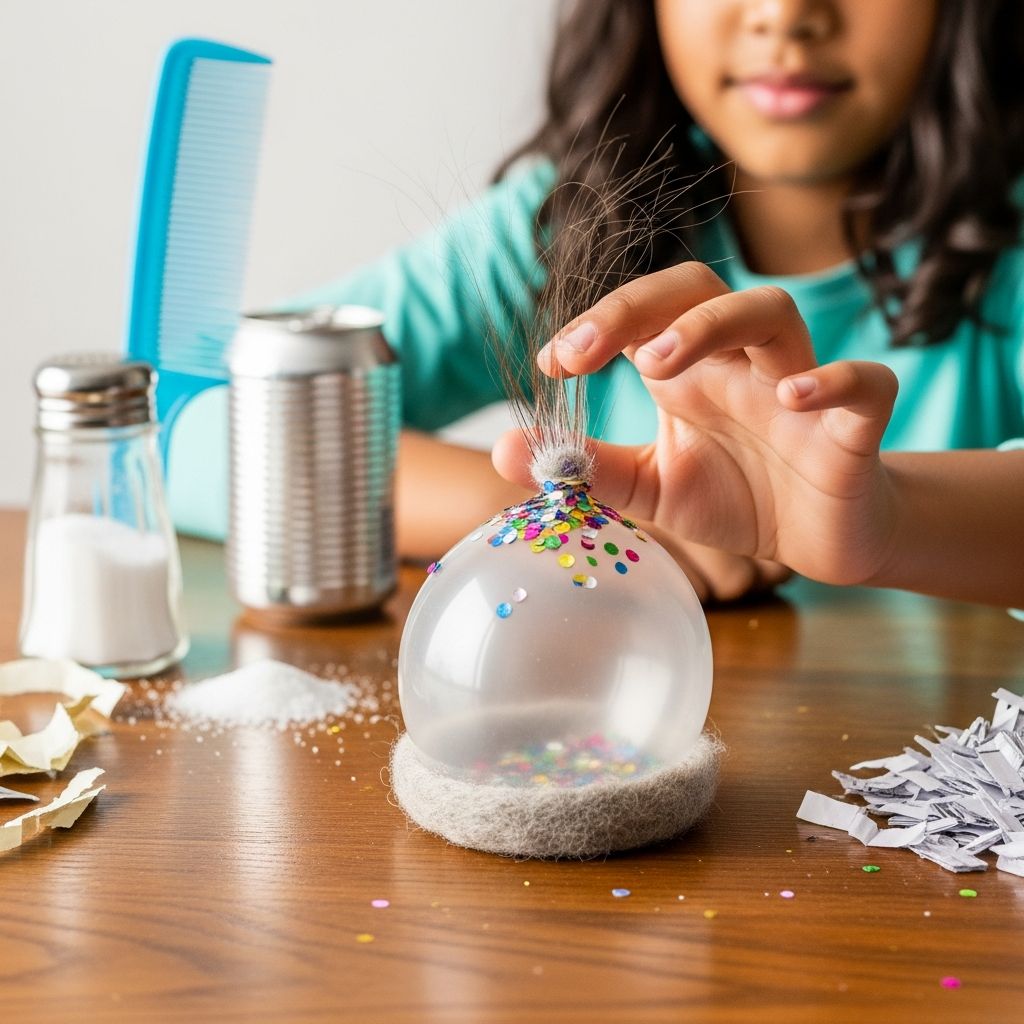
Static electricity offers a captivating entry point into the world of physics, demonstrating invisible forces through simple, everyday materials. These experiments reveal how charges build up and interact, creating effects like attraction, repulsion, and motion without batteries or wires. Ideal for children aged 5 and up, they require minimal setup and foster curiosity about natural phenomena.
Understanding the Science Behind Static Electricity
Static electricity arises when electric charges accumulate on an object’s surface, often through friction. Materials like rubber or plastic gain extra electrons when rubbed against hair, wool, or cloth, becoming negatively charged. Nearby neutral objects experience induced charges—positive on one side, negative on the other—leading to attraction or repulsion. This principle explains everyday occurrences like sock shocks on carpets or hair standing on end after hat removal.
Key concepts include:
- Electrons transfer: Friction moves negatively charged electrons between objects.
- Opposite charges attract: Positive and negative charges pull toward each other.
- Like charges repel: Two negatives or positives push apart.
- Discharge: Built-up charge releases suddenly, often as a spark.
These demos make abstract ideas tangible, encouraging observation and hypothesis testing.
Essential Materials for Static Experiments
Most activities use household staples, ensuring accessibility:
| Item | Purpose | Common Alternatives |
|---|---|---|
| Balloon | Charge generator via hair rubbing | Rubber comb, plastic ruler |
| Water faucet | Stream for bending demo | Thin water trickle from bottle |
| Salt and pepper | Mixture for separation | Lentils and rice |
| Aluminum cans | Rolling objects for races | Empty soda cans (clean, dry) |
| Tissue paper | Lightweight levitators | Paper scraps, plastic bag bits |
Work in dry conditions for best results, as humidity dissipates charges quickly.
Experiment 1: Defying Gravity with a Charged Balloon
This classic demo shows attraction overpowering gravity. Inflate a balloon, tie it, and rub vigorously on dry hair or wool for 20-30 seconds until hair stands up—indicating charge buildup.
- Hold the balloon near a thin faucet stream (pencil-width). The water bends toward the balloon without contact, as the negative charge induces positive ions in the water.
- Try sticking the balloon to a wall: It adheres briefly due to induced charge on the wall’s surface.
- Repeat with two balloons: Rub both, then push them together—they repel, demonstrating like-charge behavior.
Why it works: The balloon’s electrons repel water’s electrons, polarizing the stream toward the positive side. Kids love predicting outcomes and varying distances.
Experiment 2: Magical Spice Separator
Demonstrate selective attraction with a salt-pepper mix. Combine equal parts in a bowl.
- Charge a balloon by rubbing on hair.
- Hover it 1-2 inches above the mix. Lighter pepper particles leap to the balloon, leaving salt behind.
- Shake off pepper and repeat for multiple rounds.
Science explained: Pepper’s lightness allows easy lift; salt’s weight resists. The balloon polarizes spices, attracting positive sides more forcefully on pepper. Extend by timing separation speed or trying other lightweight items like confetti.
Experiment 3: Rolling Can Races
Turn cans into racers powered by invisible forces. Line up 3-4 clean, empty aluminum cans on a smooth floor.
- Charge a balloon via friction.
- Position it behind a can and watch it roll away as if pushed.
- Race friends: Who moves their can farthest without touching?
Mechanism: Balloon induces opposite charge on can’s near side, attracting it forward. Vary balloon height or charge strength for speed control. Emphasize fair play and multiple trials.
Experiment 4: Flying Ghost Illusion
Create a spectral levitator for spooky fun. Cut tissue paper into ghost shapes (2×3 inches).
- Charge an inflated balloon.
- Hold balloon above ghost on a table—the tissue rises and ‘flies’ mid-air.
- Wave gently for dancing effects.
Attraction lifts the lightweight paper; releasing lets it fall. Discuss charge induction: Balloon repels tissue electrons, drawing positive side upward. Theme for holidays enhances engagement.
Experiment 5: Levitating Lightweight Wonders
Explore repulsion with plastic bags or Styrofoam. Tear produce bag into strips.
- Rub balloon on wool/sweater (negative charge).
- Bring near charged strip—it levitates, repelled upward.
- Try foam plates: Charged ones hover with resistance.
Repulsion occurs between like charges. Compare pull (cans) vs. push (bags) for deeper insight.
Advanced Variations and Challenges
Build on basics:
- Bubble deflection: Charge PVC pipe; blow bubbles nearby—they veer toward it.
- Paper scrap pickup: Use charged comb/pen on hole-punch confetti.
- Hair havoc: Rub multiple balloons; tangle with friend’s hair for repulsion laughs.
- Winter crackles: Note sounds from clothing removal in dry air.
Challenge kids to invent: What repels best? Measure distances. Log results in a science journal.
Safety Guidelines for Static Play
These activities are low-risk, but precautions matter:
- Avoid near electronics—sparks can damage.
- No touching charged objects to face/eyes.
- Supervise young children with balloons (choking hazard).
- Dry environments best; wet hands reduce charge.
Pacemakers: Keep distance during rubbing[general knowledge].
Educational Benefits and Teaching Tips
These experiments boost:
- Observation: Noting charge persistence.
- Prediction: Hypothesizing outcomes.
- Critical thinking: Explaining ‘why’.
Tips: Ask questions like ‘What if wet?’ Discuss real-world links (lightning, laundry cling). Ages 5-7 focus on wow-factor; 8+ explore charges quantitatively.
Frequently Asked Questions
Why doesn’t static work in humid weather?
Moisture conducts charges away, preventing buildup.
Can I use a comb instead of a balloon?
Yes, plastic combs charge well on wool/dry cloth.
Is static electricity dangerous?
Home demos are safe; industrial sparks can ignite.
How long does the charge last?
Minutes in dry air; discharges via touch/air.
What ages are these for?
5+ with supervision; adaptable for all school levels.
References
- Three Fun Static Electricity Experiments to Do at Home — Minnesota Children’s Museum. 2023. https://mcm.org/three-fun-static-electricity-experiments-to-do-at-home/
- Get Spooky with Science: Static Electricity Experiment — Mobile Ed Productions. 2022-10-31. https://www.mobileedproductions.com/blog/get-spooky-with-science-static-electricity-experiment
- Experiment with Static Electricity — Beaches Energy Services. 2023. https://beachesenergy.com/about-us/news/experiment-static-electricity
- Static Electricity Experiments For Kids — Little Bins for Little Hands. 2024. https://littlebinsforlittlehands.com/static-electricity-experiments/
- Static Electricity Experiments — Wonders of Physics, University of Wisconsin. N/A. https://wonders.physics.wisc.edu/static-electricity/
- 9 Awesome Science Tricks Using Static Electricity! — YouTube (5-Minute Crafts PLAY). 2019-11-15. https://www.youtube.com/watch?v=ViZNgU-Yt-Y
- Static Electricity — Science World. 2023. https://www.scienceworld.ca/resource/static-electricity/

Medha Deb is an editor with a master's degree in Applied Linguistics from the University of Hyderabad. She believes that her qualification has helped her develop a deep understanding of language and its application in various contexts. Medha specializes in the areas of beauty, health, sports, and wellness and is committed to ensuring that the content on the website is…