
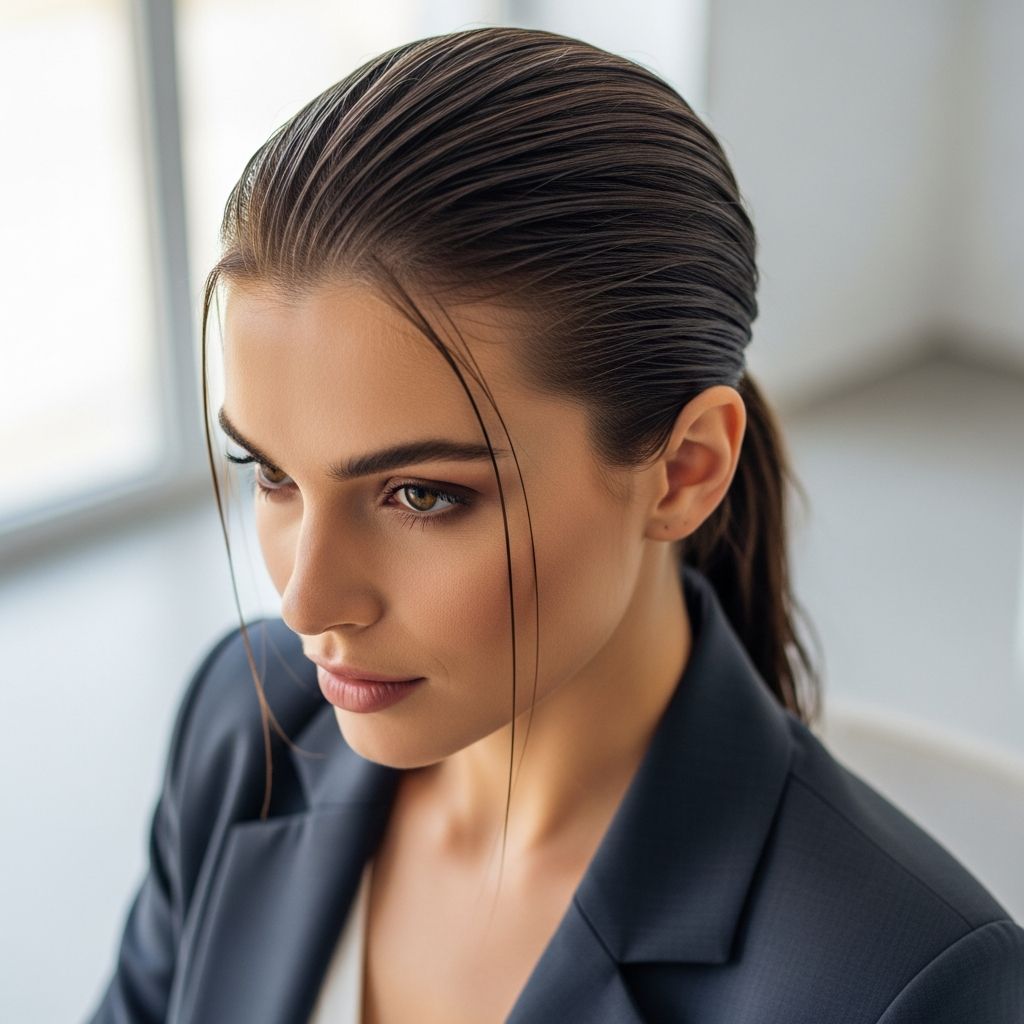
Running late does not have to mean walking into the office with hair that looks unfinished. With a few strategic wet-hair styles and the right products, you can step out the door in minutes and still look completely polished and professional.
This guide walks you through practical, office-appropriate hairstyles you can create on damp hair, plus pro tips so your strands stay healthy even when you skip the blow-dryer.
Why Wet-Hair Styling Can Work for the Office
Many people were raised to believe that arriving at work with wet hair looks unprofessional or unpolished. In conservative workplaces, visible dripping or obvious just-showered hair can still be frowned upon. However, expectations have evolved, especially in hybrid and flexible work environments, where neat, intentional styling matters more than whether you used a blow-dryer.
As long as your hair is contained, not dripping, and clearly styled in a deliberate way (rather than hanging in random damp strands), wet-hair looks can absolutely fit a professional dress code.
Prep: Healthy Wet-Hair Habits Before Styling
Wet strands are more fragile than dry strands, so preparation matters. When hair is saturated, the cuticle is slightly raised and more vulnerable to stretching and breakage if you handle it aggressively. A few small adjustments protect your hair while you rush.
Gentle Towel-Drying
- Use a soft towel or T-shirt: Pat and gently squeeze your hair rather than rubbing back and forth, which can roughen the cuticle and increase frizz.
- Remove drips: Your goal is damp, not dripping, so styles set more cleanly and don’t soak your clothes.
Combing and Detangling
- Use a wide-tooth comb: Detangle from the ends up toward the roots to minimize breakage, especially for curly or textured hair.
- Avoid harsh brushing on soaking hair: Save fine-bristle brushing for when hair is slightly drier or already smoothed into a style.
Product Basics for Wet-Hair Styling
- Leave-in conditioner or light cream: Adds slip, helps detangle, and reduces friction damage.
- Anti-frizz serum or lightweight oil: Smooths the cuticle and gives sleek styles a refined finish.
- Alcohol-free gel or mousse: Provides hold without extreme stiffness; look for flexible-hold formulas.
If you frequently use heat tools, applying a heat protectant is recommended whenever you blow-dry or flat iron, as it can significantly reduce heat-related damage over time.
Quick Style 1: Sleek Side-Part Work Pony
A low, sleek ponytail is the quickest way to turn wet hair into a deliberate, professional look. The natural moisture actually helps keep flyaways under control, giving you a glossy finish without much effort.
How to Create It
- Comb hair straight back, then create a clean, deep side part using a comb tail or your finger.
- Work a small amount of smoothing cream or serum from the hairline to mid-lengths.
- Gather hair at the nape of your neck and secure with a hair elastic.
- For a polished touch, take a thin section from the ponytail, wrap it around the elastic, and pin the end underneath.
Why It Works for the Office
- Minimal tools: You only need a comb, one elastic, and optionally a couple of bobby pins.
- Universally appropriate: This style works for nearly every industry, from corporate offices to creative agencies.
- Transition-friendly: As your hair dries, the pony remains neat, and you can always re-smooth flyaways with a bit of serum later.
Quick Style 2: Low Loop Chignon for Important Meetings
When you have a high-stakes meeting, you might want something more formal than a ponytail but still fast. A low looped chignon offers a refined, structured look that hides the fact your hair is damp.
Step-by-Step Guide
- Create a center or soft side part, whichever suits your face shape.
- Gather hair into a low ponytail at the base of your neck and secure with an elastic.
- On the last pass of the elastic, pull the pony only halfway through, leaving a loop with the ends pointing down.
- Wrap the loose ends around the base of the loop and pin them in place, shaping the loop into a rounded chignon.
- Use a bit of gel or cream along the hairline for extra smoothness.
When to Choose This Style
- Formal settings: Good for presentations, client meetings, or interviews.
- Medium to long hair: Works best when you have enough length to form a loop and wrap the ends.
- Second-day hair: Also a great option to disguise slightly oily roots.
Quick Style 3: Polished Braided Bun for All-Day Wear
Adding a braid to a bun instantly makes it look more intentional and intricate, even though it takes only a few extra minutes. Braiding damp hair also helps control frizz as it dries.
How to Create a Braided Bun
- Apply a light styling cream or mousse through damp hair for hold.
- Gather hair into a mid-height ponytail (between the crown and nape) and secure with an elastic.
- Braid the ponytail in a simple three-strand braid and secure the end with a small elastic.
- Wrap the braid around the base of the ponytail to form a bun and pin it securely.
- Tuck in any short layers with extra pins and smooth the hairline with a little serum.
Benefits of a Braided Bun
- Long-lasting: Once pinned, it stays put through long commutes and full workdays.
- Works on many textures: Straight, wavy, and curly hair all braid well when damp.
- Heat-free waves later: When you take it out after work, you’ll usually have soft, no-heat waves.
Quick Style 4: Half-Up Twists for Casual Offices
In a relaxed work environment, a half-up style is an easy way to look put together while keeping your hair off your face. Twists are faster than a full braid and look refined on damp hair.
Creating the Look
- From each side of your head, take a section of hair starting at the temples.
- Twist each section backward, away from your face, adding small pieces as you move toward the back of your head.
- Meet the two twists in the middle and secure them together with a small elastic or a barrette.
- Lightly scrunch or smooth the remaining loose hair, depending on your texture.
When This Style Makes Sense
- Creative or casual offices: Ideal where business casual is the norm.
- Growing out bangs or layers: Twists keep shorter pieces out of your eyes.
- Transition to after-work plans: Looks intentional at the office and relaxed after hours.
Quick Style 5: Stacked Mini Buns for an Edgy, Yet Neat Look
If your workplace is open to trendier hair, stacked mini buns along the back of your head can give you an on-purpose, architectural look that tames wet hair in sections.
Step-by-Step Overview
- Part your hair horizontally into three sections: top, middle, and bottom. Clip away sections you’re not working on.
- Starting with the bottom section, gather hair into a small ponytail, twist it, and wrap into a mini bun. Secure with an elastic or pins.
- Repeat with the middle and top sections so you have three stacked buns down the back of your head.
- Use a small amount of gel along the sides to keep everything smooth.
Pros and Cons
| Pros | Cons |
|---|---|
| Controls thick or heavy hair by dividing it into smaller sections. | May feel too edgy for conservative workplaces. |
| Stays secure through commuting, walking, and meetings. | Requires a few more elastics and pins than simpler styles. |
| Creates a visually interesting style that looks intentional. | Might leave more defined bends or kinks when taken down. |
Choosing the Right Wet-Hair Style for Your Hair Type
Different textures respond differently to wet-styling. Knowing how your hair behaves as it dries helps you pick the style that gives the best results.
Straight and Fine Hair
- Best choices: Sleek low pony, low loop chignon, half-up twists.
- Products: Lightweight mousse for volume at the roots, minimal oil to avoid looking greasy.
- Tip: Avoid heavy creams that can weigh hair down and make styles slip.
Wavy Hair
- Best choices: Polished braided bun, half-up twists, stacked buns for thicker waves.
- Products: Curl-enhancing cream or light gel to encourage pattern and reduce frizz.
- Tip: Scrunch product into mid-lengths and ends before styling up; it keeps waves defined when you take styles down later.
Curly and Coily Hair
- Best choices: Low chignon, braided bun, or twisted updos that preserve curl pattern.
- Products: Leave-in conditioner, curl cream, and sealant oil; a routine like this helps maintain moisture balance and reduce breakage.
- Tip: Detangle in the shower with conditioner and a wide-tooth comb; then style while hair is still very damp.
Office Etiquette for Wet-Hair Days
- Avoid drips: Make sure hair isn’t soaking your collar, blazer, or chair.
- Skip the shower-fresh look: Opt for contained styles rather than loose, visibly wet lengths.
- Bring a small kit: Keep a travel-size serum, a comb, and a couple of elastics at your desk for quick touch-ups.
- Know your culture: In very traditional industries, reserve wet-hair styling for truly unavoidable mornings and choose the most conservative styles.
Hair Health Considerations When You Skip the Blow-Dryer
There is often a debate about whether air-drying or blow-drying is healthier. Heat styling at high temperatures can damage the cuticle and internal proteins if done frequently without protection. On the other hand, leaving hair wet for very long periods under tension (like tight elastics) is also not ideal.
Dermatology and hair research suggests a balanced approach: if you use a blow-dryer, using a moderate temperature and keeping the dryer at least 15 centimeters (about 6 inches) from the hair can reduce damage compared with high heat at close range. Wet styling without heat removes thermal stress but still requires gentle handling and not pulling wet hair into excessively tight styles.
On rushed mornings, it is reasonable to:
- Gently towel-dry and detangle.
- Apply a leave-in conditioner and heat protectant if you will use even brief heat later.
- Choose styles that are secure but not painfully tight at the roots.
Frequently Asked Questions (FAQs)
Q: Is it unhealthy to leave my hair damp all morning?
Occasional wet-hair mornings are generally fine if you handle your hair gently and avoid tight, heavy styles that tug on the roots while hair is saturated. Over time, constantly keeping hair wet and tightly bound can contribute to breakage, especially along the hairline.
Q: Are wet-hair styles acceptable for job interviews?
For most interviews, especially in conservative fields, it is safer to arrive with mostly dry hair. If you absolutely must style it wet, choose the most polished option (like a sleek low chignon) and make sure there are no drips or visible product buildup.
Q: What if my hair frizzes badly when it dries after a wet style?
Use an anti-frizz cream or serum on damp hair, focus on mid-lengths and ends, and choose styles with some structure (like braids or buns) that hold the shape as hair dries. Later in the day, you can smooth any frizz with a pea-sized amount of finishing product.
Q: How tight is too tight for a work updo on wet hair?
If you feel tension, soreness, or a pulling sensation at the scalp, it is too tight. Loosen elastics slightly and use more bobby pins instead of extra pulling; this reduces mechanical stress on wet strands and on the follicles.
Q: Can I sleep in these wet-hair styles to save time in the morning?
Some people set braids or loose buns overnight on damp hair to create waves in the morning, but hair experts generally advise against sleeping with hair that is completely wet because it can increase friction and breakage as you move. If you try it, let hair partially air-dry first and choose soft, loose styles.
References
- Hair breakage: Common causes and how to prevent it — American Academy of Dermatology Association. 2023-04-18. https://www.aad.org/public/diseases/hair-loss/insider/breakage
- Hair care tips for different hair types — American Academy of Dermatology Association. 2022-09-01. https://www.aad.org/public/everyday-care/hair-scalp-care/hair
- Thermal and Photochemical Damage of Hair — Robbins, C.R. & Kelly, C.I., in Cosmetic Dermatology. 2010-01-01. https://doi.org/10.1201/b14110-17
- Hair shaft damage from heat and drying time of hair dryer — Lee, Y. et al., Annals of Dermatology. 2011-11-30. https://doi.org/10.5021/ad.2011.23.4.455

- Integrated M.A. in Applied Linguistics, University of Hyderabad
- 5+ years in editorial, instructional, SEO, and research-based writing
Sneha is a relationships and lifestyle writer with a strong foundation in applied linguistics and certified training in relationship coaching. She brings over five years of writing experience to theskillvault, crafting thoughtful, research-driven content that empowers readers to build healthier relationships, boost emotional well-being, and embrace holistic living. Her writing and insights reflect the belief that beauty, happiness, and wellness…