
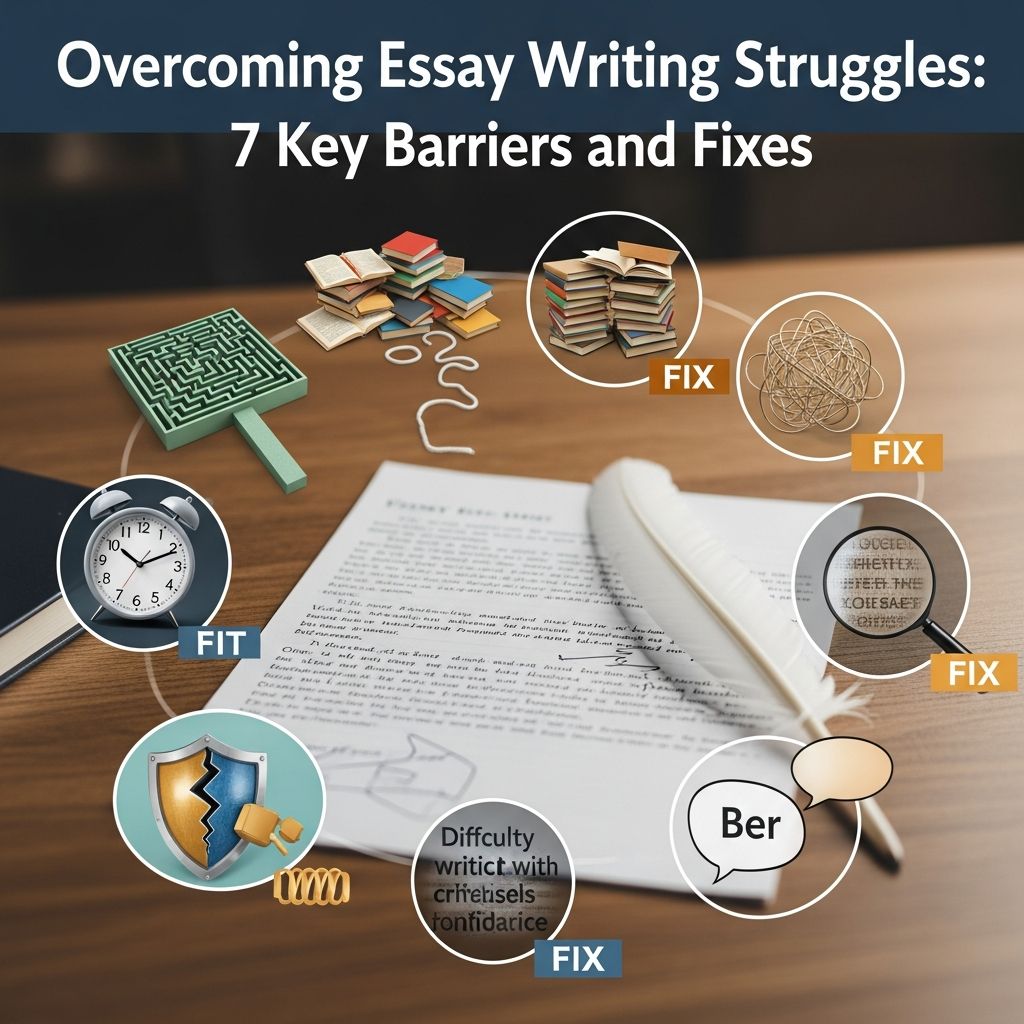
Many students face significant hurdles when tasked with writing essays, often feeling overwhelmed or stuck despite their efforts. This comprehensive guide identifies seven prevalent barriers drawn from educational research and expert observations, offering targeted strategies to help you build competence and confidence in academic writing.
Understanding the Roots of Essay Writing Difficulties
Essay writing demands a blend of cognitive skills, including critical analysis, organization, and clear expression. When these elements are underdeveloped, the process becomes daunting. Studies from institutions like Carnegie Mellon University highlight that incoming college students frequently lack foundational abilities in reading comprehension, argument construction, and evidence integration, leading to subpar outputs. High school curricula often prioritize short opinion pieces over extended analytical papers, leaving gaps that persist into higher education. Addressing these issues requires recognizing them as systemic rather than personal failings.
Barrier 1: Gaps in Formal Instruction
A primary challenge is the absence of systematic training in essay composition. Many learners progress through school without explicit guidance on structuring arguments or integrating sources effectively. University environments exacerbate this, assuming prior mastery and providing minimal direct instruction.
- Lack of step-by-step methodologies: Students miss out on tools for planning and drafting.
- Content-focused education: Emphasis on facts over writing technique hinders skill development.
Solution: Seek structured learning resources. Enroll in workshops or online courses that break down essay elements, such as thesis formulation and paragraph development. Practice with templates that guide from outline to revision, gradually reducing reliance on scaffolds.
Barrier 2: Ineffective Preparation Habits
Students often dive into readings without aligning them to the essay prompt, resulting in irrelevant notes and last-minute panic. This mismatched approach wastes time and fosters overwhelm.
| Common Habit | Problem | Better Alternative |
|---|---|---|
| Reading all assigned materials first | Leads to information overload | Analyze prompt; select targeted sources |
| Passive note-taking | Notes lack essay relevance | Annotate with prompt keywords |
| Procrastinating planning | Rushed writing | Outline early based on key themes |
Solution: Adopt prompt-driven research. Begin by dissecting the question into core components—what, why, how. Curate readings accordingly, summarizing each with direct ties to your thesis. This strategic method ensures efficiency and relevance.
Barrier 3: Limited Opportunities for Skill Building
High-stakes assignments offer little room for trial and error, unlike iterative practice in other skills. Without low-pressure rehearsals, improvement stalls.
- Few drafts before submission heighten anxiety.
- Feedback arrives too late for immediate application.
Solution: Create practice routines. Write timed mini-essays on past prompts weekly. Use peer review groups or writing centers for formative feedback. Track progress in a journal to visualize growth, building resilience against perfectionism.
Barrier 4: Rigid or Inadequate Structural Frameworks
Basic models like PEEL provide starters but fail at advanced levels, lacking guidance on critical depth or fluid argumentation.
Solution: Embrace flexible planning tools. Shift to mind-mapping for idea generation, followed by reverse outlining to refine structure. Incorporate analytical layers: describe, analyze, evaluate, synthesize. Resources with annotated exemplars demonstrate seamless integration.
Barrier 5: Misaligned Effort and Strategies
Dedication alone isn’t enough if efforts are inefficient—simultaneous writing and editing, or imprecise cuts, amplify frustration.
- Writing without outlines leads to disorganization.
- Over-editing early blocks momentum.
Solution: Implement phased workflows. Allocate distinct stages: plan (20%), draft (50%), revise (20%), edit (10%). Use timers to maintain focus, prioritizing higher-order concerns like argument strength before mechanics.
Barrier 6: Underlying Foundational Deficiencies
Weak grammar, syntax, or reading skills undermine even strong ideas. Poor comprehension prevents engaging source arguments effectively. High school habits, like avoiding first-person rigidly, create awkward phrasing.
Solution: Bolster basics systematically. Daily grammar drills via apps; read academic journals actively, noting rhetorical moves. Practice source synthesis through summary-response exercises to sharpen analytical precision.
Barrier 7: Psychological and Motivational Hurdles
Fear of failure, boredom, or perceived irrelevance demotivates. Overwhelm from abstract demands or repeated revisions compounds this. Time mismanagement due to low stakes awareness leads to rushed work.
- Boredom from lack of purpose.
- Fear stifles creativity.
Solution: Cultivate mindset and habits. Connect assignments to personal goals for relevance. Break tasks into micro-goals with rewards. Mindfulness techniques reduce anxiety; schedule writing in peak energy windows, valuing process over product initially.
Building a Sustainable Writing Practice
Transform struggles into strengths by integrating these fixes holistically. Start small: one essay per strategy. Over time, habits compound, yielding fluent, persuasive writing. Educational bodies emphasize ongoing support, from skill audits to scaffolded assignments.
Frequently Asked Questions (FAQs)
How long does it take to improve essay writing skills?
Consistent practice yields noticeable gains in 4-6 weeks; mastery requires 3-6 months of deliberate application.
What’s the best way to start an essay when stuck?
Freewrite for 10 minutes without judgment, then extract a tentative thesis to guide outlining.
Can technology help with essay writing barriers?
Yes—tools like Grammarly for mechanics, outlining apps like Notion, and AI prompts for brainstorming accelerate progress.
How do I handle feedback effectively?
Categorize into content, structure, style; revise one category at a time, tracking patterns for self-correction.
Is writer’s block a real barrier or just procrastination?
It’s often a mix—address with structured breaks and pre-writing rituals to distinguish and overcome both.
Advanced Techniques for Mastery
Beyond basics, explore genre-specific conventions—e.g., argumentative essays demand counterarguments, while reflective ones prioritize voice. Analyze prize-winning student papers for patterns. Join writing communities for accountability. Quantitative tracking, like word count goals or rubric self-scores, sustains momentum.
Incorporate multimodal practice: discuss ideas aloud before writing to clarify thoughts. Vary prompts to build versatility. Long-term, reading widely across disciplines enhances vocabulary and perspective.
Case Studies: Real Student Turnarounds
- Case 1: Sarah, overwhelmed by research, adopted prompt-analysis; cut prep time 40%, boosted grade from C to A-.
- Case 2: Mike battled motivation; micro-goals and relevance-linking turned dread into routine, averaging B+.
- Case 3: Lisa fixed structure issues with mind-maps; essays gained coherence, earning faculty praise.
These examples illustrate accessible paths to proficiency.
References
- 5 Reasons Why Essay Writing Feels So Hard (and How to Fix It) — Chloe Burroughs. Accessed 2026. https://chloeburroughs.com/why-essay-writing-feels-so-hard/
- Why are students poorly prepared to write — Carnegie Mellon University Eberly Center. Accessed 2026. https://www.cmu.edu/teaching/designteach/teach/instructionalstrategies/writing/poorlyprepared.html
- Top Five Reasons Students Hate to Write (and How You can Help!) — The Write Foundation. Accessed 2026. https://thewritefoundation.org/articles/top-five-reasons-students-hate-to-write/
- The Real Reasons Students Can’t Write — Inside Higher Ed. 2006-04-28. https://www.insidehighered.com/views/2006/04/28/real-reasons-students-cant-write
- Our Students Can’t Write Very Well—It’s No Mystery Why — Education Week. 2017-01. https://www.edweek.org/teaching-learning/opinion-our-students-cant-write-very-well-its-no-mystery-why/2017/01

Medha Deb is an editor with a master's degree in Applied Linguistics from the University of Hyderabad. She believes that her qualification has helped her develop a deep understanding of language and its application in various contexts. Medha specializes in the areas of beauty, health, sports, and wellness and is committed to ensuring that the content on the website is…