
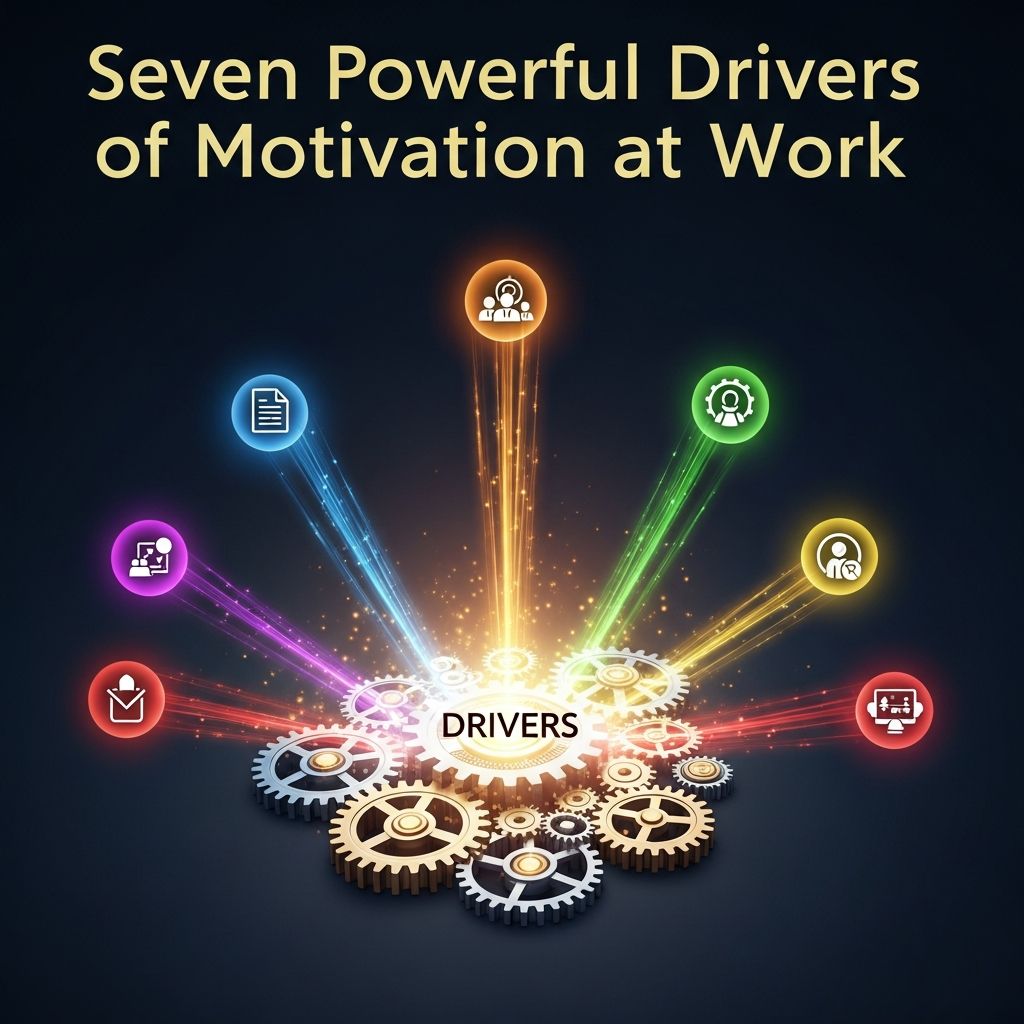
Employee motivation is not a single lever you can pull with a pay rise or an occasional perk. Sustainable motivation grows when multiple psychological and social needs are met: people want to feel that their work matters, that they have a voice, that they are treated fairly, and that they can thrive as human beings as well as professionals.
This article explores seven powerful drivers of motivation at work and offers practical ideas for leaders, HR professionals, and team members who want to create a more energized, high-performing workplace.
Understanding Motivation: Beyond Carrots and Sticks
Classic reward-and-punishment approaches assume that people work harder for more money or stricter oversight. Research in organizational psychology paints a more nuanced picture. According to self-determination theory, three psychological needs support high-quality motivation:
- Autonomy – feeling that you have choice and control over how you do your work.
- Competence – feeling capable and effective at your tasks.
- Relatedness – feeling connected to others and part of a community.
When these needs are supported, people are more likely to feel intrinsically motivated, show persistence, and perform better. Conversely, when they are undermined by rigid control, isolation, or unclear expectations, motivation drops even if pay is high.
The Seven Key Drivers of Motivation at Work
While motivations vary from person to person, research and practice consistently highlight seven broad drivers that shape most employees’ engagement and effort:
- Meaning and purpose
- Autonomy and influence
- Growth and mastery
- Recognition and feedback
- Connection and belonging
- Fairness and psychological safety
- Work–life balance and flexibility
The sections below unpack each driver, show how it influences performance, and suggest practical actions to strengthen it.
1. Meaning and Purpose: Knowing Why the Work Matters
People are more motivated when they see a clear link between their daily tasks and a broader purpose. Work feels meaningful when it contributes to something valued, whether that is helping customers, advancing a mission, or supporting colleagues.
Why meaning drives motivation
- Employees who feel their work is meaningful report higher job satisfaction and are less likely to leave.
- Progress on meaningful work is a powerful source of positive emotion, creativity, and persistence.
Practical ways to strengthen meaning
- Connect tasks to impact: Regularly explain how roles support customers, communities, or strategic goals.
- Share real stories: Use customer feedback or case examples to show the real-world effects of people’s work.
- Clarify expectations: Link individual objectives to the team’s and organization’s outcomes.
| Low-meaning environment | High-meaning environment |
|---|---|
| Tasks feel disconnected and purely administrative. | Employees see how their work shapes results and lives. |
| Goals are abstract or unclear. | Goals are specific and tied to a clear mission. |
| Little conversation about purpose or values. | Leaders regularly reference purpose in decisions and communication. |
2. Autonomy and Influence: Having a Say in How Work Gets Done
Autonomy is not about working in isolation. It is the sense of having real input into how you organize your work, solve problems, and use your time. Large-scale survey research across 25 countries found that autonomy is positively related to work motivation.
How autonomy fuels performance
- Autonomy supports intrinsic motivation by allowing people to align work with their values and strengths.
- Employees with more control typically show better well-being and engagement, especially under pressure.
Everyday actions that build autonomy
- Set goals, not methods: Agree on desired outcomes and allow employees to choose how to achieve them.
- Involve people in decisions: Ask for input on processes, targets, and tools that affect their daily work.
- Avoid unnecessary micromanagement: Provide guidance and guardrails, then step back where possible.
3. Growth and Mastery: The Drive to Learn and Progress
Motivation increases when people can see themselves developing skills and moving toward valued goals. Opportunities for learning, stretch assignments, and career development are core to this driver.
Why growth opportunities matter
- Evidence reviews show that jobs with rich skill variety, clear task identity, and real responsibility promote feelings of competence and motivation.
- Challenging tasks that match people’s abilities can be strong intrinsic motivators.
Practical ways to enable growth
- Offer learning pathways: Provide access to courses, mentoring, and knowledge-sharing.
- Redesign tasks: Where possible, enrich roles so employees can see an entire piece of work from start to finish.
- Use stretch assignments: Assign projects that push people slightly beyond their comfort zone with adequate support.
4. Recognition and Feedback: Feeling Seen and Valued
Recognition does more than boost morale for a moment; it helps employees understand what is working and whether they are progressing. When feedback is timely, fair, and constructive, it reinforces a sense of competence and contribution.
What effective recognition looks like
- Specific: It describes what was done well and why it mattered, rather than using vague praise.
- Balanced: It highlights strengths and offers clear suggestions for improvement.
- Frequent: It occurs regularly enough that people are not left guessing about their performance.
Recognition ideas for teams
- Start meetings with quick shout-outs linked to team goals.
- Encourage peer-to-peer recognition to highlight collaboration.
- Use data from projects or customers to celebrate real impact.
5. Connection and Belonging: Being Part of a Supportive Community
Humans are social by nature. A sense of belonging at work—feeling accepted, respected, and included—has strong links to motivation and mental health. Research shows that social relatedness positively impacts work motivation, partly because it orients people toward shared objectives.
How connection boosts motivation
- Supportive relationships increase willingness to share ideas, ask questions, and take initiative.
- Feeling part of a team can help employees persist through demanding periods.
Ways to foster belonging
- Build inclusive habits: Rotate speaking opportunities, invite quieter voices, and avoid cliques.
- Create shared rituals: Regular check-ins, learning sessions, or informal gatherings can strengthen ties.
- Clarify team norms: Make expectations for collaboration, responsiveness, and feedback explicit.
6. Fairness and Psychological Safety: Trusting the System and the People
Even generous rewards lose their power when people perceive unfairness. Fair treatment, transparent processes, and psychological safety—the belief that you can speak up without fear of humiliation or punishment—are crucial foundations for motivation.
The role of fairness and safety
- Perceptions of justice in decision-making and rewards strongly affect motivation and willingness to contribute.
- Psychological safety encourages employees to share ideas, admit mistakes, and seek feedback, all of which support learning and innovation.
Practical steps to increase fairness and safety
- Be transparent: Explain the reasons behind decisions about workload, promotions, and pay where possible.
- Respond constructively: When employees raise issues, listen carefully and respond without blame.
- Model vulnerability: Leaders who admit their own uncertainties make it safer for others to speak honestly.
7. Work–Life Balance and Flexibility: Making Sustainable Effort Possible
Motivation depends not only on what happens at work but also on how work fits into the rest of life. Surveys have found that work–life balance is one of the most important factors influencing employees’ decisions to stay or leave, especially in tight labor markets.
Why balance matters
- Chronic overwork and lack of recovery reduce energy, creativity, and commitment.
- Flexible arrangements can help employees manage caregiving, health, and other responsibilities, reducing stress and turnover.
Supporting balance without losing performance
- Clarify priorities: Focus on outcomes rather than hours spent online.
- Offer smart flexibility: Where roles allow, use flexible hours or hybrid work with clear expectations.
- Protect boundaries: Avoid normalizing long-hours culture or constant availability.
Putting the Drivers Together: A Whole-System View
These seven drivers do not operate in isolation. They reinforce one another. For example, investing in growth (Driver 3) without providing autonomy (Driver 2) can feel like extra pressure. Offering flexibility (Driver 7) without maintaining fairness (Driver 6) can create resentment if options seem arbitrary.
| Driver | Main question for employees | Risk if ignored |
|---|---|---|
| Meaning & purpose | “Does my work matter?” | Indifference and disengagement |
| Autonomy & influence | “Do I have a say?” | Compliance instead of commitment |
| Growth & mastery | “Can I develop here?” | Stagnation and talent loss |
| Recognition & feedback | “Is my effort noticed?” | Frustration and reduced effort |
| Connection & belonging | “Do I fit in?” | Isolation and low collaboration |
| Fairness & safety | “Can I trust this place?” | Cynicism and silence |
| Balance & flexibility | “Is this sustainable?” | Burnout and attrition |
FAQs About Motivation at Work
Q1: Is pay still important for motivation?
Compensation needs to be fair and competitive; when it is not, dissatisfaction and turnover rise quickly. However, once basic expectations of fairness are met, non-financial drivers such as autonomy, recognition, and meaningful work often play a larger role in sustaining day-to-day motivation.
Q2: Can managers really influence intrinsic motivation?
Managers cannot force intrinsic motivation, but they can shape the conditions that support it. By providing autonomy, opportunities to use and develop skills, and a sense of connection, leaders can help employees internalize goals and feel more self-driven.
Q3: How do remote and hybrid work affect motivation?
Remote work can enhance motivation by increasing flexibility and autonomy, but it can also weaken connection and blur boundaries if not managed carefully. Intentional communication, clear expectations, and deliberate efforts to maintain social ties are essential to keep motivation high in distributed teams.
Q4: What is one small change that has a big impact?
Regular, high-quality check-ins between managers and employees are one of the most powerful small changes. Short conversations that cover priorities, progress on meaningful work, barriers, and well-being can simultaneously support several drivers: meaning, autonomy, growth, and connection.
Q5: How can organizations measure motivation?
Organizations often use engagement or climate surveys with items that tap into the seven drivers: perceived purpose, autonomy, learning opportunities, recognition, team relationships, fairness, and balance. Qualitative data from interviews or focus groups can deepen understanding and guide targeted improvements.
References
- Work Motivation: The Roles of Individual Needs and Social Conditions — Salas-Vallina, A. et al., International Journal of Environmental Research and Public Health. 2022-02-22. https://www.ncbi.nlm.nih.gov/pmc/articles/PMC8869198/
- Work Motivation: An Evidence Review — van der Riet, P. et al., Chartered Institute of Personnel and Development (CIPD). 2021-01-01. https://www.cipd.org/globalassets/media/knowledge/knowledge-hub/evidence-reviews/work-motivation-scientific-summary_tcm18-89562.pdf
- Rousing Our Motivation — Azar, B., American Psychological Association Monitor on Psychology. 2021-10-01. https://www.apa.org/monitor/2021/10/feature-workers-motivation
- Why Is Employee Motivation Important in the Workplace? — Johnson & Wales University. 2022-03-03. https://online.jwu.edu/blog/why-is-employee-motivation-important-in-the-workplace/
- What Employees Say Matters Most to Motivate Performance — McKinsey & Company. 2021-10-22. https://www.mckinsey.com/capabilities/people-and-organizational-performance/our-insights/what-employees-say-matters-most-to-motivate-performance
- What Leaders Get Wrong About Employee Motivation — Achor, S. & Reece, A., MIT Sloan Management Review. 2021-02-09. https://sloanreview.mit.edu/article/what-leaders-get-wrong-about-employee-motivation/

- Integrated M.A. in Applied Linguistics, University of Hyderabad
- 5+ years in editorial, instructional, SEO, and research-based writing
Sneha is a relationships and lifestyle writer with a strong foundation in applied linguistics and certified training in relationship coaching. She brings over five years of writing experience to theskillvault, crafting thoughtful, research-driven content that empowers readers to build healthier relationships, boost emotional well-being, and embrace holistic living. Her writing and insights reflect the belief that beauty, happiness, and wellness…