
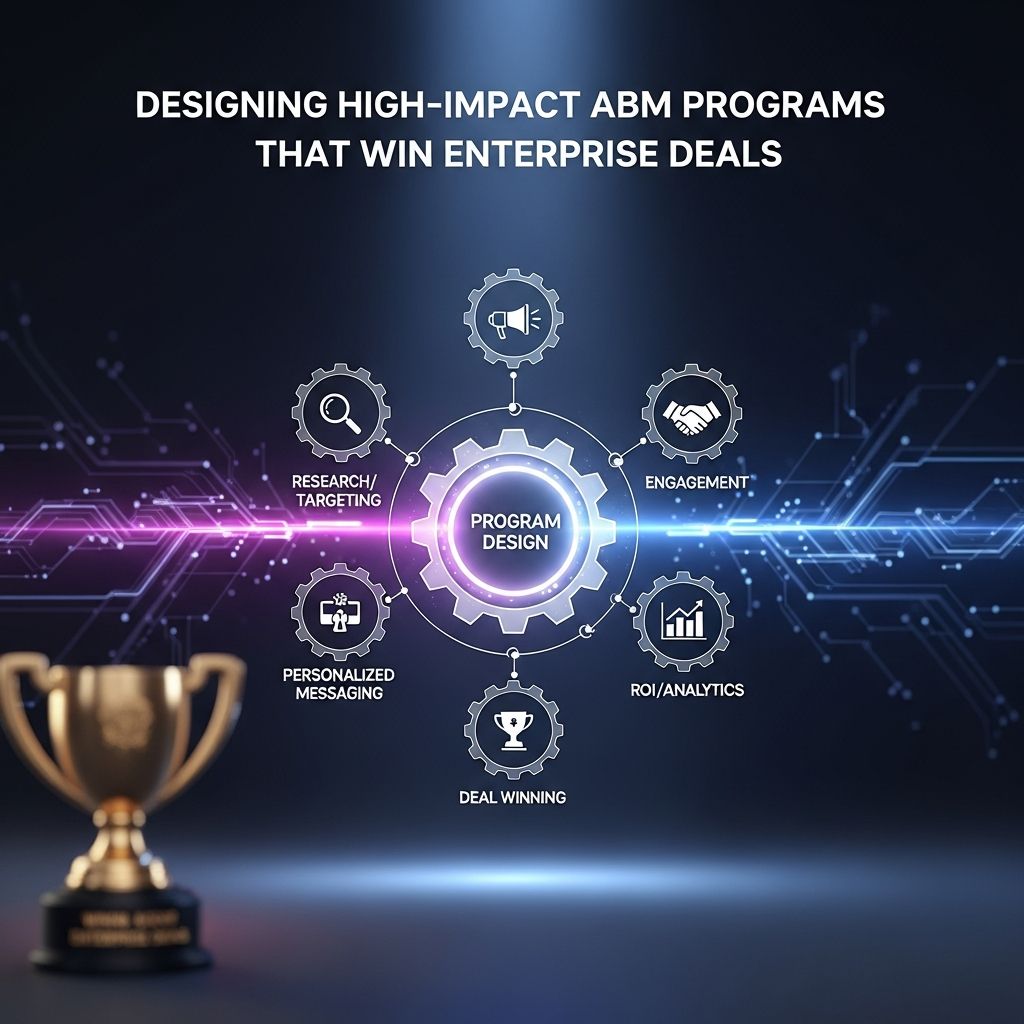
Account-based marketing (ABM) has moved from buzzword to core B2B growth strategy. When done well, ABM aligns sales and marketing around a carefully selected set of high-value accounts, delivering personalized experiences that drive revenue, improve ROI, and shorten sales cycles.
This guide walks through how to design modern ABM programs that are practical, scalable, and tightly connected to pipeline and revenue.
What Is an ABM Program, Really?
An ABM program is a coordinated set of campaigns, plays, and processes focused on a defined group of target accounts, with the shared goal of winning, growing, or retaining those accounts.
Instead of casting a wide net for individual leads, ABM concentrates people, budget, and technology on accounts with the greatest potential value and likelihood to buy.
| Traditional Lead Generation | Account-Based Marketing Program |
|---|---|
| Optimizes for lead volume | Optimizes for revenue from defined accounts |
| Focuses on individuals | Focuses on buying committees and organizations |
| Marketing and sales operate in silos | Marketing and sales co-own strategy and execution |
| Generic content and campaigns | Personalized experiences tailored to each account |
| Broad targeting using firmographic filters | Tight account lists built from fit, intent, and engagement |
Why ABM Programs Matter for B2B Growth
For complex B2B deals with multiple decision-makers, ABM provides a structure to focus on the right accounts and engage them with relevance.
- Higher ROI: Concentrating resources on a smaller number of high-value accounts typically delivers better return on marketing investment than broad demand generation.
- Shorter sales cycles: ABM lets teams engage key stakeholders earlier and more efficiently, which can reduce time-to-opportunity and time-to-close.
- Stronger customer relationships: Personalized, consistent experiences deepen trust and loyalty, improving retention and expansion.
- Sales–marketing alignment: ABM requires shared goals, shared data, and shared accountability, which improves collaboration and performance.
Core Building Blocks of an Effective ABM Program
Before designing specific plays, you need a solid foundation. The most successful programs are built on six pillars.
1. Clear Business Objectives
ABM programs exist to serve measurable business goals, not vanity metrics. Decide what you are trying to achieve:
- Net-new acquisition of strategic logos
- Expansion into new business units or regions within existing accounts
- Retention and risk mitigation for high-revenue customers
- Acceleration of deals that are stuck in late-stage pipeline
Each program should map directly to pipeline and revenue targets with explicit timelines.
2. A Joint Sales–Marketing Operating Model
ABM fails quickly if sales and marketing are not working as one team.
- Define shared KPIs (e.g., opportunities created, deal velocity, revenue, account penetration).
- Agree on how accounts are selected, prioritized, and reassigned.
- Set up regular joint reviews to inspect performance and adjust plays.
- Establish clear ownership: who triggers plays, who follows up, and what SLAs apply.
3. Ideal Customer Profile (ICP) and Target Account List
An accurate ICP underpins every strong ABM program. It typically includes:
- Firmographics (industry, size, revenue, geography)
- Technographics (tools and platforms in use)
- Buying triggers (events like mergers, funding, regulatory shifts)
- Problem indicators (pain points you are uniquely positioned to solve)
Use this ICP to build a prioritized target account list that both sales and marketing sign off on.
4. Insight-Driven Account Research
ABM personalization depends on insight. Questions your research should answer include:
- What strategic initiatives is the account focused on this year?
- Who sits on the buying committee and what do they care about?
- What competitors or alternatives are they already using?
- What content topics or channels have they engaged with most?
Blend public information with first-party data from CRM, marketing automation, and sales conversations.
5. Orchestrated Multichannel Engagement
ABM is not a single campaign. It is a coordinated set of touchpoints tailored to each account or cluster of similar accounts.
Common channels and tactics include:
- Personalized email sequences tied to specific stakeholders
- Targeted advertising reaching defined account lists
- Direct mail, gifts, or physical experiences for high-value accounts
- Executive briefings, roundtables, or custom workshops
- Industry-specific landing pages, microsites, or resource hubs
6. Measurement, Feedback, and Optimization
Because ABM focuses on a smaller universe of accounts, you can measure impact more precisely.
Key areas to track:
- Account-level engagement (visits, content consumption, meeting volume)
- Pipeline metrics (opportunities created, win rate, deal size)
- Sales velocity (time from first engagement to opportunity and to closed-won)
- Customer metrics (renewals, expansions, NPS, advocacy)
Types of ABM Programs (and When to Use Them)
Different ABM motions fit different stages of growth and levels of deal complexity. Most mature teams blend several types.
One-to-One ABM (Strategic Accounts)
Purpose: Win or grow a small number of high-value, complex enterprise accounts.
- Number of accounts: Typically 10–50
- Personalization level: Very high, often account-specific content and experiences
- Ownership: Dedicated account teams with marketing deeply embedded
One-to-Few ABM (Industry or Segment Clusters)
Purpose: Capture a set of accounts that share key characteristics (industry, use case, region).
- Number of accounts: Dozens to a few hundred
- Personalization level: Tailored by cluster (e.g., manufacturing vs. financial services)
- Ownership: Joint effort across field marketing and sales pods
One-to-Many ABM (Programmatic ABM)
Purpose: Reach a large number of target accounts efficiently using technology and automation.
- Number of accounts: Hundreds to thousands
- Personalization level: Rule-based, using data like industry, behavior, and stage
- Ownership: Central demand generation or growth marketing teams
Step-by-Step: Designing Your First ABM Program
The following framework provides a practical path from idea to launch.
Step 1: Align on Strategy and Scope
- Clarify the business problem ABM should address (e.g., stagnating enterprise pipeline).
- Choose which ABM type(s) to run initially (one-to-one, one-to-few, or one-to-many).
- Decide pilot scope: number of accounts, markets, and sales teams included.
Step 2: Build and Validate Your Target Account List
- Start from your ICP and historical win/loss data.
- Ask sales to flag strategic accounts that should be included or excluded.
- Layer in intent or engagement signals if available (e.g., topic interest, website behavior).
- Segment the list into tiers (e.g., Tier 1: full one-to-one treatment; Tier 2–3: cluster-level ABM).
Step 3: Map the Buying Committee and Journeys
Most B2B decisions involve several stakeholders with different priorities.
- Identify functional roles (economic buyer, technical evaluator, user champion, procurement).
- List typical objections, questions, and success criteria for each role.
- Document the stages from awareness to renewal for that account type.
Step 4: Create Value-First Messaging
ABM messaging must be grounded in the account’s world, not your product. Focus on:
- The business outcomes the account is targeting
- The risks they are under pressure to mitigate
- Proof points that look like their environment (similar region, industry, or scale)
- Clear next steps that feel tailored, such as workshops, assessments, or pilots
Step 5: Design Coordinated Plays Across Channels
An ABM “play” is a repeatable, cross-channel sequence designed to achieve a specific objective for a set of accounts.
- Objective examples: open new opportunities, accelerate stalled deals, land multi-product expansions.
- Channels: email, LinkedIn outreach, targeted ads, executive events, personalized content hubs, direct mail.
- Triggers: engagement spikes, new executive hire, RFP issued, contract renewal window.
Step 6: Set Up Data, Tracking, and Dashboards
- Instrument your website and content to track account-level engagement.
- Ensure CRM fields support ABM reporting (account tier, program membership, buying group data).
- Build views that show progress by account, not just by lead or contact.
Step 7: Launch, Learn, and Iterate
ABM performance improves with continuous feedback.
- Hold recurring reviews where marketing and sales inspect results by account.
- Double down on plays that show clear impact on meetings, opportunities, and revenue.
- Retire or redesign plays that generate engagement but not commercial outcomes.
Common ABM Program Pitfalls (and How to Avoid Them)
Even well-designed ABM programs can fail if they fall into predictable traps.
- Overly large account lists: Trying to “do ABM” for thousands of accounts without adequate resources leads to thin, generic outreach that looks like traditional marketing. Keep lists manageable by tier.
- No sales buy-in: If sales teams are surprised by ABM plays or see them as extra work, they will not follow up. Involve them from the start in planning and account selection.
- Measuring only marketing metrics: Open rates and impressions matter, but ABM success is defined by opportunities, revenue, and relationship depth.
- Ignoring existing customers: ABM is powerful for upsell, cross-sell, and renewal motions, not just net-new logo acquisition.
- One-off campaigns: ABM requires sustained programs, not sporadic stunts. Build durable plays and refine them over time.
Scaling ABM: From Pilot to Standard Operating Model
Once a pilot shows impact, the challenge becomes scaling without diluting relevance.
- Codify successful plays: Document triggers, assets, steps, owners, and SLAs so plays are repeatable.
- Standardize data definitions: Align what “engaged account,” “qualified buying group,” and “ABM opportunity” mean across teams.
- Invest in enablement: Train sales and customer success on how ABM works and how to use program insights in conversations.
- Expand cautiously: Add new segments or regions incrementally, ensuring you maintain depth of personalization.
- Continually refresh account lists: Remove accounts that show no potential, and add those that now fit your ICP or show new intent.
ABM Program Metrics That Matter
To keep ABM credible with executives, focus on business-centric KPIs supported by clear narratives.
| Metric Category | Example Metrics | Why It Matters |
|---|---|---|
| Engagement | Account reach, web visits, content depth, event attendance | Shows whether target accounts are paying attention and interacting |
| Pipeline | Opportunities created, pipeline value, stage progression | Connects programs directly to sales outcomes |
| Revenue | Closed-won value, win rate, average deal size | Demonstrates financial impact of ABM investment |
| Velocity | Time-to-opportunity, time-to-close | Indicates whether ABM is shortening sales cycles |
| Customer Value | Renewal rate, expansion revenue, advocacy | Highlights ABM’s role in retention and growth of key accounts |
Frequently Asked Questions About ABM Programs
Q1: Is ABM only for large enterprises?
ABM is most visible in large enterprises because they sell complex solutions to large buying groups, but the principles apply to any B2B company with high-value accounts and longer sales cycles. Smaller organizations can start with a simple one-to-few program targeting their most strategic prospects or customers.
Q2: How long does it take to see results from an ABM program?
The timeline depends on your sales cycle length and starting point. Many teams see early leading indicators—higher engagement and meeting volume—within the first 60–90 days. Material impact on pipeline and revenue often becomes clear over two to four quarters, especially for enterprise deals.
Q3: What technology do I need to run ABM?
At a minimum, you need a well-maintained CRM and a marketing automation platform that supports account-level views. As programs mature, teams often add tools for account identification, intent data, programmatic advertising, and analytics to orchestrate and measure multichannel engagement more precisely.
Q4: How does ABM interact with our existing demand generation?
ABM should complement, not replace, broader demand generation. Traditional campaigns feed the top of the funnel and identify interest, while ABM focuses deeper effort on accounts with the highest potential value. Many organizations run both motions in parallel, with shared data and common revenue goals.
Q5: Can ABM help with customer retention and expansion?
Yes. ABM is highly effective for renewal, upsell, and cross-sell because it frames engagement around the customer’s strategic objectives and tailors content and experiences accordingly. Programs can be designed to support key renewal windows, product adoption milestones, or executive business reviews.
References
- What is Account-Based Marketing (ABM)? A Guide for Beginners — American Marketing Association. 2023-05-10. https://www.ama.org/marketing-news/what-is-account-based-marketing/
- Account-Based Marketing (ABM): A Complete Guide — Salesforce. 2024-03-15. https://www.salesforce.com/marketing/account-based-marketing-guide/
- What Is Account-Based Marketing? — Optimizely. 2023-09-01. https://www.optimizely.com/optimization-glossary/account-based-marketing/
- 7 Key Benefits of Account-Based Marketing (ABM) — Revv Growth. 2024-06-20. https://www.revvgrowth.com/abm/benefits
- What Is Account-Based Marketing? (With Benefits and Tips) — Indeed Career Guide. 2023-11-08. https://ca.indeed.com/career-advice/career-development/account-based-marketing
- 4 Benefits of Account-Based Marketing for Programmatic — StackAdapt. 2023-04-03. https://www.stackadapt.com/resources/blog/benefits-of-account-based-marketing
- Your Guide to Account-Based Marketing (ABM) — Adobe. 2024-01-12. https://business.adobe.com/uk/blog/basics/account-based-marketing

- Integrated M.A. in Applied Linguistics, University of Hyderabad
- 5+ years in editorial, instructional, SEO, and research-based writing
Sneha is a relationships and lifestyle writer with a strong foundation in applied linguistics and certified training in relationship coaching. She brings over five years of writing experience to theskillvault, crafting thoughtful, research-driven content that empowers readers to build healthier relationships, boost emotional well-being, and embrace holistic living. Her writing and insights reflect the belief that beauty, happiness, and wellness…